Holo4 brings open-weight agents to screens, code and tools
H Company releases Holo4 27B and 35B-A3B. We separate OSWorld from OSWorld 2.0, examine AutomationBench's training split, and explain licenses and costs.
In this article
H Company introduced Holo4 on 28 September, a family of computer-use models designed to complete tasks by combining screen actions, code and tool calls. The release includes a 27-billion-parameter dense model and a 35-billion-parameter mixture-of-experts model with about 3 billion active parameters per token. Both have downloadable weights and access through H Models API. The company also introduced Holotron4 Nano, an update to its smaller-model line.
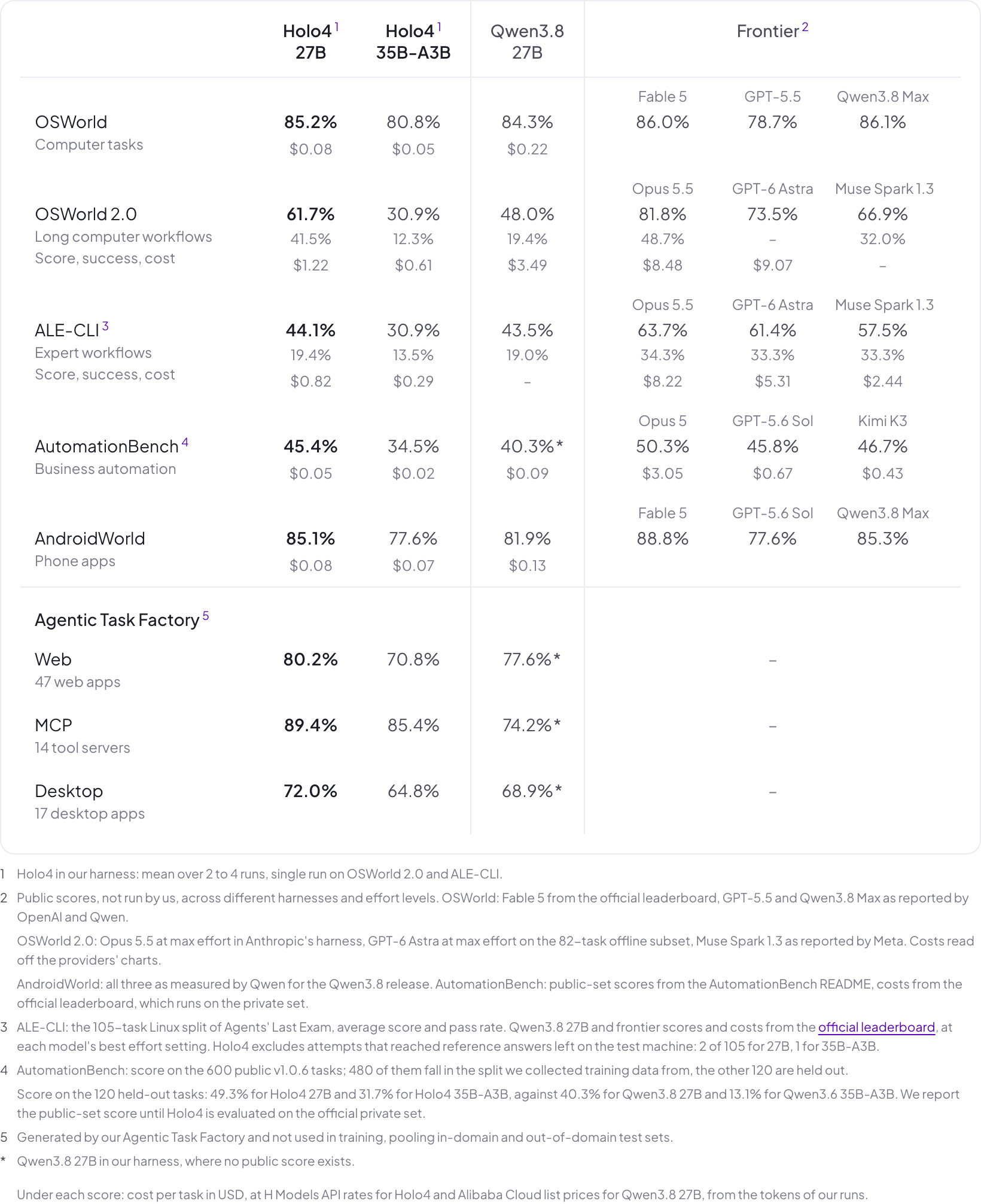
The headline number is 85.2% on OSWorld for Holo4 27B. It is a result reported by H Company in its own evaluation setup, not a result from our independent test. More demanding long workflows tell a different story, so that number needs context before it becomes a claim about reliably automating a workplace.
One agent, several ways to act
Holo4 can inspect screenshots, click and type in graphical interfaces, execute code, and call MCP or other API tools. H says the same model can work on desktop, web and Android, as well as in a code sandbox. The practical idea is that a task may start in a web app, continue through a command line and finish in software without a convenient API. A controller, or harness, supplies the model with observations, executes its requested actions and returns the results. Model capability and harness design therefore both matter.
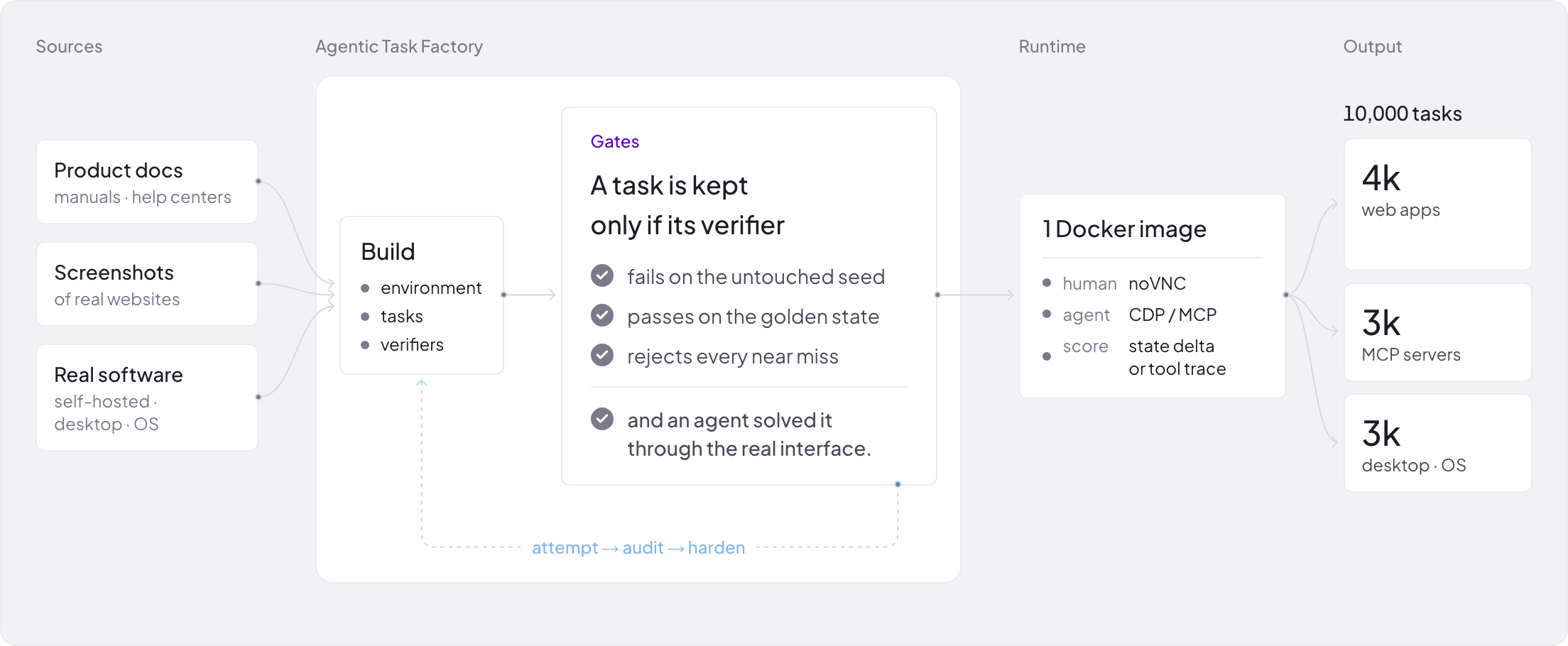
The model cards identify Holo4 27B as using a Qwen3.8 dense architecture. The 35B-A3B card identifies a Qwen3.5 mixture-of-experts architecture. The release also names Qwen3.6 35B-A3B in benchmark comparisons; that comparison label does not establish the exact fine-tuning checkpoint of Holo4 35B-A3B. H says its training combined supervised agent trajectories with reinforcement learning, and that its task-generation system has produced about 10,000 web, desktop and MCP tasks. These are the company’s descriptions of its development process, not evidence that an arbitrary business application will work without setup.
Two OSWorld results, two different measurements
H reports 85.2% on OSWorld for Holo4 27B, with an estimated $0.08 per task at its API rates. On OSWorld 2.0, the same model has a 61.7% average partial score and a 41.5% task success rate, at $1.22 per task. Partial score credits progress toward a task; success counts completed tasks. The 61.7% and 41.5% figures are not two estimates of the same outcome, and neither should be substituted for the original OSWorld figure. Holo4 35B-A3B records a 30.9% partial score and 12.3% success on OSWorld 2.0, with an estimated $0.61 per task.
H’s table puts closed models alongside these results, but its notes say the public competitor figures came from different harnesses, effort settings and sometimes different task subsets. For example, the company’s own OSWorld 2.0 run is a single run, while the cited GPT-6 Astra figure uses an 82-task offline subset. Those rows are useful orientation, not a controlled head-to-head contest. H also says its reported public-benchmark trajectories can be replayed or downloaded, which gives readers a way to inspect individual runs.
Read AutomationBench’s split before the ranking
On AutomationBench, H reports 45.4% for Holo4 27B and 34.5% for Holo4 35B-A3B, using all 600 public v1.0.6 tasks. The company explicitly says 480 of those tasks belong to a split from which it collected training data. The remaining 120 tasks are held out. On that 120-task subset, H reports 49.3% for 27B and 31.7% for 35B-A3B. A task in the training-data collection split is not necessarily an identical training example, but the full 600-task score is not a wholly independent held-out evaluation. H says it will report the official private-set result after that evaluation is run.
The release also lists Agentic Task Factory results on web, MCP and desktop workflows. H describes these as test sets generated by its own pipeline and excluded from training. They help illustrate the range of interfaces, but self-generated evaluations and public benchmark scores answer different questions. Neither, by itself, establishes performance in a reader’s particular organization.
What the demonstrations show
H’s launch page includes screen replays for professional software. One example asks Holo4 27B to build a geometrically specified Eiffel Tower in FreeCAD, and offers a comparison with its Qwen base model under the same prompt and harness. The page labels that Holo4 example as 84 calls and 1.3 million tokens. Other selectable examples cover 3D modeling and a game-design task. They show extended, multi-step interaction, but a selected demonstration is not a representative success rate. The FreeCAD example also makes the resource question tangible: a long trajectory can consume substantial context and time even when the final task succeeds.
H says harness changes were significant for OSWorld 2.0: persistent memory across hundreds of steps, a shell on the desktop machine, and changes to action limits and time budgets. This means a local deployment cannot expect the published results simply by loading the weights and asking for a click. It needs a compatible execution loop, access controls and an environment that can recover from mistakes. Those engineering requirements are part of the real cost of computer-use agents.
Weights, licenses and price
The 35B-A3B weights carry Apache 2.0. The 27B model card labels its weights CC BY-NC 4.0, so the flagship model’s weight license is restricted to noncommercial use; an API offering does not change that weight license. H lists BF16, FP8, NVFP4 and 4-bit GGUF variants for both Holo4 sizes, and the cards list a 262,144-token maximum context configuration. Holotron4 Nano is a separate release; the announcement reports improvements over its Nemotron base model, not the Holo4 27B score.
For hosted use, H lists $0.40 input and $3.00 output per million tokens for 27B, versus $0.30 input and $2.00 output for 35B-A3B; cached input is listed at $0.04 and $0.03 respectively. The per-task benchmark costs are calculated from those API rates and the tokens in H’s runs. They are not a fixed price for every workflow: long tasks, retries, infrastructure and human review can change the total. Holo4 is a notable open-weight computer-use release, but the decisive test for a deployment remains a held-out set of its own tasks, measured for completion, latency and total cost.
Sources
- Holo4 official announcement ↗H Company
- Holo4 technical blog ↗H Company / Hugging Face
- Holo4-27B model card ↗H Company
- Holo4-35B-A3B model card ↗H Company
- Holotron4 Nano model card ↗H Company
Created with AI assistance.
Suggest a correction
Found an error or a missing source? Send a private suggestion to the editor. It will be reviewed and will not appear as a public comment. No name, email or account is needed.


Send us a message