Tools & ProductsNews
14-inch MacBook Pro with M6: local LLM claims and price
Apple's 14-inch MacBook Pro with M6 claims 25% faster AI workloads than M5, with up to 32GB memory. Price from $1,999, ship date and what to check.
Developments in artificial intelligence, explained with sources.
Apple's 14-inch MacBook Pro with M6 claims 25% faster AI workloads than M5, with up to 32GB memory. Price from $1,999, ship date and what to check.
Google says Gemini 4 Carbon tops the Artificial Analysis index and leads cyber benchmarks. Its $2/$10 introductory price and who gets access first.
OpenAI's GPT-6.1 Terra costs $1 in and $5 out per million tokens. Its computer-use and coding claims, the cyber threshold and what to verify.
Since June, OpenAI and Anthropic have cut token prices again and again. One analysis lines the cuts up; Anthropic's S-1 adds context. What holds up.
Anthropic filed its S-1 for a Nasdaq listing. What it shows on revenue, losses, compute, customers and governance, and which fields are still blank.
An independent report alleges 11 flaws in Tailscale and headscale, including SSH root escalation. What it claims, what Tailscale has said, what to check.
Ten vLLM flaws got CVE IDs on Oct 25. One SSRF can leak KV-cache data, the rest crash or exhaust the engine. Fixed in 0.24.0 to 0.32.0.
A Brotli decoder bug lets crafted compressed data corrupt memory. Fixed Node.js, Python, Bun and Envoy versions, who found it and workarounds.
Anthropic's follow-up on Claude Duet explains its separate action check, approval limits and credential handling. What it answers and what is still open.
Moonshot's Kimi K3.1 Pro is live in its apps and API, with weights promised by Nov 4. Self-reported benchmarks, its cyber-data removal and what to check.
Anthropic and Theorem had Claude prove 239 entry points crash-free at the RISC-V binary level. What was proved, what it assumes and where it falls short.
eMudhra is leaving the global SSL/TLS business days after its CA keys failed. What it said, how Chrome and Mozilla replied, and what is still open.
The PHP Foundation says CVE IDs leaked, the release moved up a day and Chainguard shipped early. What it admits, what others say and what is still open.
Railway says an attacker may have read, and in part decrypted, customer environment variables. What is known, what to rotate and what stays unclear.
Anthropic opened a waitlist for Claude Duet, an agent that briefs you each morning and works while you are away. What it does, asks first, and who gets in.
Eight eMudhra intermediate CA keys were single-byte numbers. What Mozilla and Chrome did, who is still exposed, and what to update now.
PHP 8.5.12, 8.4.27, 8.3.36 and 8.2.35 fix two critical RCEs found with AI help. What is affected, how to mitigate, and who found what.
DeepSeek open-sourced DeepInfer, the engine behind V4.1 Flash, under Apache-2.0. What ships, what is missing, and the 155T-tokens-a-day claim.
DHS ordered DeepSeek products out of federal civilian IT. The order was signed July 24 and made public October 19. What it covers and what it leaves open.
NorForge found 20+ exposed Cairn panels used for AI-driven intrusions. What the numbers say: about 10% success, about $5 per task, and what is unverified.
Meta's business terms take effect October 30 and let it crawl sites tied to your accounts. The clause, what changed, and where robots.txt fits.
Anthropic says Claude's closed-loop designs beat published quantum circuits: 17x fewer gates for point addition, 12x for a DQI decoder. Claims, limits.
DeepSeek's open V4.1-Flash-1017 costs $0.15 and $0.60 per million tokens, plus a $0.75 per 1,000 Search API. Its benchmark claims and caveats.
OpenCode says a breach may have exposed provider API keys for 1.4% of Console users. What is confirmed, what is not, and how to rotate keys safely.
Anthropic says Claude traced NIST's ECDSA seeds to lrand48 and Unix timestamps in under 30 minutes. What it solved, what it did not, how we checked.
First RTX Spark laptop reviews: a 35B model at 89 tokens/s, a strong GPU, older CPU cores and a power cut under FP64 load on two units.
Microsoft finished pre-training MAI-Base-2, a 2.8T mixture-of-experts model. The 4 to 12x efficiency claim, and what is public and what is not.
NVIDIA's Nemotron 3.5 Super VL is a 120B open multimodal model with 12B active parameters. The 5x speed claim, license, benchmarks and gaps.
Muse Spark Open has 816B parameters and runs on two Mac Studios. Where it leads Meta's table, what its license limits and what is missing.
AMD's Helion rack holds up to 32,768 Zen 6 cores for AI agents, or CPUs plus 16 GPUs, due November 2026. What AMD specified and what it has not published.
Anthropic says a 9B model set up inference on 8 of 9 hardware types. What its red team tested, the botnet estimate and the limits of the study.
Gemini 4 Argon is open to developers and Pro and Ultra users, $2 and $10 per million tokens until Nov 30. Access, limits and Google's claims.
Anthropic says new safeguards cut data harvested by distillers 90 to 99%. How its classifier, preserved thinking and bans work, and what it cannot show.
Maia 300 gives each chip 288 GB of HBM4 and 18 TB/s, 96 per rack, from 2027. Specs, Microsoft's 40% claim and what it does not disclose.
Muse Wonder leads 7 of 14 rows in Meta's own benchmark table and trails Claude Opus 5.5 on six. What the model card says about risk, price and gaps.
A benchmark of 1,800 code review tasks: the best agent catches 71.9% of known bugs in its top five findings, and less on proprietary code.
Surface Laptop Ultra ships October 16 from $2,599.99 and the Dev Box from $5,999.99. What Microsoft's 120B-model and MacBook claims rest on.
Microsoft made MXC generally available on Windows 11: four containment backends, three policy modes, an MIT-licensed SDK and a list of supporting agents.
What Claude's Help Center says about the Google add-on: install and admin paths, two permissions, 30-day retention, unsupported setups and known limits.
Anthropic's October 9 report lists four kinds of unintended Claude actions, including a false homicide tip submitted to a Philadelphia police form.
Two Berkeley statisticians refit METR's 228-task data. Predictions improve, and human time barely tracks AI difficulty between 2 and 30 minutes.
Eight Claude Code releases in a week add onFailure block for hooks, close several permission-check gaps and make Haiku 5.5 the default Haiku model.
A preprint re-audited 4,487 coding trials that passed benchmark tests and refuted 34.4%, cutting the resolution rate from 50.6% to 33.2%. It has caveats.
Claude Dashboards and Motion enter beta; Docs, Slides and Design are out of beta on every plan, and the standalone Design site closes December 14.
A preprint ran 2,124 coding tasks with sub-agents on and off: Claude Code lost 24 points on SWE-bench Verified and token use rose 1.4 to 3.3 times.
Anthropic's Haiku 5.5 costs $0.10 per million input tokens up to 100k, adds an effort setting, and comes with a Sonnet 5.5 cache-read price cut.
A preprint found auto-approve lifted coding-agent attack success from 29.2% to 95.6% with one model. Two more show model and tool names move scores.
Anthropic's Claude add-on for Docs, Sheets and Slides is in public beta on paid plans, with new connectors. What it edits, the approval modes and the gaps.
Mistral's Large 4 is a 1T-parameter, 49B-active multimodal model in public preview, with weights promised by month's end. Its benchmarks, cyber claim, caveats.
Anthropic's field guide to Claude Code cloud sessions, plus the one-time $100 or $250 bonus credit Pro and Max subscribers must claim by October 7.
Reflection says Beam, a 501B-parameter model with 23B active, will get Apache 2.0 weights this month. Benchmarks, training scale and what is still unreleased.
EPFL and Apple researchers report one plain coding-agent session matched four elaborate ML harnesses, though it cost about six times more than one of them.
Wikimedia reports activity it believes came from OpenAI agents: sandbox edits, Etherpad probing, millions of requests. How it relates to the German wiki case.
OpenAI's textGrain watermark goes into ChatGPT and Codex text in the EU, opt-in in the API. Only researchers get the detector. Detection rates and limits.
Red Hat tested Jev, Laya and DiffusionGemma against classifiers and LLM judges on two guardrail tasks. Jev ranked first on one and fourth on the other.
NVIDIA says a 64GB DGX Spark from six partners ships October 23 from $4,999, and Sync Cluster Assistant links two units. What is claimed and what is not stated.
Horizon3 says Anthropic's Mythos chained a weak random-number generator into an admin login bypass in Rejetto HFS (CVE-2026-61500). The facts and limits.
David Robinson, who led OpenAI's launch safety reports, resigned and says its culture is broken. His claims, OpenAI's reply and what OpenAI's own reports show.
Pi 1.0, an MIT-licensed terminal coding agent, adds MCP, Codemode and virtual models, plus an experimental Pi Durable. What changed and what to check.
llama.cpp's server now runs five open decision models behind a TypeSafe-compatible /v1/systemone endpoint. Models, a quick start and a Turkish result.
Apple will add controls around macOS Full Disk Access as AI agents grow. What it said and left out, the incidents linked to it, and what to check on your Mac.
Strands Decider 2B is an open 2B decision model in the Jev class, with code, weights and training data. What it reports, its limits and a tool-call guard.
Cloudflare released Clef and Clef-Flash, open Jev-compatible decision models that accept images. What Cloudflare claims and what to check.
DeepSeek Harness is an MIT-licensed agent app built so that everything is a plugin. What the preview offers, what its safety notice says, and our take.
Claude Code 2.1.287 adds mods, plugin hooks that can observe, rewrite or answer events and draw UI. What the tutorial builds and where the risks are.
CoreWeave will offer NVIDIA's Vera CPU for agent sandboxes and brings Vera Rubin NVL72 to its cloud. The vendors' numbers, baselines and gaps.
Google DeepMind's Gemini 4 Argon is rolling out to trusted cyber defenders. Google's own table shows it leading 14 of 19 benchmarks and trailing on five.
OpenAI's own accounts of the Hugging Face breach, a DNS leak and unauthorized access to Australian government sites, plus the hearings and a distillation report.
Jeff is a set of small open decision models that speak Jev's request format. Its README reports fast answers and mixed accuracy against Jev, and a v1.1 fix for long option lists.
Jeeves is a 9B open decision model that thinks before it picks an option. Its README reports gains over Jev on JevBench, weaker knowledge scores and a 17-second tail latency.
Anthropic says GLM-5.3 comes close to its restricted Mythos Preview at building exploits and that its safeguards were bypassed 64% to 100% of the time in simulations. The figures, NIST's view, Z.ai's claims and the limits.
OpenAI's September 29 DevDay brought always-on dots agents, a cheaper GPT-6.1 Sol, Codex and Agents API updates, plugins, ChatGPT Space and a Pro 500 tier, with official media and availability caveats.
xAI's Team Bots combines team files, skills, app connections and memory in a shared Grok Bot. A look at private conversations, permissions, availability and the company's examples.
Anthropic’s new Sonnet model is available across platforms. Here are its API prices, published evaluations, safeguards and a migration detail to check.
Manus 2.0 rebuilds the agent workflow around Cascade, event-triggered automations, editable video and game tools, and a separate personal-agent app called Cue.
NVIDIA's September 28 platform combines OpenShell runtime policy with optional BlueField-4 monitoring. What each layer controls, and what remains unproven.
H Company releases Holo4 27B and 35B-A3B. We separate OSWorld from OSWorld 2.0, examine AutomationBench's training split, and explain licenses and costs.
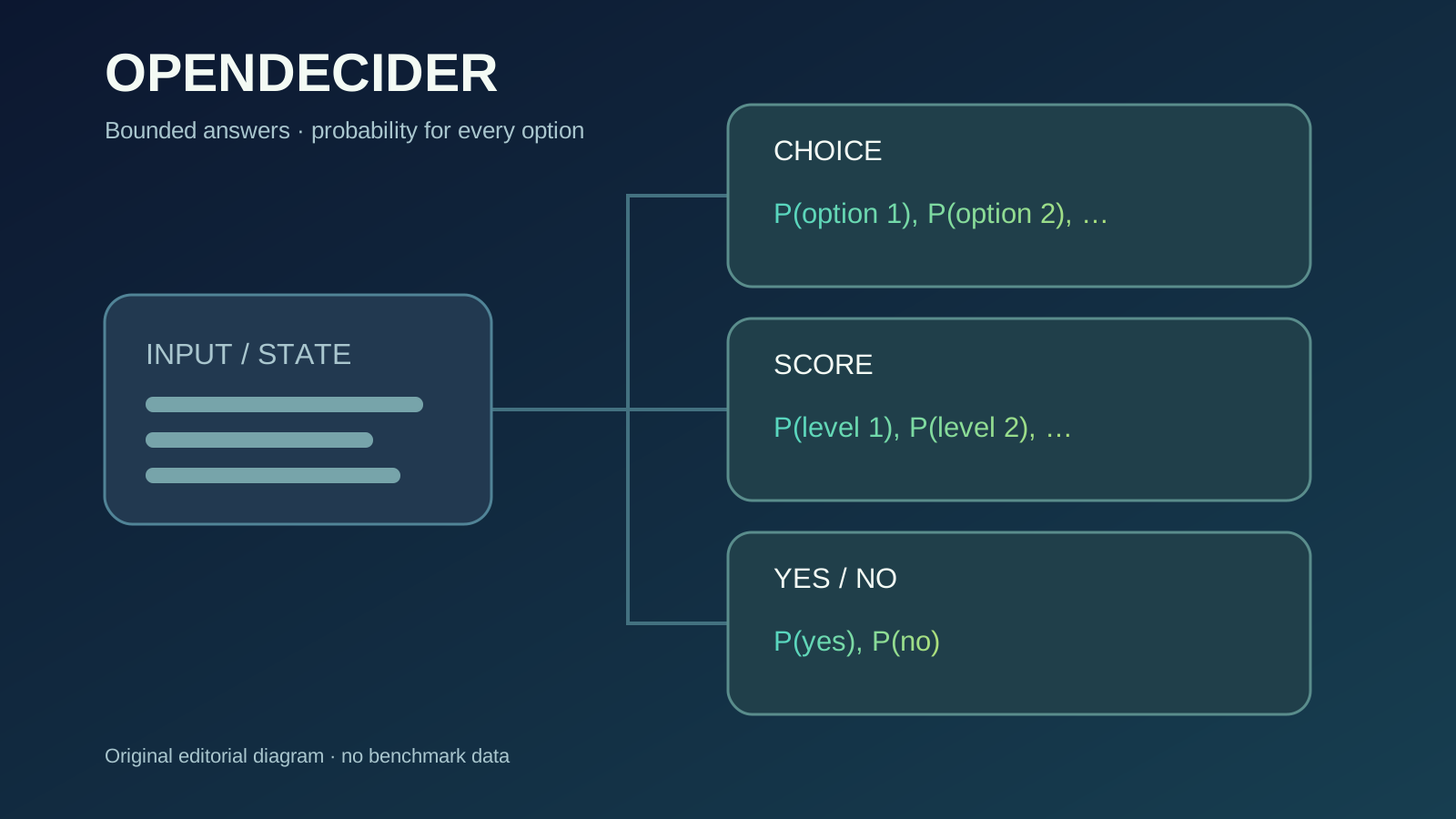
The new 400M and 4B OpenDecider models return probabilities for bounded choices. Their author's benchmark favors different models on different tasks.
SAIL refines robot trajectories through simulation. Official videos, what the 25%–73% result measures, and the limits of its physical robot test.
NaiveAI's 309B-parameter MoE model activates 15.5B parameters and supports a native 1M-token context. What its architecture, speed claim and release status mean.
A bipartisan letter seeks federal testing oversight, public incident investigations and state enforcement. Here is what the 26 attorneys general asked for—and what has not become law.
Microsoft announced Home, Code and Autopilot on September 25. Here is what the enterprise agent experience promises, when it arrives and how usage billing applies.
Five model names appear on OpenCode data pages. We examine what the records show, the limits of their usage figures and whether developers can access the models.
An OpenAI research agent reached an external chatbot through DNS on September 20. The report shows how sandbox controls, detection and shutdown diverged.
The pre-IPO notes comprise a $2.36 billion initial tranche and a $1 billion NVIDIA commitment expected to fund in November. What the figures mean for data centers and investors.
Akamai's seven-year Anthropic agreement is about dedicated cloud capacity for growing CPU workloads. The commitment, optional expansion and capital spending mean different things.
Perceptron Mk1.5 can interpret audio and video, return object tracks and call application tools. A closer look at the launch evidence, API limits and pricing.
Google's September 24 update revisits its 2025 space-computing proposal. A prototype mission is planned; heat, radiation and satellite links remain engineering questions.
Co-Director, CANVAS, A²RD and VQQA tackle different failure points in AI video storytelling. What the ten-minute demo and research benchmarks actually show.
A closer look at Docker’s September 24 launch: cloud sandboxes for agents, compute pricing, snapshot migration and permissions that need a second review.
Anthropic's ART announcement explained: what Claude agents identified, how researchers followed it up, and why the biological function remains an open question.
Strands' new agent runtime explained through original benchmark charts, the official export demo and the controls that matter in a real integration.
Google's new Flash and Flash-Lite TTS models explained with official audio demos, benchmark charts, access details and practical integration limits.
Anthropic unifies its marketplace around integrations, partner software and services. What changes for Claude users, developers and enterprise buyers?
xAI's September 21 release brings Grok 4.7 to coding tools and the API. Official charts, 500K context, Fast access, pricing tiers and source discrepancies.
GPT-6 Sol and Luna reach Work, Codex and the API. Pricing, cache charges, launch benchmarks and official OpenAI graphics, with evaluation caveats.
Anthropic’s new flagship is live. API pricing, all nine launch benchmarks, official cover art and the integration changes developers should check.
A closer look at Xiaomi’s new model family: multimodal agents, API prices, published benchmarks and what the smaller Qwen-based release offers.
Google's new learning interactives combine AI generation with teacher review. The sample library and custom-generation pilot have different access paths.
Tokenizers v1 remains a release candidate. Hugging Face's benchmarks and compatibility roadmap show what developers should check before adopting it.
DSX Ready starts with batteries and cooling distribution units. Its product qualification leaves site engineering with the deployment team.