Gemini 3.8 TTS: custom voices, dialogue control and the API details that matter
Google's new Flash and Flash-Lite TTS models explained with official audio demos, benchmark charts, access details and practical integration limits.
In this article
Google announced Gemini 3.8 Flash TTS and Flash-Lite TTS on September 23. The two models turn written scripts into directed speech, with a different emphasis: Flash targets expressive voice design, while Flash-Lite targets volume and efficiency. Gemini API and AI Studio access is rolling out; enterprise API access is marked as coming later in the announcement.
For a publisher, game studio or support-product team, the useful question is how much control survives beyond a short demo. Can a voice keep its identity, pronounce the important words and deliver the revised line without forcing a complete rerecording?
Which model fits which job?
| Model | Google’s intended role | Our suggested first test |
|---|---|---|
| Gemini 3.8 Flash TTS | Character voices, expressive performances and sustained dialogue | A scene with changing emotions and two recurring characters |
| Gemini 3.8 Flash-Lite TTS | High-volume speech generation with attention to cost and speed | A batch of short explanations with names, numbers and repeated terminology |
The Flash reference lists a text-in, audio-out model without function calling or Live API support. The Flash-Lite reference describes the lighter alternative. These are speech-generation components: a conversational application still needs to handle its incoming audio, decisions and tools.
Listen to the official examples
The following clips are Google’s original demos. The first explores a strong character voice; the second makes the script and delivery easier to compare. Press play to hear them; neither starts automatically.
From a voice description to a scene
Google also supplies a detective short showing voice design, script directions and delivery together. It lets you compare a written performance direction with the resulting voice. This is an official demonstration, not our own generation.
What changes in the API?
The generation guide separates the words to be spoken from performance directions. Turn-level style goes in speech_metadata; inline tags handle brief reactions or pauses. Unary requests return WAV by default, which matters if an older integration adds its own WAV header.
There is also a practical boundary for dialogue: the documented single-request, two-speaker path uses prebuilt voices. For custom designed or replicated voices, the guide describes generating each turn separately and joining the audio. A product demo showing two characters is therefore not enough to infer the API integration required.
Read the benchmark charts carefully
Google’s release includes Hume AI quality and voice-design results, plus Voice Arena comparisons. These are the original published charts, available to enlarge; we have not redrawn them or reproduced the evaluations.
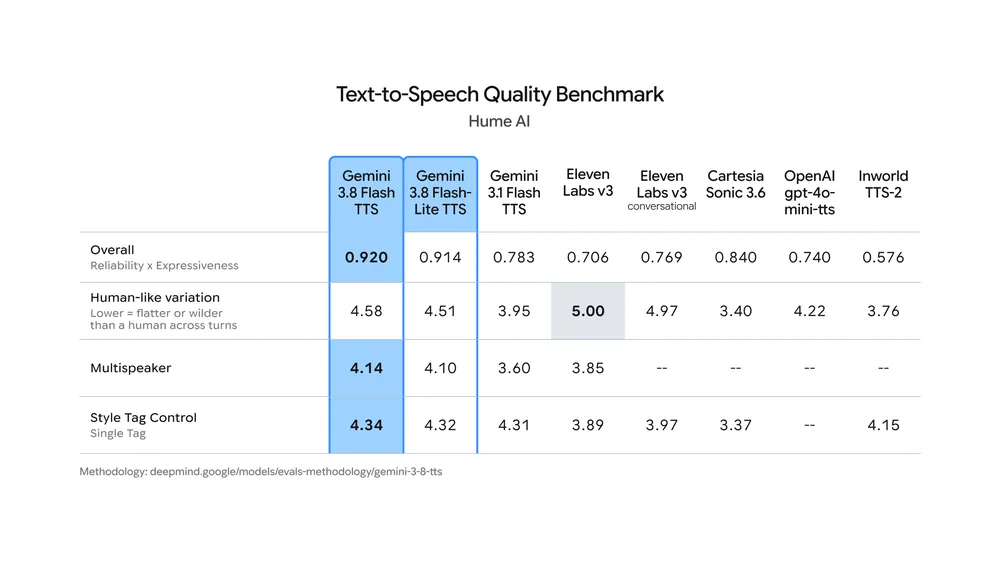
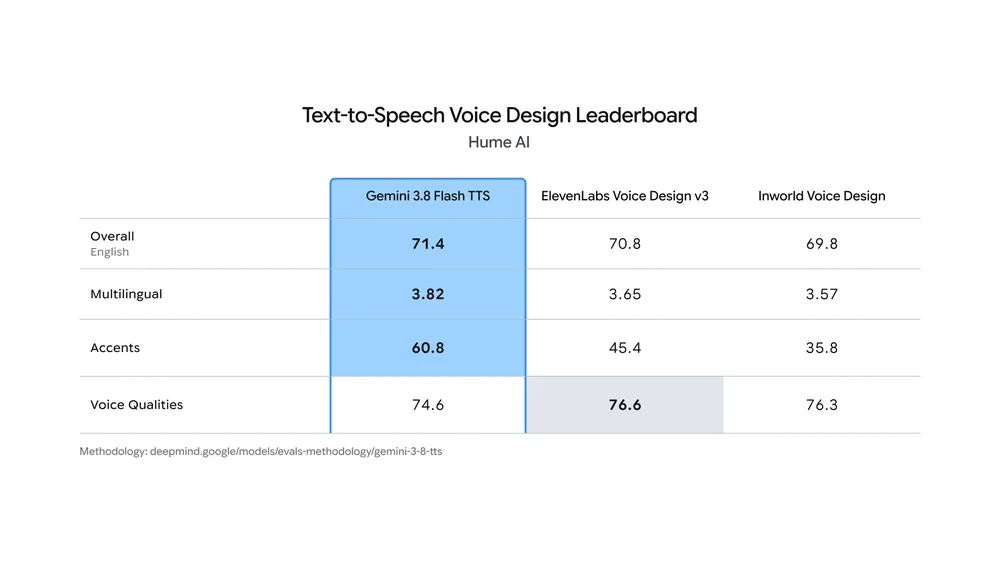
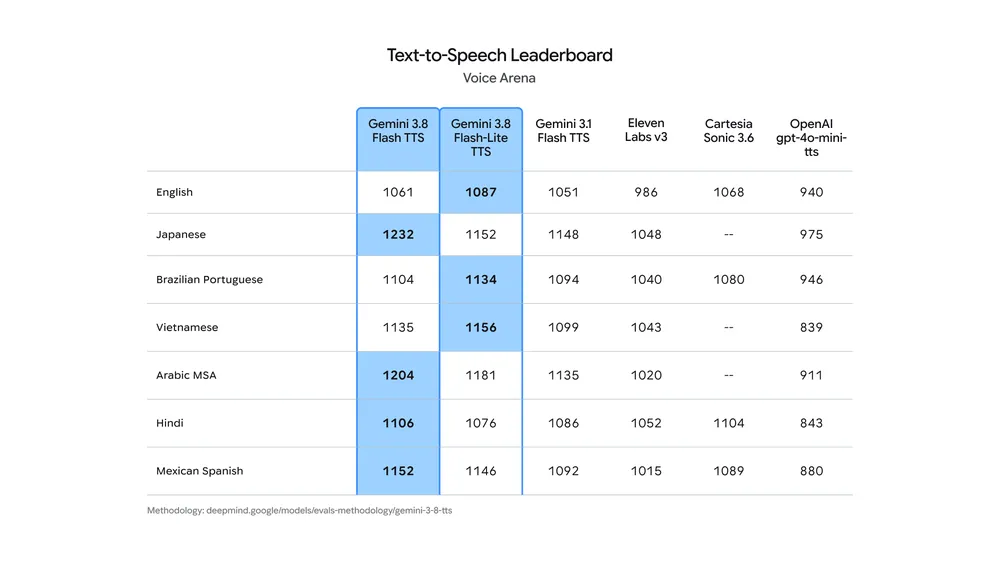
Our reading: the ordering varies by task and language, so one headline rank should not choose the model for every project. The displayed language comparison does not establish Turkish performance. For this site’s bilingual use, we would test Turkish names, English product names embedded in Turkish, dates, abbreviations and longer passages before choosing a voice.
Replication requires consent; production still needs review
Google’s replication documentation describes a reference recording and a matching consent recording. Availability also depends on region; check the current requirements for the account and deployment. The launch describes SynthID watermarking and identifies voice remixing as a future feature.
The following screen recording shows the voice replication workflow in AI Studio. It illustrates the interface; the consent and availability requirements above still apply.
The model card also notes possible foundation-model errors, slowness and timeouts. Our production checklist would therefore include pronunciation review, retry handling and measuring the cost of an accepted clip, including failed generations.
For canberk.me, a worthwhile trial would be a short TR/EN news briefing. We would first listen for factual fidelity and consistent pronunciation, then compare editing time and cost. No independent audio-generation test was performed for this report; the clips and charts above belong to the official release.
Sources
- Gemini 3.8 text-to-speech — launch announcement, 23 September 2026 ↗Google
- Text-to-speech generation: API workflow and limitations ↗Google AI for Developers
- Gemini 3.8 Flash TTS model reference ↗Google AI for Developers
- Gemini 3.8 Flash-Lite TTS model reference ↗Google AI for Developers
- Voice replication: consent and API workflow ↗Google AI for Developers
- Gemini 3.8 Audio model card ↗Google DeepMind
Created with AI assistance.
Suggest a correction
Found an error or a missing source? Send a private suggestion to the editor. It will be reviewed and will not appear as a public comment. No name, email or account is needed.


Send us a message