NVIDIA DGX Spark gets a 64GB version on October 23, and two can cluster
NVIDIA says a 64GB DGX Spark from six partners ships October 23 from $4,999, and Sync Cluster Assistant links two units. What is claimed and what is not stated.
In this article
NVIDIA is adding a cheaper memory tier to its small desktop AI computer. On October 2 it announced a DGX Spark with 64GB of unified memory, and a tool that lets two units work as one. This article covers what NVIDIA says, what the numbers do and do not tell you, and what we could not check. It is based on NVIDIA’s announcement; we have not tested the product.
What did NVIDIA announce for DGX Spark 64GB?
| Item | What NVIDIA says |
|---|---|
| Memory | 64GB of unified memory; same GB10 Grace Blackwell chip, DGX OS and software stack as the 128GB model |
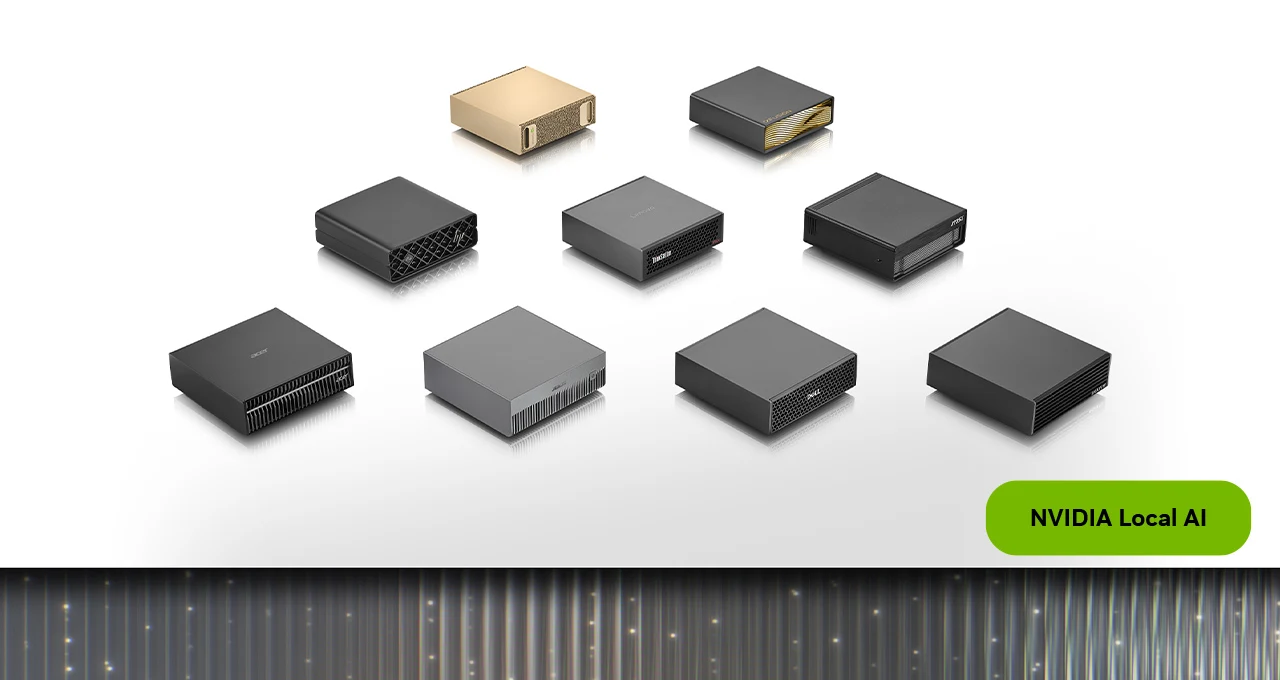
| Sold by | Acer, ASUS, Dell, Gigabyte, HP and MSI only (“exclusively from manufacturer partners”) |
| Price and date | From $4,999, on Friday, October 23 |
| Models | Up to 100 billion parameters on one unit |
| Networking | Built-in ConnectX-7 network card; two units connect directly with a QSFP cable over 200 GbE |
| Software | NVIDIA Agent Toolkit, CUDA-X libraries, Nemotron models; llama.cpp, Ollama, vLLM, LM Studio, PyTorch with CUDA |
Blender is named as an early creative-app supporter, with an installer “coming soon.”
How does clustering two DGX Spark units work?
The new software is NVIDIA Sync Cluster Assistant. According to NVIDIA it detects two connected units, validates their configuration and sets up the ConnectX-7 network, so the pair needs no manual network work. The two together pool 128GB of memory and, NVIDIA says, run models of up to 200 billion parameters with “twice the memory bandwidth and up to 1.7x the performance.”
The 1.7x figure comes from one test: in NVIDIA’s Qwen 3.8 27B run, two clustered 64GB systems gave up to 1.7x the performance of a single system. The announcement does not give the precision, batch size, context length or what “performance” counts (tokens per second, for example). The “twice the bandwidth” line reads as the two machines’ memory bandwidth added together; each chip still reads only its own memory, so it does not mean a single model reads twice as fast. That reading is ours, not NVIDIA’s wording.
NVIDIA Sync Model Launcher, due at the end of October, is meant to download Qwen3.8 27B, run it on one unit or a cluster, make it reachable from a laptop and configure OpenCode, a coding agent, to use it.
What do the 100B and 200B parameter limits imply?
NVIDIA says 64GB runs “up to 100-billion-parameter models” and the pair 200 billion. It does not say how the weights are stored. As a rough check, 100 billion parameters at 4 bits each is about 50GB, leaving room for the cache and the system, while at 8 bits it would be about 100GB and would not fit. So these limits only make sense for heavily compressed (around 4-bit) models. That is our arithmetic, not an NVIDIA statement, and quality at that compression varies by model.
Two things buyers should note
- What the 128GB model costs. NVIDIA’s post describes $4,999 as an “accessible price point” for the 64GB model but gives no price for the 128GB one, so we cannot say how much the memory cut saves.
- Where it is sold. The post says the 64GB model is available “exclusively from manufacturer partners,” so look for it from the six makers, not from NVIDIA directly.
What to keep in mind
These are our observations:
- It is a memory decision. NVIDIA says only the memory differs from the 128GB model. Decide by the models you want to run, since a model has to fit in memory.
- Clustering is a scale-up path, not a speed multiplier. The 1.7x figure is a vendor test of one model; run your own workload before buying a second unit.
- Treat the numbers as NVIDIA’s. The announcement has no independent benchmark.
Editorial review: October 5, 2026 (AI). Prepared from NVIDIA’s announcement of October 2, read the same day. We did not test the product or run the Sync software; all performance and compatibility claims are NVIDIA’s. The cover is NVIDIA’s own illustration, reproduced with credit and a link to the source. The parameter-limit arithmetic and “What to keep in mind” are ours.
Sources
Created with AI assistance.
Suggest a correction
Found an error or a missing source? Send a private suggestion to the editor. It will be reviewed and will not appear as a public comment. No name, email or account is needed.


Send us a message