DeepSeek V4.1-Flash-1017: benchmarks, price and Search API
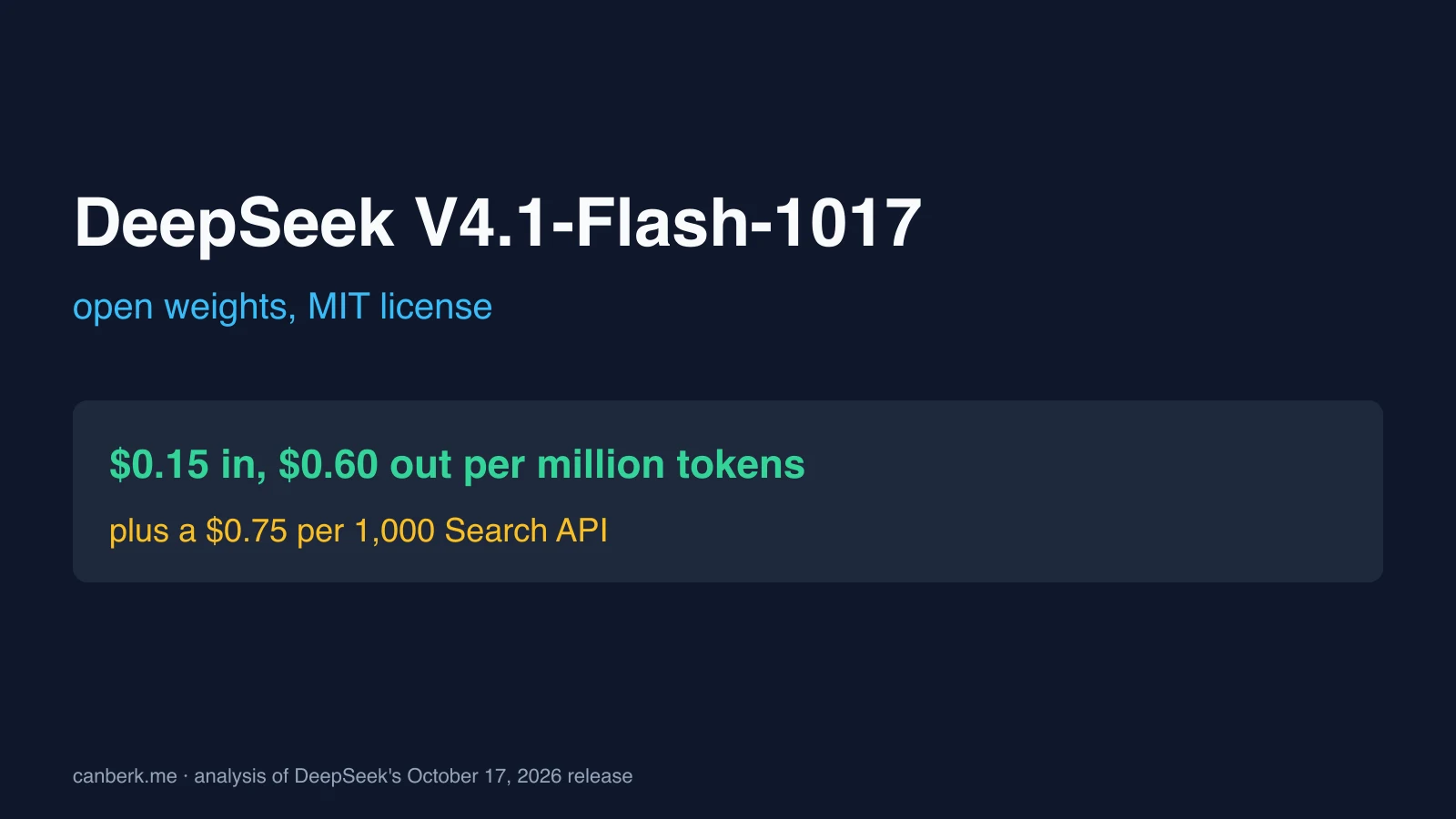
DeepSeek's open V4.1-Flash-1017 costs $0.15 and $0.60 per million tokens, plus a $0.75 per 1,000 Search API. Its benchmark claims and caveats.
In this article
- What did DeepSeek release on October 17?
- What does DeepSeek V4.1-Flash-1017 cost?
- What are the new Search and Fetch APIs?
- What does the open-weights release contain?
- How does it score on DeepSeek’s table?
- Can you trust DeepSeek’s benchmark comparison?
- What is still unknown about DeepSeek V4.1-Flash-1017?
- What to keep in mind
DeepSeek has updated its cheap flagship Flash model and, for the first time, sells live web access with it. On October 17 the company released DeepSeek-V4.1-Flash-1017, a minor update to V4.1-Flash, and opened a Search and Fetch API to all users. We read DeepSeek’s release page, API documentation and Hugging Face model card. This article covers what changed, what it costs, how its benchmark table reads and what DeepSeek did not document.
What did DeepSeek release on October 17?
A model update, a search service and an agent harness. DeepSeek says DeepSeek-V4.1-Flash-1017 is live on its website, app and API and is open-weights on Hugging Face and ModelScope. It calls the changes “a Pareto improvement in performance and cost”: stronger benchmark results, faster task completion and shorter outputs. It says the model was trained with reinforcement learning using self-feedback to improve end-to-end project building, and shows demos including a Forbidden City 3D model, a web racing game and a Godot-based Portal 2 recreation. The model is optimized for DeepSeek Harness, which is in developer preview, and for Tencent’s CodeBuddy and WorkBuddy; DeepSeek recommends Harness v0.2.1-rc.1 or later.
What does DeepSeek V4.1-Flash-1017 cost?
Very little, by the prices DeepSeek lists:
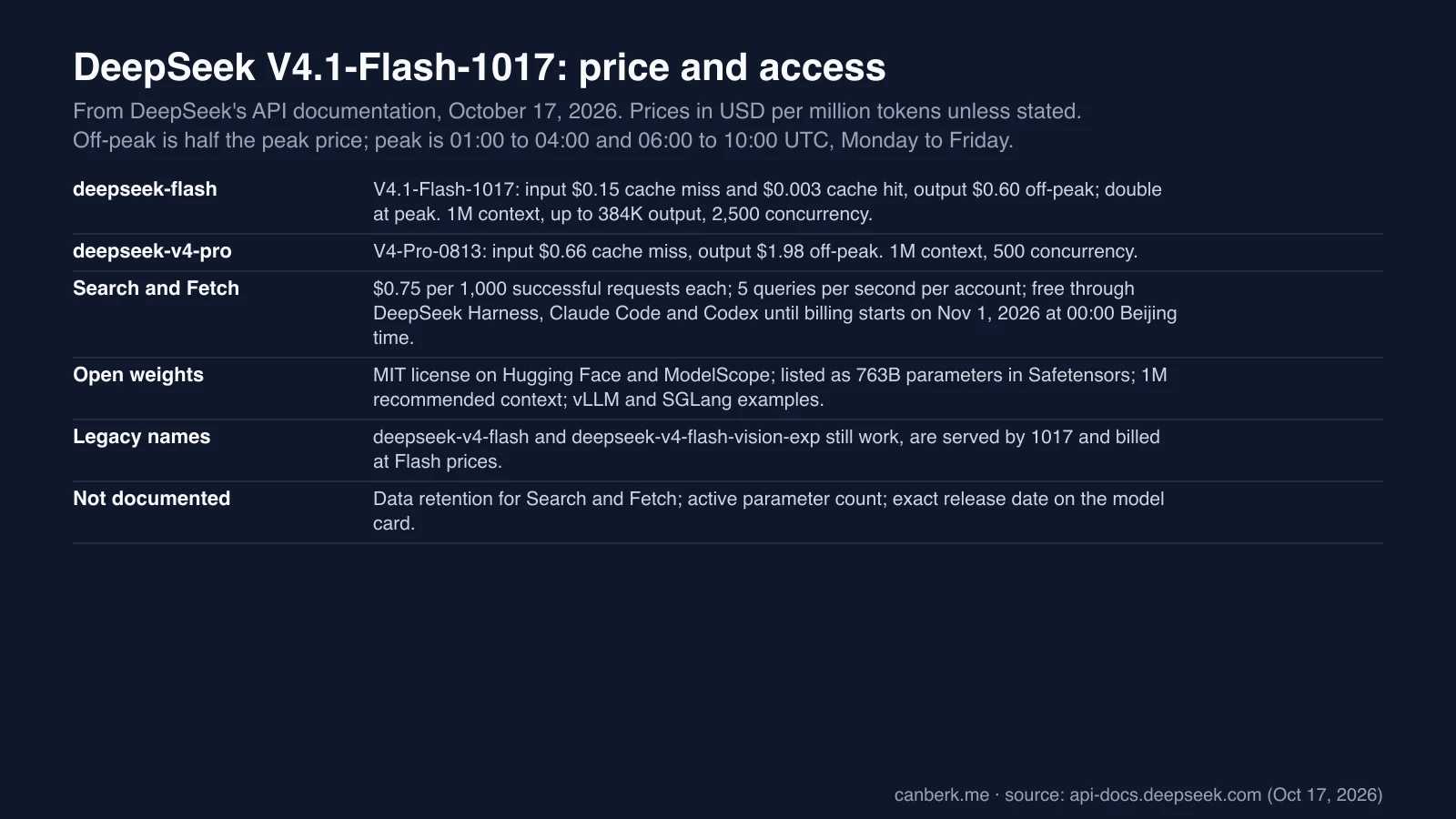
The API name deepseek-flash now points to V4.1-Flash-1017. Per million tokens, the off-peak prices are $0.15 for cache-miss input, $0.003 for cache-hit input and $0.60 for output, and the peak prices are double. Peak hours are 01:00 to 04:00 and 06:00 to 10:00 UTC, Monday to Friday, excluding Chinese public holidays. Context is 1M tokens with up to 384K output and a concurrency limit of 2,500. deepseek-v4-pro, which DeepSeek lists as DeepSeek-V4-Pro-0813, costs $0.66 for cache-miss input and $1.98 for output off-peak. The older names deepseek-v4-flash and deepseek-v4-flash-vision-exp still work but are served by 1017 at Flash prices.
For scale, using Anthropic’s list prices we read on October 16, Claude Opus 5 costs $5 per million input tokens and $25 per million output, which is about 33 times and 42 times DeepSeek’s off-peak Flash prices (our arithmetic). That is a price comparison only, not a quality one.
What are the new Search and Fetch APIs?
Two raw JSON endpoints that give agents live web content, billed per successful request. Per DeepSeek’s guide, Search (POST /v1/tools/search) returns structured results from DeepSeek’s in-house search engine for a query of up to 128 characters, with count from 1 to 50, optional content, a rerank score, an authority score and operators such as site: and after:. Fetch (POST /v1/tools/fetch) takes one URL of up to 8,192 characters and returns the page as Markdown. Each costs $0.75 per 1,000 successful requests, and only responses that return results are billed. Each has a limit of 5 queries per second per account, and Fetch also has a per-domain limit. Calls made through DeepSeek Harness, Claude Code or Codex are free until billing starts on October 31 at 16:00 UTC, which DeepSeek’s guide gives as 00:00 Beijing time on November 1. The documentation does not cover data retention or detailed terms, and says Fetch can be blocked by site policies.
What does the open-weights release contain?
A very large model with a permissive license. The Hugging Face repository lists the model at 763B parameters in Safetensors (BF16, F32, F8_E4M3 and I8 tensors) under the MIT license, takes image and text input, and recommends a 1M-token context, at least 256K max tokens, temperature 1.0 and top_p 1.0. There is no Jinja chat template; DeepSeek provides a Python encoding reference and recommends its Rust deepseek-recipe library for production. Inference examples cover vLLM, SGLang and Docker Model Runner, and the page links 18 community quantizations. The card does not state an active parameter count, and other outlets earlier reported different figures for V4.1 Flash, so we do not give one.
How does it score on DeepSeek’s table?
Ahead on agentic coding and automation, behind Claude Opus 5 on harder reasoning and vision:
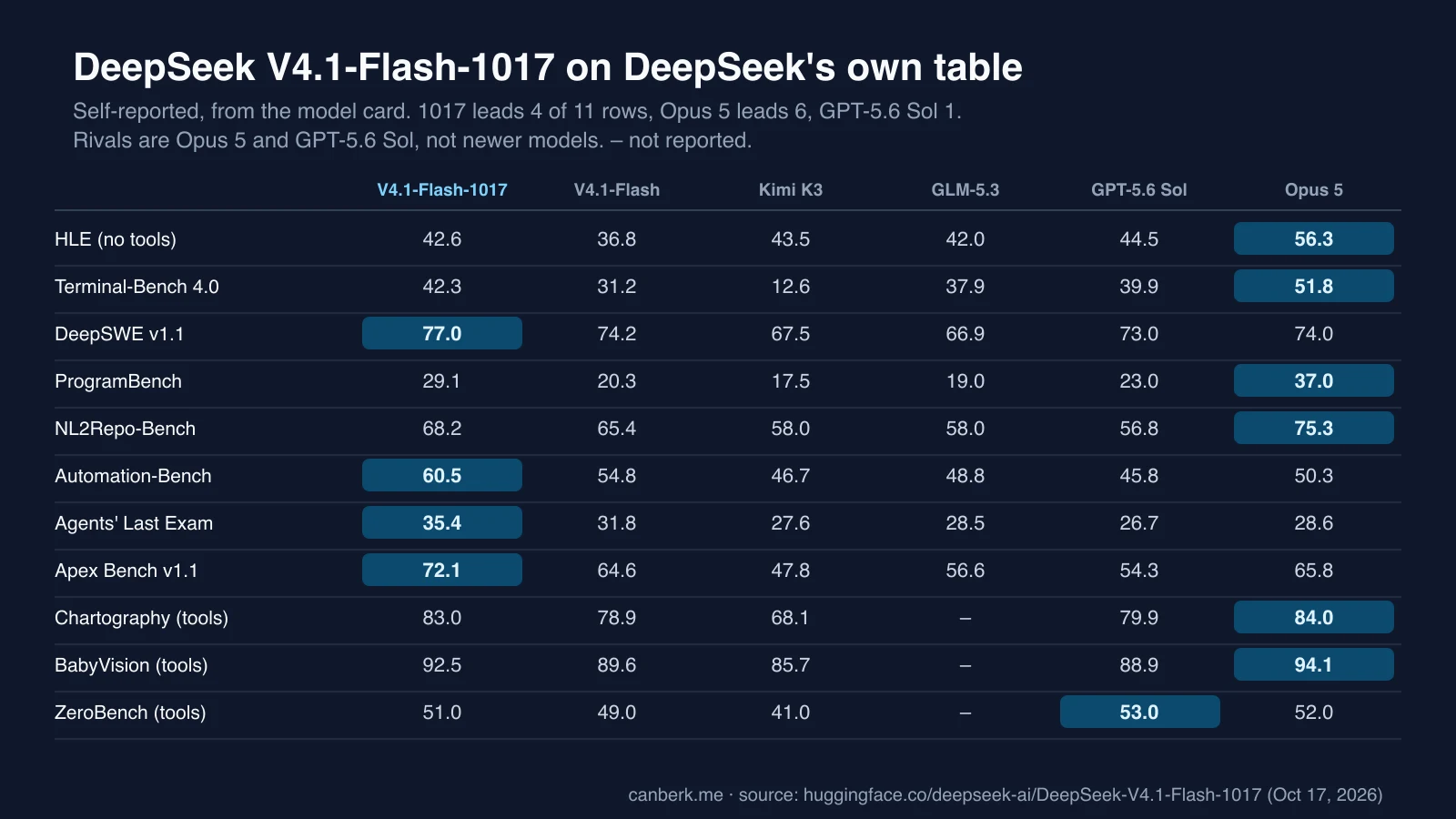
- Versus V4.1-Flash. It improves on every row, for example Terminal-Bench 4.0 from 31.2 to 42.3, ProgramBench from 20.3 to 29.1 and Apex Bench from 64.6 to 72.1.
- Where it leads. DeepSWE v1.1 at 77.0 against 74.0 for Opus 5, Automation-Bench at 60.5, Agents’ Last Exam at 35.4 and Apex Bench at 72.1.
- Where Claude Opus 5 leads. HLE without tools (56.3 against 42.6), Terminal-Bench 4.0 (51.8 against 42.3), ProgramBench (37.0), NL2Repo-Bench (75.3), Chartography with tools (84.0) and BabyVision with tools (94.1). GPT-5.6 Sol leads ZeroBench with tools at 53.0.
- Against the open models. It is ahead of Kimi K3 and GLM-5.3 on all but HLE, where Kimi K3 scores 43.5.
The card notes that HLE uses the text-only subset for some entries, that Terminal-Bench 4.0 uses the Claude Code harness and that DeepSWE v1.1 uses the Mini-SWE-V2 harness.
Can you trust DeepSeek’s benchmark comparison?
Read it as DeepSeek’s own comparison against older models. All numbers are self-reported, and DeepSeek’s release page shows its DeepSWE and cost comparison only as images. The rivals are Claude Opus 5 and GPT-5.6 Sol; newer models we have covered, such as Claude Opus 5.5, Claude Fable 5.1 and the GPT-6 family, are not in the table. Settings differ by benchmark and harness, and the card does not say how the other models were run. We saw no independent evaluation.
What is still unknown about DeepSeek V4.1-Flash-1017?
- Independent results. None that we saw.
- Active parameters and architecture changes. The card gives neither.
- Search and Fetch data handling. No retention or terms in the guide.
- Billing after the free period. Charges start November 1 (Beijing time); we do not know how many users will move to paid calls.
- How the search quality compares. DeepSeek’s claim that its engine serves hundreds of millions of daily requests is unverified.
What to keep in mind
These are our observations:
- The price is the headline. At $0.15 and $0.60 off-peak, a model near Opus 5 on some agentic tests costs a small fraction of it.
- Quality varies by task. The table shows Opus 5 ahead on harder reasoning and vision rows.
- Search is now a priced API. Free through some agent tools until November 1, then $0.75 per 1,000 successful calls.
- Peak hours double the bill. The schedule runs on UTC weekday hours.
Editorial review: October 18, 2026 (AI). Prepared from DeepSeek’s release news page, Search and Fetch guide and pricing page (all read as text through summarizing fetches), the Hugging Face model card (read through a summarizing fetch; benchmark images on the release page were not viewable), and Anthropic’s pricing page read on October 16. We did not run the model or the APIs and did not use secondary reporting.
Sources
- DeepSeek-V4.1-Flash-1017 release news (DeepSeek API Docs, October 17, 2026) ↗DeepSeek
- DeepSeek-V4.1-Flash-1017 model card (Hugging Face, deepseek-ai) ↗DeepSeek on Hugging Face
- Search & Fetch API guide (DeepSeek API Docs) ↗DeepSeek
- Models & Pricing (DeepSeek API Docs) ↗DeepSeek
- Pricing (Anthropic Claude docs), read October 16, 2026 ↗Anthropic
Created with AI assistance.
Suggest a correction
Found an error or a missing source? Send a private suggestion to the editor. It will be reviewed and will not appear as a public comment. No name, email or account is needed.


Send us a message