Nemotron 3.5 Super VL: NVIDIA's 120B open model explained
NVIDIA's Nemotron 3.5 Super VL is a 120B open multimodal model with 12B active parameters. The 5x speed claim, license, benchmarks and gaps.
In this article
- What is Nemotron 3.5 Super VL?
- What else did NVIDIA release with it?
- What are the Nemotron 3.5 Super VL specs?
- Is Nemotron 3.5 Super VL really 5x faster?
- How does Nemotron 3.5 Super VL score?
- Can you run Nemotron 3.5 Super VL, and under what license?
- What do customers report?
- What is still unknown about Nemotron 3.5 Super VL?
- What to keep in mind
NVIDIA has released a 120B open model built for agents, and its headline claim is speed. On October 15 the company introduced Nemotron 3.5 Super VL, a vision-language mixture-of-experts model that activates 12B parameters per token, together with two smaller Bolt models for local use. We read NVIDIA’s blog post, its technical blog and the Hugging Face model card. This article covers what was released, how to read the 5x speed claim, the scores and the license.
What is Nemotron 3.5 Super VL?
An open multimodal model for agentic work. NVIDIA describes Nemotron 3.5 Super VL as having 120B parameters, with its developer post adding that 12B are active per token. It combines reasoning, instruction following, tool use and understanding of text, images, documents and video. NVIDIA calls it “the fastest open agentic model in its class” and says it is comparable to its largest reasoning model at roughly one-fifth the parameter count. Per the model card, inputs are text, JPEG and PNG images and MP4 video up to two minutes, output is text, and the context window is up to 1M tokens shared by prompt, visual inputs, history, tool results and output.
What else did NVIDIA release with it?
Two Bolt models for running agents locally:
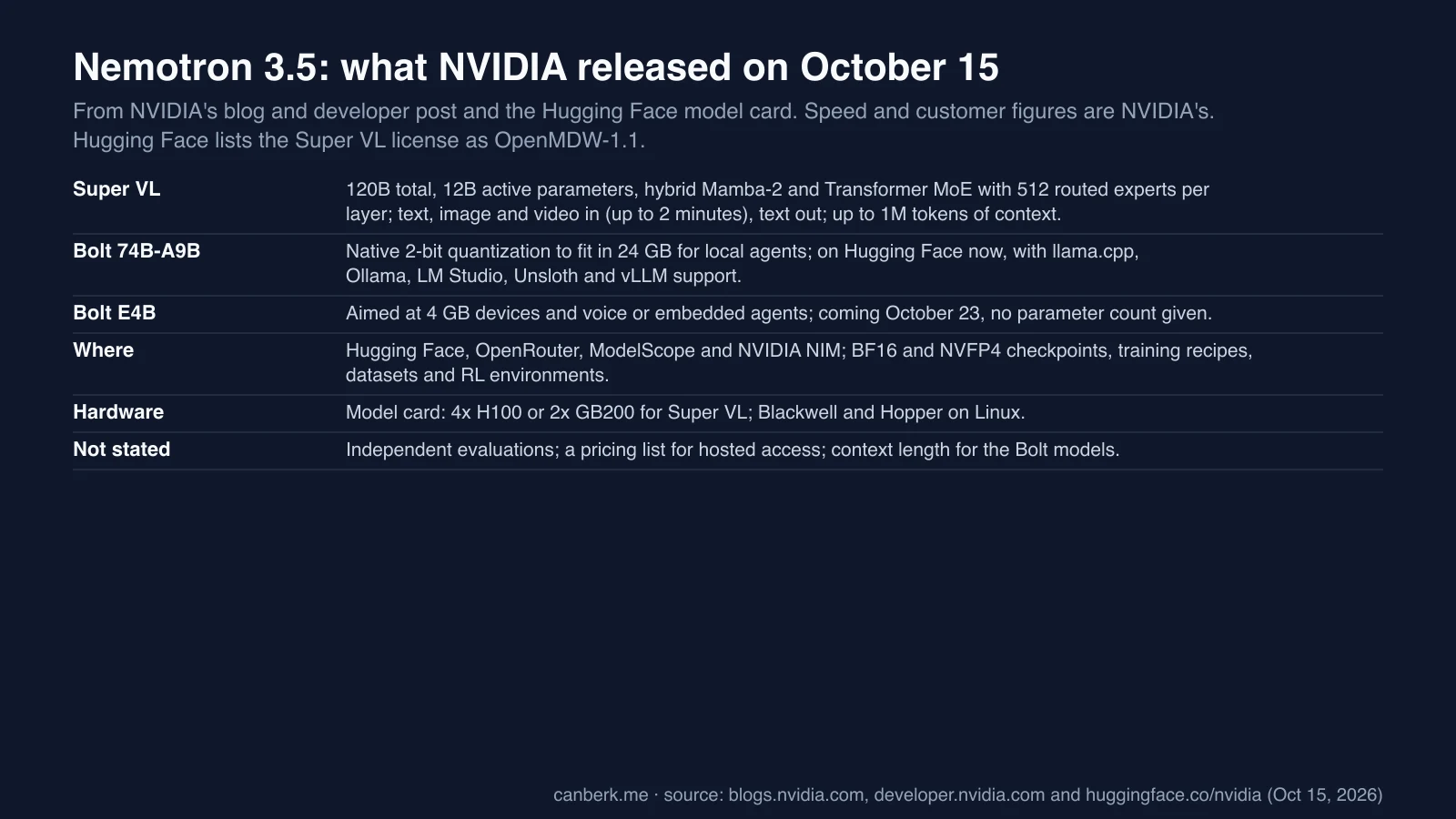
- Bolt 74B-A9B uses native 2-bit quantization to fit in 24 GB of memory, so it can run alongside other applications on GeForce RTX PCs, RTX PRO workstations, DGX Spark and the NVIDIA RTX Spark laptops that NVIDIA says arrive October 16. NVIDIA says it ranks first among open models in its class on PinchBench and second on BrowseComp. It is on Hugging Face with llama.cpp, Ollama, LM Studio, Unsloth and vLLM support. We covered those laptops in our Surface RTX Spark report.
- Bolt E4B 4GB targets fast conversational agents such as voice assistants and embedded interfaces. It is coming October 23, and NVIDIA gave no parameter count.
What are the Nemotron 3.5 Super VL specs?
Per the Hugging Face model card, it is a hybrid Mamba-2 and Transformer mixture of experts with 512 routed experts per MoE layer, a C-RADIO vision encoder, a vision-language connector and a multi-token prediction head for speculative decoding. NVIDIA’s developer post says it was distilled from Nemotron 3 Ultra using a loss called SkewReverse, and post-trained with multi-teacher on-policy distillation across text and vision teachers. The model card says the foundation data exceeds 20 trillion tokens, with collection through December 2025, while the blog cites about 26 trillion tokens of pretraining and continued pretraining and roughly 3.8 million post-training samples plus reinforcement learning. The two figures count training differently and NVIDIA does not reconcile them. Continued pretraining added 10B Indic tokens, and NVIDIA is releasing a dataset of about 2.8T tokens across 22 Indian languages built with IIT Madras and AI4Bharat.
Is Nemotron 3.5 Super VL really 5x faster?
Against models with the same index score, yes on NVIDIA’s chart. NVIDIA says it has “up to 5x higher throughput than other models in its class,” and its developer post shows over 600 output tokens per second on Artificial Analysis agentic tasks, measured on a Baseten endpoint. In the speed chart for open-weight models at 100k input tokens, Super VL sits at about 625 tokens per second with an Intelligence Index of about 26.
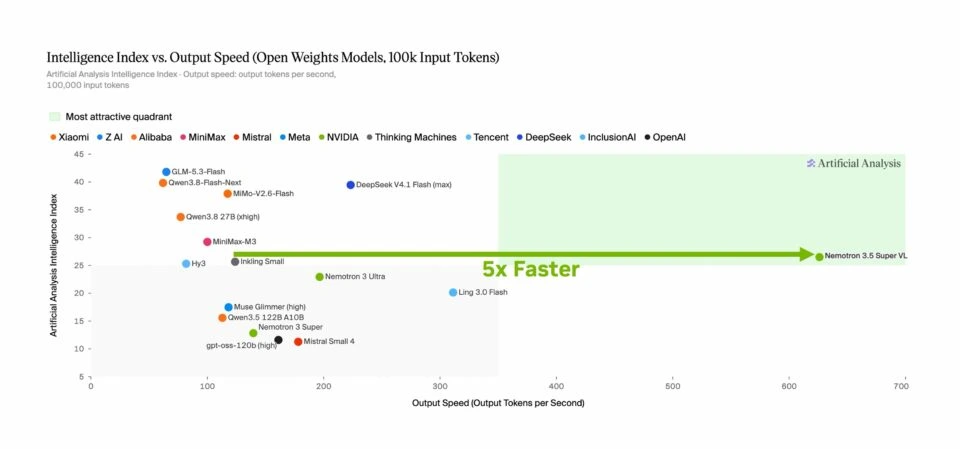
Our reading of the chart is that the “5x” arrow starts at Inkling Small, which scores the same index value (about 26) at roughly 120 tokens per second. Models with higher index scores in the same chart, such as GLM-5.3-Flash (about 42) and Qwen3.8-Flash-Next (about 40), generate far more slowly. So the claim is about speed at a middle-of-the-pack intelligence level, not a speed lead among stronger models. NVIDIA also claims 4x faster completion of 10,000 coding tasks on B200 GPUs and, with NVIDIA Dynamo on 16 B200 GPUs, up to 8x as many users and 85% lower time to first token at 50 tokens per second per user. These are NVIDIA’s figures.
How does Nemotron 3.5 Super VL score?
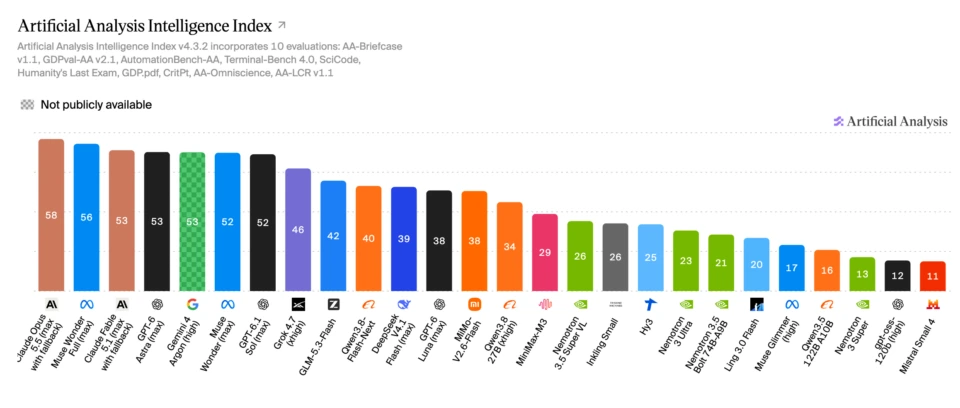
Modestly on the broad index, well on selected tests. NVIDIA’s Artificial Analysis chart puts Super VL at 26, above Nemotron 3 Ultra (23) and well below Claude Opus 5.5 (58), Meta’s Muse Wonder Full (56) and GPT-6 Astra (53).
On selected tests, the model card reports:
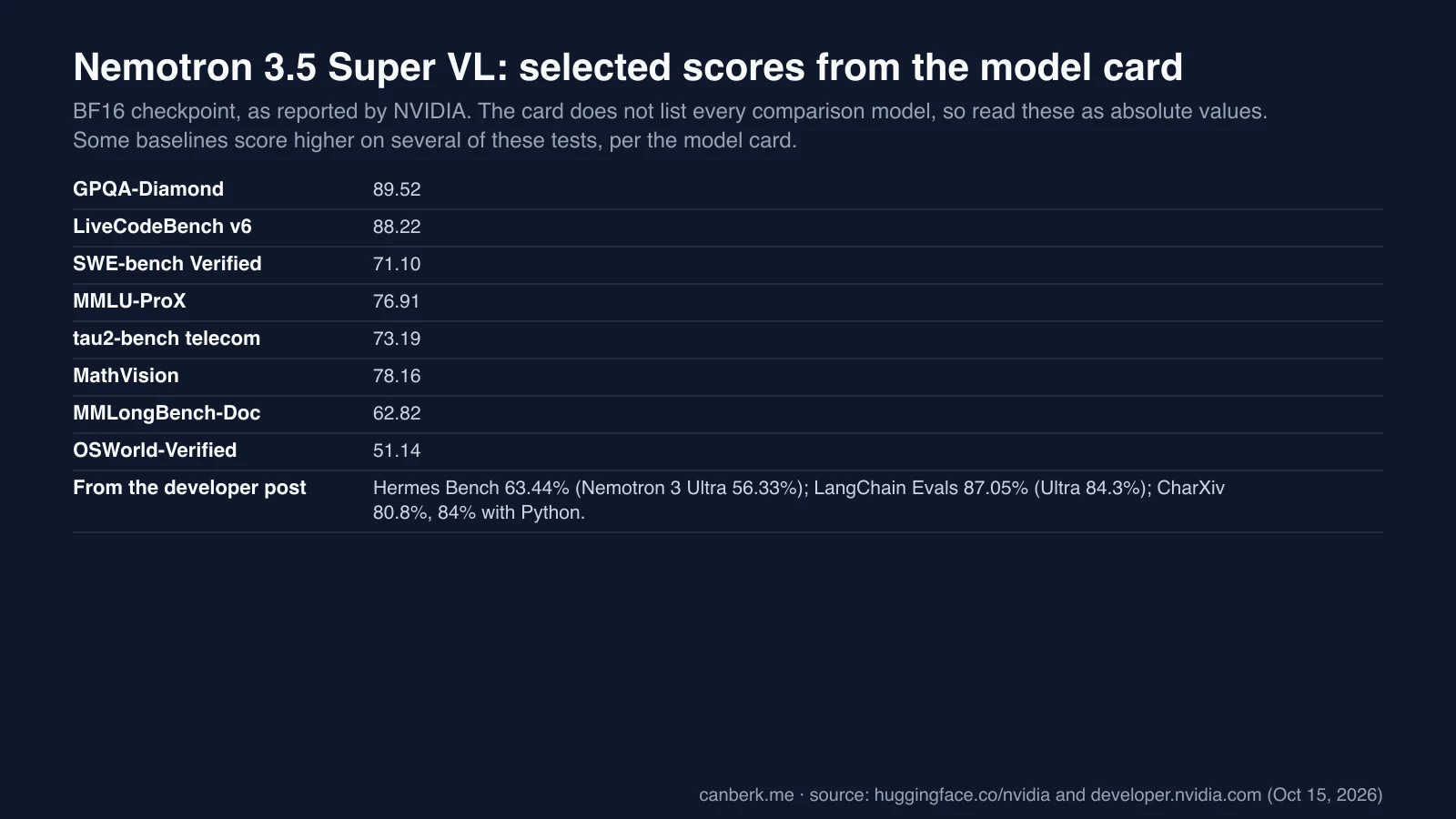
The model card says it does not lead on every benchmark and that several comparison models score higher on some tasks, for example MMLU-ProX and GPQA-Diamond for some baselines. The developer post adds that it outperforms Nemotron 3 Super on SWE-bench and Terminal-Bench setups without giving figures, and that on Indic benchmarks it scores highest of three compared models without exact scores. Scores in the card may use different harnesses from other labs’ tables, so do not compare them across vendors; for example, the Muse Spark Open model card lists OSWorld Verified at 80.4 under Meta’s own setup.
Can you run Nemotron 3.5 Super VL, and under what license?
On a multi-GPU machine, under a permissive license. The model card lists OpenMDW-1.1 and says the model is ready for commercial or non-commercial use. It recommends 4x H100 or 2x GB200, on NVIDIA Blackwell or Hopper with Linux, and gives vLLM and SGLang serving examples with multi-token prediction. NVIDIA released BF16, post-trained and NVFP4 checkpoints, training recipes, data and reinforcement learning environments, and the weights are on Hugging Face and ModelScope with hosted access through OpenRouter and NVIDIA NIM. NVIDIA says NIM containers are refreshed every two weeks. We did not read the OpenMDW-1.1 text itself.
What do customers report?
Large gains, all vendor-reported. NVIDIA’s developer post says Scale AI saw 40x lower inference cost and 5x lower latency for vendor credit processing at Skydance, and Ramp saw up to 50% higher throughput and 10x lower latency converting receipts to JSON. The blog lists further customers and integrations, including Hebbia, EY, Atlassian, CrowdStrike, Salesforce and Synopsys. These come from the companies’ own use cases and we could not verify them.
What is still unknown about Nemotron 3.5 Super VL?
- Independent results. The scores and speed claims are NVIDIA’s or its chart partner’s; we saw no outside reproduction beyond the Artificial Analysis chart NVIDIA published.
- Why the training token figures differ. The model card and blog count different stages.
- Hosted prices. Neither post gives a price.
- Bolt E4B details. No size or context length.
- Limitations. The model card text we read had no dedicated limitations section.
What to keep in mind
These are our observations:
- Read “5x” as speed at an index of 26. Stronger open models in the same chart are slower.
- The license is the friendliest part. OpenMDW-1.1 for commercial use contrasts with the limited terms on Meta’s Muse Spark Open.
- Hardware is the entry cost. 4x H100 or 2x GB200 is a lot, while Bolt 74B-A9B targets a 24 GB card.
- Check the model card per task. Some baselines beat it on several tests.
Editorial review: October 16, 2026 (AI). Prepared from NVIDIA’s blog post and technical blog (both read as text, charts viewed as images) and the Hugging Face model card (read through a summarizing fetch; the last portion of the page was not read). We did not run the models, did not read the OpenMDW-1.1 license text and did not use secondary reporting.
Sources
- Open From Data Center to Desktop: NVIDIA Expands Nemotron Family With Highest Efficiency Super VL and Bolt Models (Kari Briski, NVIDIA Blog, October 15, 2026) ↗NVIDIA
- NVIDIA Nemotron 3.5 Super VL Powers Specialized Agents with Multimodal Reasoning (NVIDIA Technical Blog, October 15, 2026) ↗NVIDIA
- NVIDIA-Nemotron-3.5-Super-VL-120B-A12B-BF16 model card (Hugging Face, NVIDIA) ↗NVIDIA on Hugging Face
Created with AI assistance.
Suggest a correction
Found an error or a missing source? Send a private suggestion to the editor. It will be reviewed and will not appear as a public comment. No name, email or account is needed.


Send us a message