Meta Muse Spark Open: 816B open weights, license and benchmarks
Muse Spark Open has 816B parameters and runs on two Mac Studios. Where it leads Meta's table, what its license limits and what is missing.
In this article
- What is Muse Spark Open?
- What are the Muse Spark Open specs?
- Can you run Muse Spark Open at home?
- How does Muse Spark Open score against other open models?
- Is it really the most capable US open-weight model?
- Can you trust Meta’s benchmark comparison?
- What does the Muse Model License allow?
- What does Meta say about safety?
- What is still unknown about Muse Spark Open?
- What to keep in mind
Meta has released the weights of a very large model that it says you can run at home, with strings attached. On October 15 the company published Muse Spark Open, an 816B-parameter model it calls “the most capable US open-weight model to date.” We read Meta’s announcement, its evaluation methodology report and the model card. This article covers what it is, how to run it, where it leads and trails Meta’s own table, and what the license allows.
What is Muse Spark Open?
An open-weight, natively multimodal coding and agent model. Meta describes Muse Spark Open as having 816B total parameters (42B active) and a 1M-token context window, “built for coding and agentic work.” It follows Muse Wonder, which Meta introduced three days earlier through its own API and Muse Code. Unlike Wonder, Muse Spark Open’s weights are downloadable, under a custom license.
What are the Muse Spark Open specs?
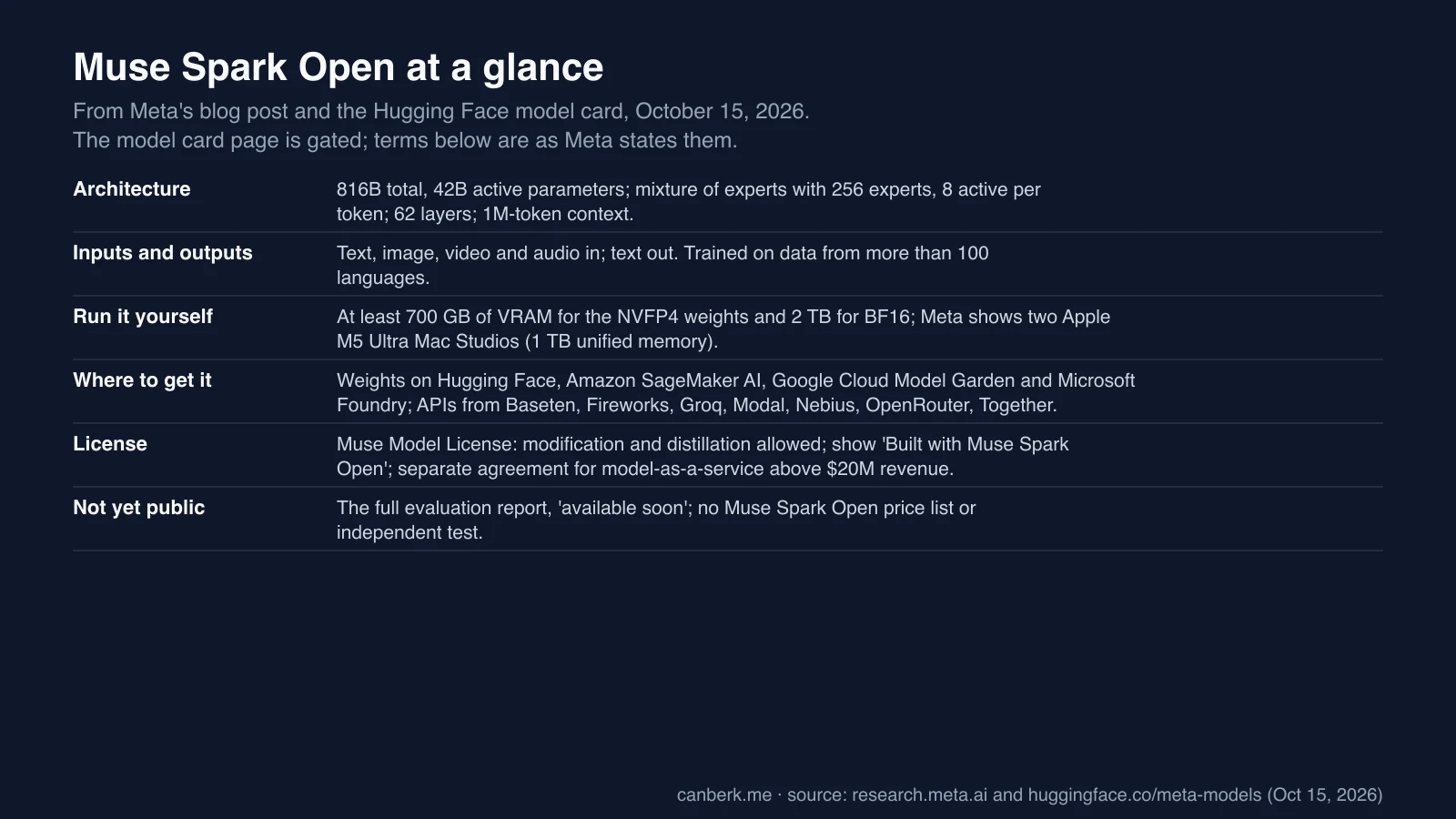
Per the model card, it is a mixture-of-experts Transformer with a Perception Encoder: hidden dimension 8192, 62 layers, 128 query heads and 16 key-value heads, 256 experts with 8 activated per token, and a vocabulary of 202,048 tokens. The 1.8B-parameter encoder handles images and video. It accepts text, image, video and audio as input and produces text only, and was trained on data from more than 100 languages. Weights come in BF16 and NVFP4.
Can you run Muse Spark Open at home?
On a very expensive desktop, yes. Meta says it is “the first model in its class to run on your desktop,” using two Apple M5 Ultra Mac Studios with the latest MLX framework. Each Mac Studio’s integrated GPU can use up to 512 GB of unified memory with 1.2 TB/s of bandwidth, so two machines “behave like one supercomputer with a terabyte of unified memory.” The model card puts the self-hosting minimum at 700 GB of VRAM for NVFP4 and 2 TB for BF16.
Meta says it tested on-device agentic workflows with Muse Code powered by the model, including shipping iOS fixes and features to the open-source Mastodon client Ice Cubes and driving DaVinci Resolve to find and crop video highlights. We saw no speed figures for the two-Mac setup. For everyone else, Meta lists API access through Baseten, Fireworks AI, Groq, Modal, Nebius, OpenRouter and Together AI, and weight downloads on Hugging Face, Amazon SageMaker AI, Google Cloud Model Garden and Microsoft Foundry Models. The Hugging Face model card page, read on October 15, says no inference provider currently hosts the model, which does not match the blog’s “available today” for providers.
How does Muse Spark Open score against other open models?
Meta’s scorecard compares it with seven models and shows it ahead on six of 11 rows:
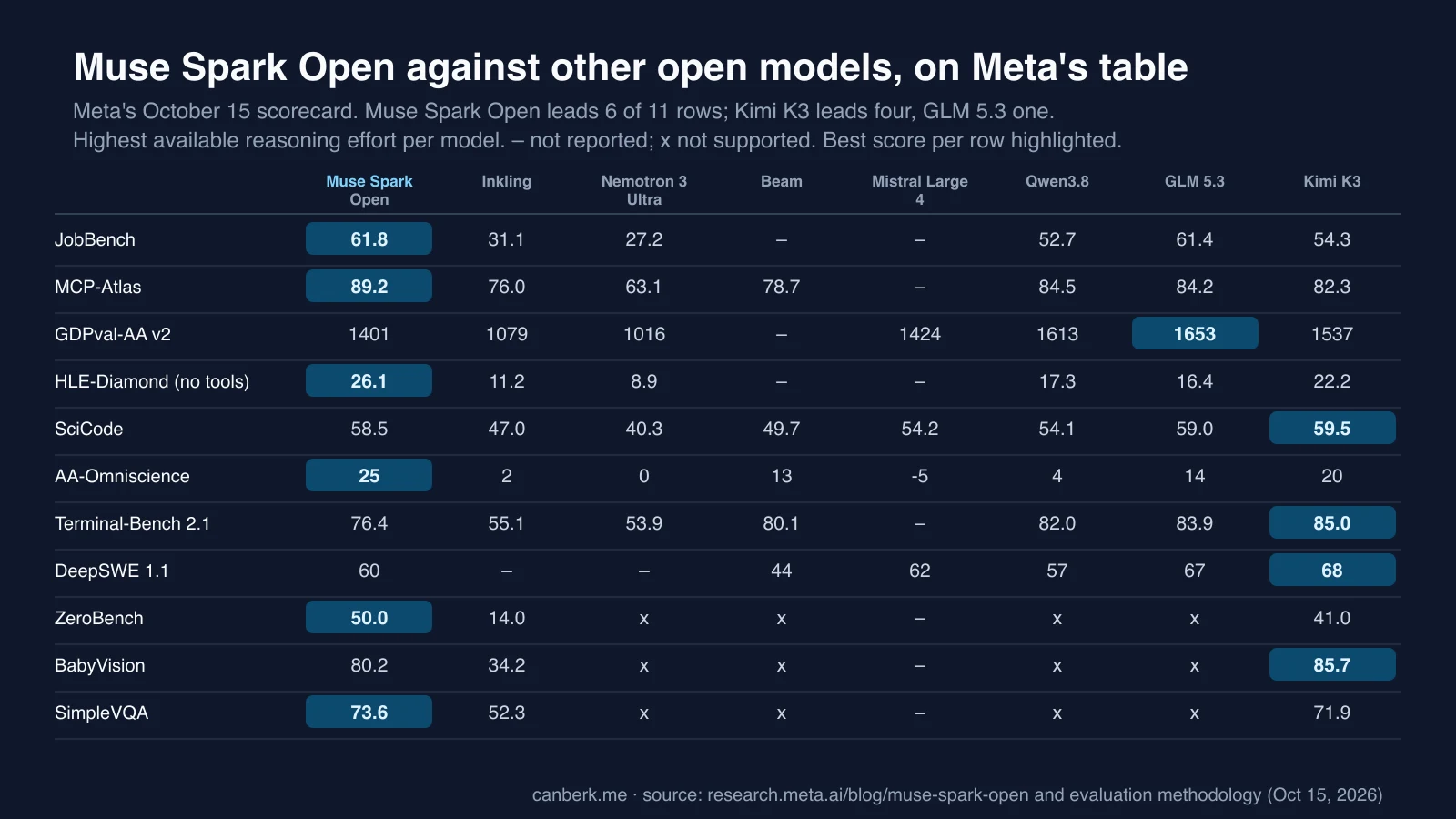
- Muse Spark Open leads. JobBench (61.8 against 61.4 for GLM 5.3), MCP-Atlas (89.2), HLE-Diamond without tools (26.1), AA-Omniscience (25), ZeroBench (50.0) and SimpleVQA (73.6).
- Kimi K3 leads four. SciCode (59.5 against 58.5), Terminal-Bench 2.1 (85.0 against 76.4), DeepSWE 1.1 (68 against 60) and BabyVision (85.7 against 80.2).
- GLM 5.3 leads GDPval-AA v2 at 1653 against 1401. On that row Qwen3.8, Kimi K3 and Mistral Large 4 also score above Muse Spark Open.
The model card lists further results, for example an Artificial Analysis Intelligence Index of 39, which the model card page shows below GLM 5.3 (45) and Kimi K3 (44), plus OSWorld Verified at 80.4 and GPQA Diamond at 89.0. We read the model card through a text summary, so check its table for those rows.
Is it really the most capable US open-weight model?
Meta’s claim depends on the word “US.” The models that beat it on several rows in its own scorecard, Kimi K3, GLM 5.3 and Qwen3.8, are not US models, and Meta’s headline carves them out. Among the other models in the table, Meta lists Nemotron 3 Ultra and Beam, whose methodology links to a Reflection AI launch post, and Meta does not label which entries it counts as US models. On the table’s numbers, Muse Spark Open is ahead of Nemotron 3 Ultra on every row where both have a score, and ahead of Beam on the rows where Beam reports one except Terminal-Bench 2.1 (Beam 80.1 against 76.4). Whether that makes it the most capable US model is Meta’s framing; the table shows it behind the leading Chinese models on coding and terminal tasks.
Can you trust Meta’s benchmark comparison?
It is Meta’s comparison, with conditions stated in its methodology report:
- Highest effort per model. Muse Spark Open ran at xhigh reasoning effort; GLM 5.3 and Kimi K3 at max; Qwen3.8 at xhigh.
- Mixed sources. Where an official leaderboard has all models, Meta uses it; otherwise it reports the highest comparable value from its own runs or the provider’s self-reported results. Beam and Mistral Large 4 weights were not broadly available, so their numbers are self-reported or from Artificial Analysis.
- Best-effort third-party runs. Meta says its setups “are not specifically tuned for third-party models” and may not reflect their best performance.
- Different harnesses. DeepSWE 1.1 and SWE-Atlas-QnA use each model’s preferred or self-reported harness, for example Muse Code for Muse Spark Open, Claude Code for Qwen3.8 and Kimi Code for Kimi K3.
- Gaps. Many cells are empty or “not supported,” for example the multimodal rows where several models cannot take image input.
What does the Muse Model License allow?
Free use for many developers, with conditions. Per the model card, the license permits use, copying, modification including fine-tuning, distillation, merging, distribution, sublicensing and sale, if the license and notice accompany copies and products show “Built with Muse Spark Open.” A company that offers third parties API-style access to AI models and has more than $20 million in aggregate gross revenue in any 12 months must notify Meta and sign a separate agreement before offering the model or derivatives in that business. Internal use, research and use inside a company’s own product features are outside that rule. Meta claims no ownership of outputs, and an acceptable-use policy bars illegal activity, malware, weapons, fraud and similar uses. Meta calls the terms “limited commercial terms.” The model page is gated and asks for legal name, date of birth and organization.
What does Meta say about safety?
Meta says Muse Spark Open has extra safety post-training because open weights carry their own risks, and that it met the thresholds in the Meta Superintelligence Scaling Framework. Per the model card, tested without system-level safeguards, it refused 99.2% of jailbreaks on an internal cyber benchmark and 94.8% across three public cyber sets, against 75.5% and 70.2% for Kimi K3. Chemical and biological refusal rates were above 97% on each set listed, MASK honesty was 98.1% and Agentic Misalignment misbehavior was 0%. Results apply only to the released checkpoint; Meta warns downstream changes can degrade safety. The full evaluation report is “available soon.”
What is still unknown about Muse Spark Open?
- Independent results. Every number is Meta’s; we saw no outside evaluation or reproduction.
- Real speed on two Mac Studios. Meta shows workflows but no throughput figures.
- API prices. The blog lists providers and gives no price.
- The full safety report. Meta says it is coming.
- How the license is enforced. The $20 million threshold relies on self-notification.
What to keep in mind
These are our observations:
- “Open” here means downloadable weights under a custom license, not an OSI-style open-source license, as Meta’s own “limited commercial terms” wording signals.
- Leaders by row differ. Meta’s table gives it six wins, but the models ahead on coding and terminal rows are the Chinese ones it excludes from “US.”
- Distillation is explicitly allowed. That contrasts with the anti-distillation defenses we covered in Anthropic’s October 12 post.
- Plan for hardware before the model. 700 GB to 2 TB of memory is a large entry cost.
Editorial review: October 15, 2026 (AI). Prepared from Meta’s announcement post (read in full as text; the scorecard image read in four crops), Meta’s evaluation methodology report (PDF, read in full), and the Hugging Face model card (read through a summarizing fetch, including license, architecture, benchmarks and safety figures; the page is gated). We did not run or test the model and did not use secondary reporting.
Sources
- Introducing Muse Spark Open, The Most Capable US Open-Weight Model to Date (Meta AI Research, October 15, 2026) ↗Meta AI Research
- Muse Spark Open Evaluation Methodology (Meta AI Research, October 2026) ↗Meta AI Research
- Muse Spark Open 816B-A42B model card (Hugging Face, meta-models) ↗Meta on Hugging Face
- Muse Wonder (Meta AI Research, October 12, 2026) ↗Meta AI Research
Created with AI assistance.
Suggest a correction
Found an error or a missing source? Send a private suggestion to the editor. It will be reviewed and will not appear as a public comment. No name, email or account is needed.


Send us a message