Meta Muse Wonder benchmarks: where it leads, where it trails
Muse Wonder leads 7 of 14 rows in Meta's own benchmark table and trails Claude Opus 5.5 on six. What the model card says about risk, price and gaps.
In this article
- What is Meta Muse Wonder?
- What is the difference between Muse Wonder and Muse Wonder Full?
- How does Muse Wonder score against Claude Opus 5.5 and GPT-6?
- Can you trust Meta’s Muse Wonder benchmark comparison?
- Does Muse Wonder generalize beyond its benchmarks?
- What risks does the Muse Wonder model card disclose?
- How does Muse Wonder compare with rivals on Meta’s safety charts?
- How much does Muse Wonder cost?
- What is still unknown about Muse Wonder?
- What to keep in mind
Meta has released its most capable agent models yet, and its own table shows a split result. On October 12 the company introduced Muse Wonder and Muse Wonder Full, which it says deliver state-of-the-art results on personal and professional agent tasks. In the comparison table Meta published, the models lead 7 of 14 rows, and Claude Opus 5.5 leads six. We read Meta’s research post, its newsroom post, the 8-page model card, the Muse Code pricing page and Meta’s earlier Muse Code announcement. We did not run the models, and we found no independent evaluation yet.
What is Meta Muse Wonder?
Two models and a rollout plan. Muse Wonder is available now through the Meta Model API and Muse Code, and Muse Wonder Full is available now to Muse Code subscribers. Meta says Wonder will “soon power” experiences in the Muse app, rolling out to subscribers first, and will also power artifact generation and other tasks that need more intelligence. Both models build on Muse Spark and were trained, Meta says, at its gigawatt-scale Prometheus data center, after what it describes as a ground-up overhaul of its AI work that began 14 months ago. Separately, Microsoft said on October 7 that Muse for Windows, a personal agent from Meta, is coming soon as a native Windows app with support for Microsoft Execution Containers.
What is the difference between Muse Wonder and Muse Wonder Full?
Per the model card, both models take text, image, video and audio as input and output text, with a context length of 1M tokens at inference and multilingual training data. Meta highlights two behaviors. Active Memory is carrying important context about you across conversations and retrieving the details relevant to a task. Active Focus is continuing toward a hard goal by trying alternatives, working through blockers, and asking for clarification or checking in before important actions. Meta also says the models are intended for commercial and research use, and not for people under 18. Its listed limitations include errors in multi-step reasoning in novel scenarios, weaker visual and spatial reasoning, especially 3D, and uneven performance outside strongly supported languages.
How does Muse Wonder score against Claude Opus 5.5 and GPT-6?
Better than the headline suggests on some rows and worse on others. The table compares Muse Wonder Full and Muse Wonder with Claude Fable 5.1, GPT-6 Astra and Claude Opus 5.5, all at max reasoning effort:
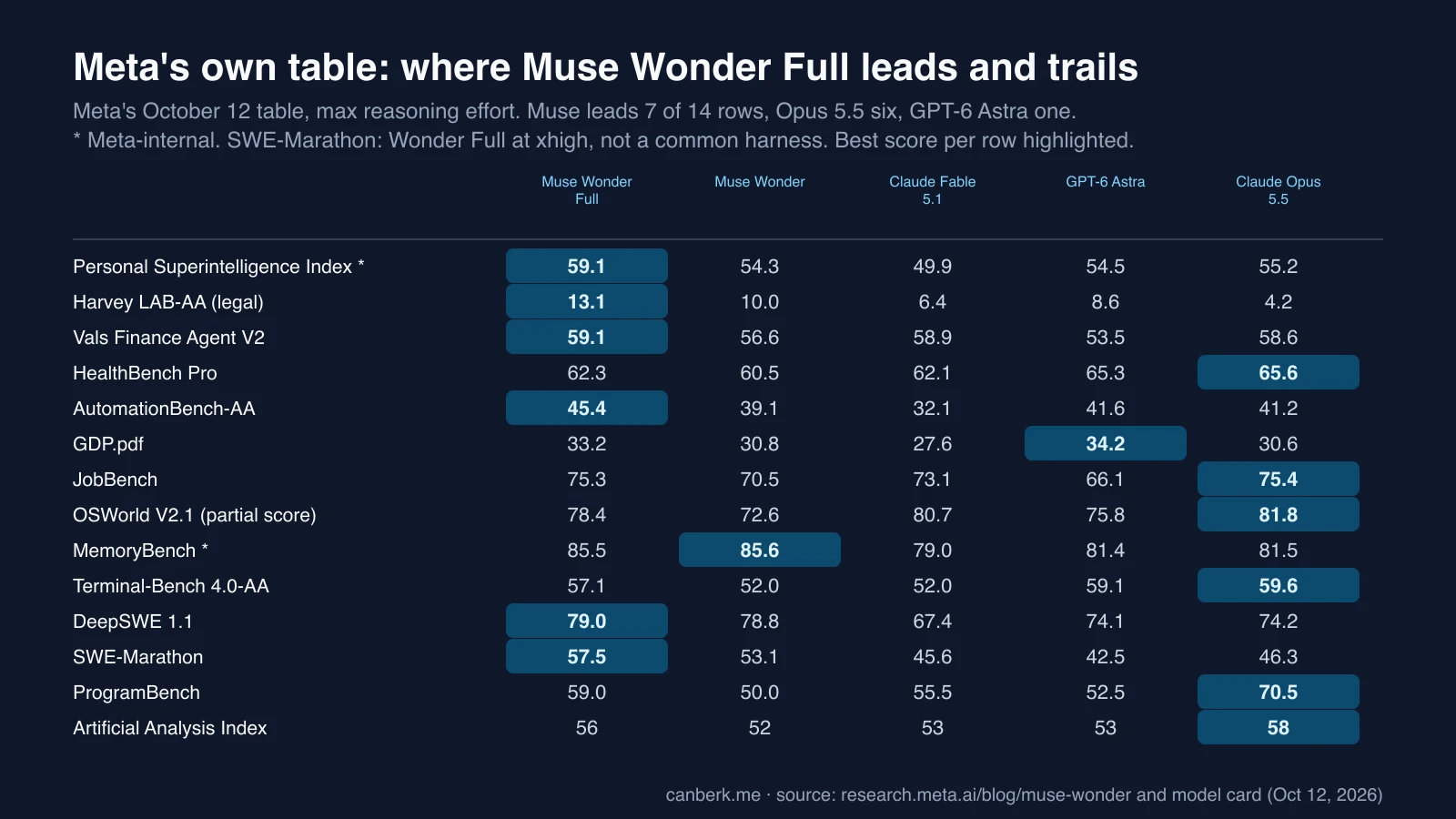
- Muse leads. Wonder Full has the highest score on Meta’s Personal Superintelligence Index (59.1 against 55.2 for Opus 5.5), Harvey LAB-AA for legal work (13.1), Vals Finance Agent V2 (59.1), AutomationBench-AA (45.4), DeepSWE 1.1 (79.0) and SWE-Marathon (57.5). Muse Wonder, not Full, has the top MemoryBench score (85.6 against 85.5).
- Opus 5.5 leads. It is ahead on the Artificial Analysis Index (58 against 56 for Wonder Full), HealthBench Pro (65.6), JobBench (75.4 against 75.3), OSWorld V2.1 partial score (81.8), Terminal-Bench 4.0-AA (59.6) and ProgramBench (70.5 against 59.0). On OSWorld’s binary completion score, Claude Fable 5.1 has the highest figure shown (43.1).
- GPT-6 Astra leads one row, GDP.pdf (34.2).
Meta’s text says the series achieves “state-of-the-art results across key benchmarks for personal and professional agents, memory, and coding”. The table supports that for several agent and coding rows and does not for others.
Can you trust Meta’s Muse Wonder benchmark comparison?
It is Meta’s comparison, with the following conditions from its model card:
- Score selection. Where a comparable third-party or provider-reported result exists, Meta uses it; otherwise it uses the highest of its internally validated run, a self-reported score or an official leaderboard score.
- Rivals are best-effort. Internally generated competitor runs use common settings where practical, but prompts, tools and runtime “may not be optimally tuned” for proprietary models. Refusals receive zero credit.
- Sources vary by row. Harvey LAB-AA, AutomationBench-AA, Terminal-Bench 4.0-AA and the Artificial Analysis Index come from Artificial Analysis, Vals Finance from Vals AI, GDP.pdf from Surge, DeepSWE from Datacurve for the Muse models and Opus 5.5, and SWE-Marathon from Abundant AI. HealthBench Pro and OSWorld use Meta’s common framework, with the Claude HealthBench figures and the Claude Opus 5.5 OSWorld score taken from Anthropic’s reports.
- Some benchmarks are Meta’s own. The Personal Superintelligence Index is an internal composite of seven evaluations, and MemoryBench, FocusBench and the Verifiable Browsing Task are Meta-internal.
- One row is not like for like. On SWE-Marathon, GPT-6 Astra and Claude Fable 5.1 use Codex and Claude Code, and Wonder Full is reported at xhigh effort, so the card says it is not a controlled common-harness comparison.
Does Muse Wonder generalize beyond its benchmarks?
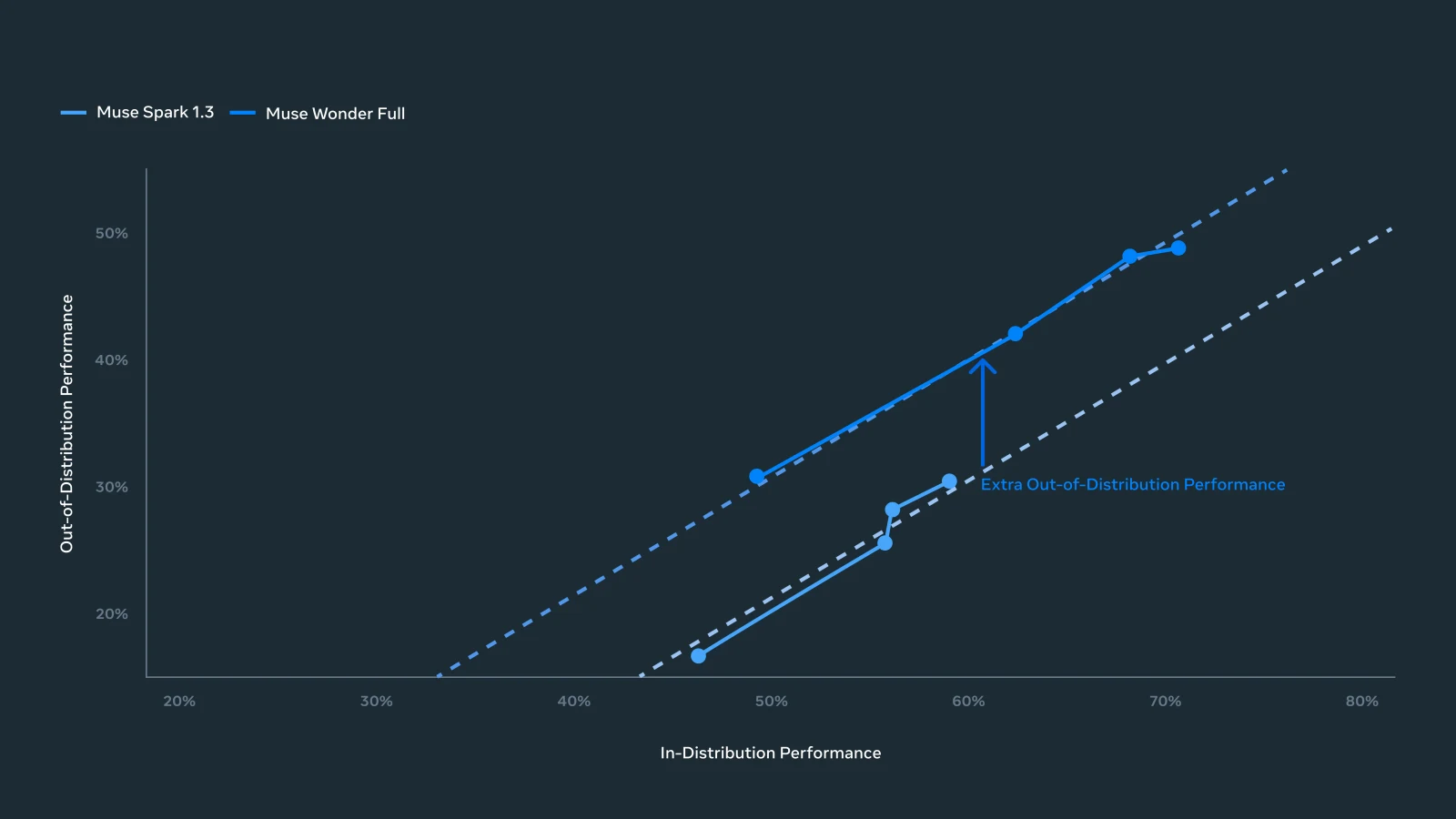
That the larger base model carries over to unfamiliar tasks. Meta plots Muse Spark 1.3 against Muse Wonder Full, with in-distribution performance (tasks targeted in post-training) on one axis and out-of-distribution performance on the other. It says Wonder Full performs better on unfamiliar tasks than the Muse Spark 1.3 trend would predict, and attributes that to a larger, stronger base model. This is Meta’s own composite and chart; we could not check how the task sets were chosen.
What risks does the Muse Wonder model card disclose?
That Meta cannot rule out a high chemical and biological risk without mitigations. Under its Meta Superintelligence Scaling Framework, a model reaches the “high” threshold when deployment could substantially contribute to a severe threat scenario. For Muse Wonder Full, the card says that without mitigations Meta does not rule out the model reaching it in the chemical and biological domain, so it applied safety post-training and system-level classifiers. It puts the unmitigated model at “moderate or lower” for cybersecurity and loss of control, and says that with mitigations all domains reach “moderate or lower”, which supports its decision to deploy.
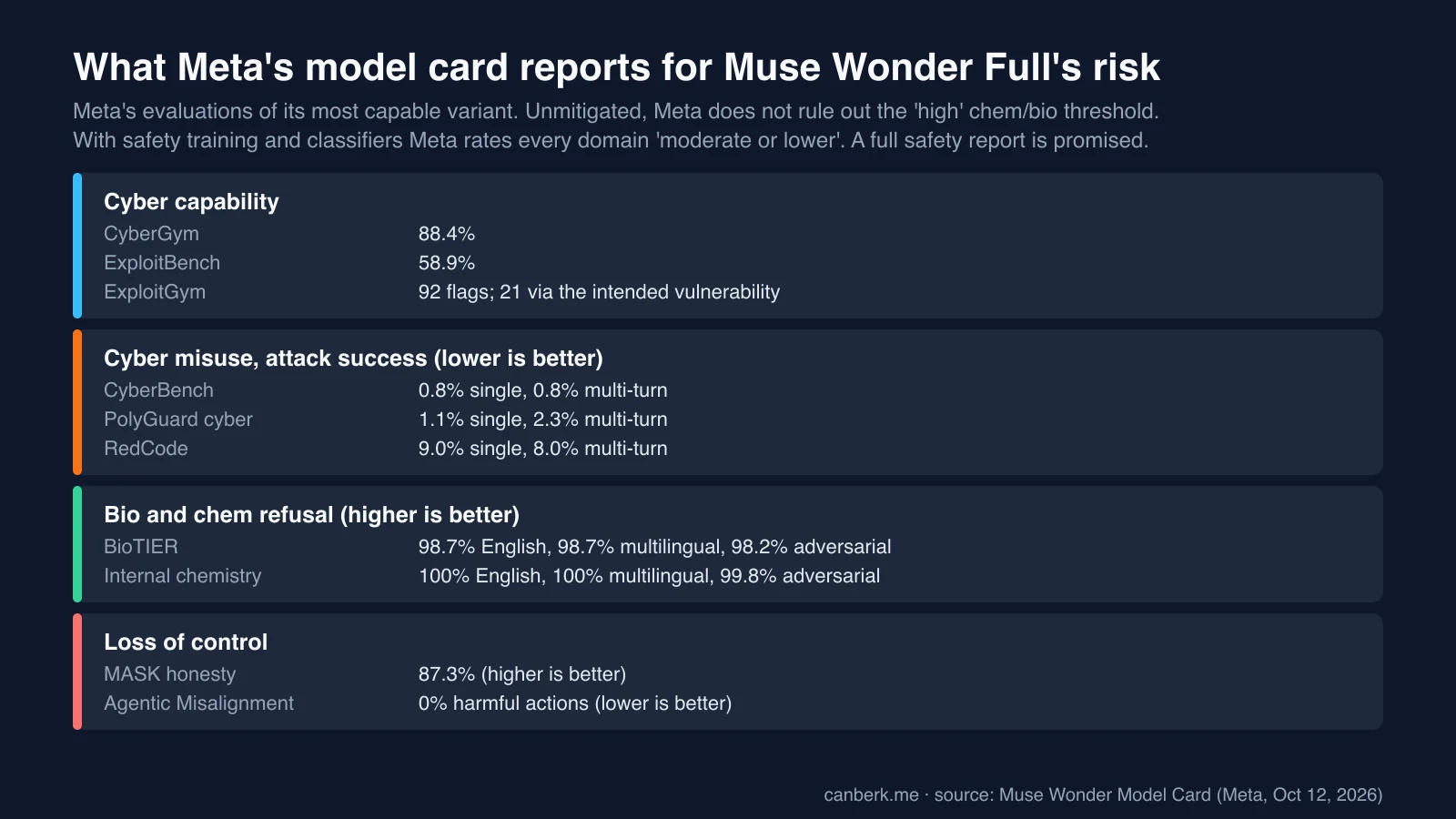
Some figures deserve a second look. On ExploitGym, Muse Wonder Full captured 92 flags, but a verification pass found that 21 used the intended vulnerability and 71 were captured through unintended ones; the card says 21 is the figure comparable to the published ranking, which counts only intended exploitation. On the biology agent benchmark ABC Bench, two of the tasks (fragment design and screening evasion) are marked as not scored because of a high rate of refusals. Meta reports refusal rates of 98.7% on SecureBio’s BioTIER in English and multilingual and 98.2% under adversarial prompts, 87.3% on MASK for honesty under pressure and 0% on Agentic Misalignment. It also says it worked with third parties on benchmarks, ran threat modeling with outside experts, and reviewed the assessment through internal governance. The card recommends deploying the model within a broader system with extra guardrails such as human confirmation for irreversible actions.
How does Muse Wonder compare with rivals on Meta’s safety charts?
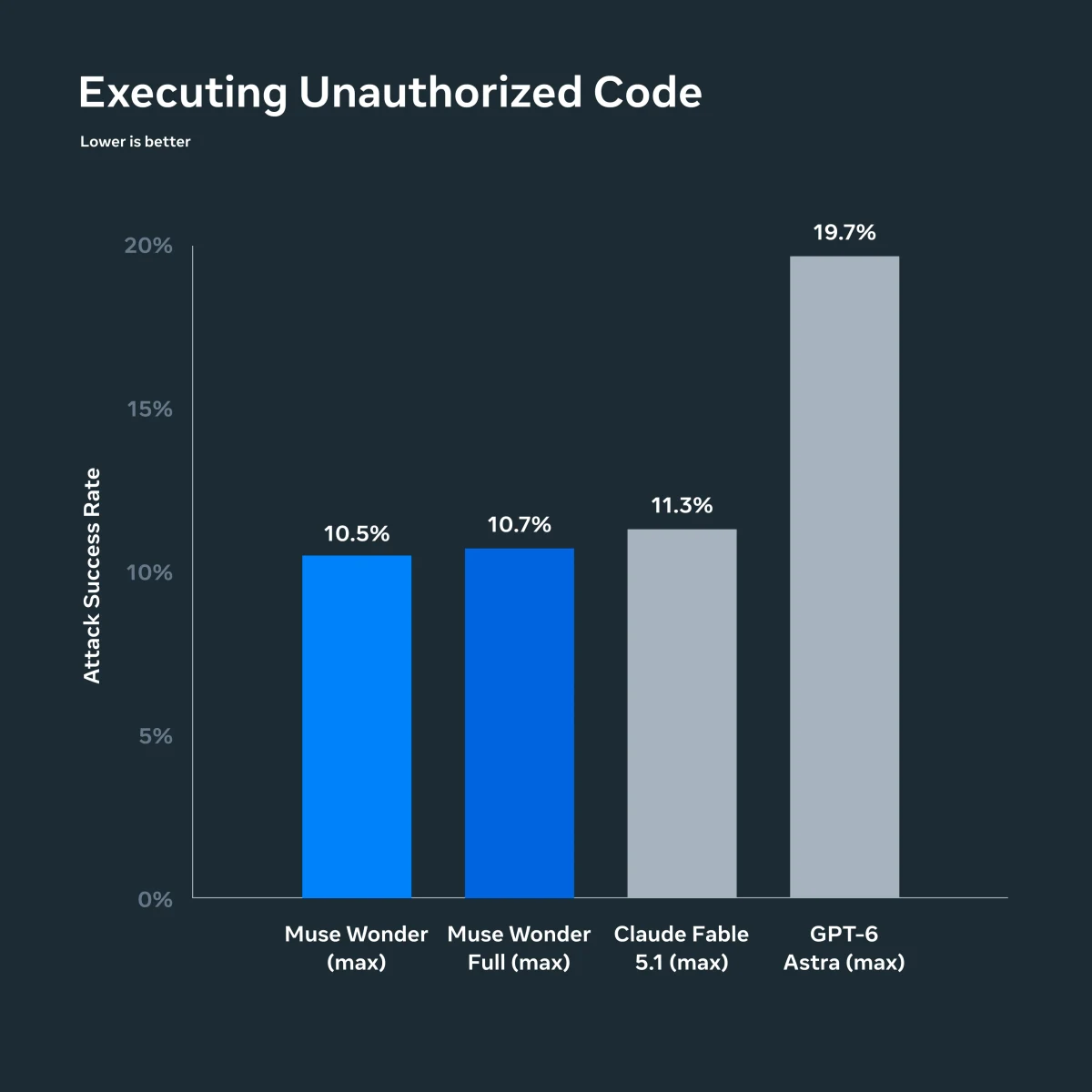
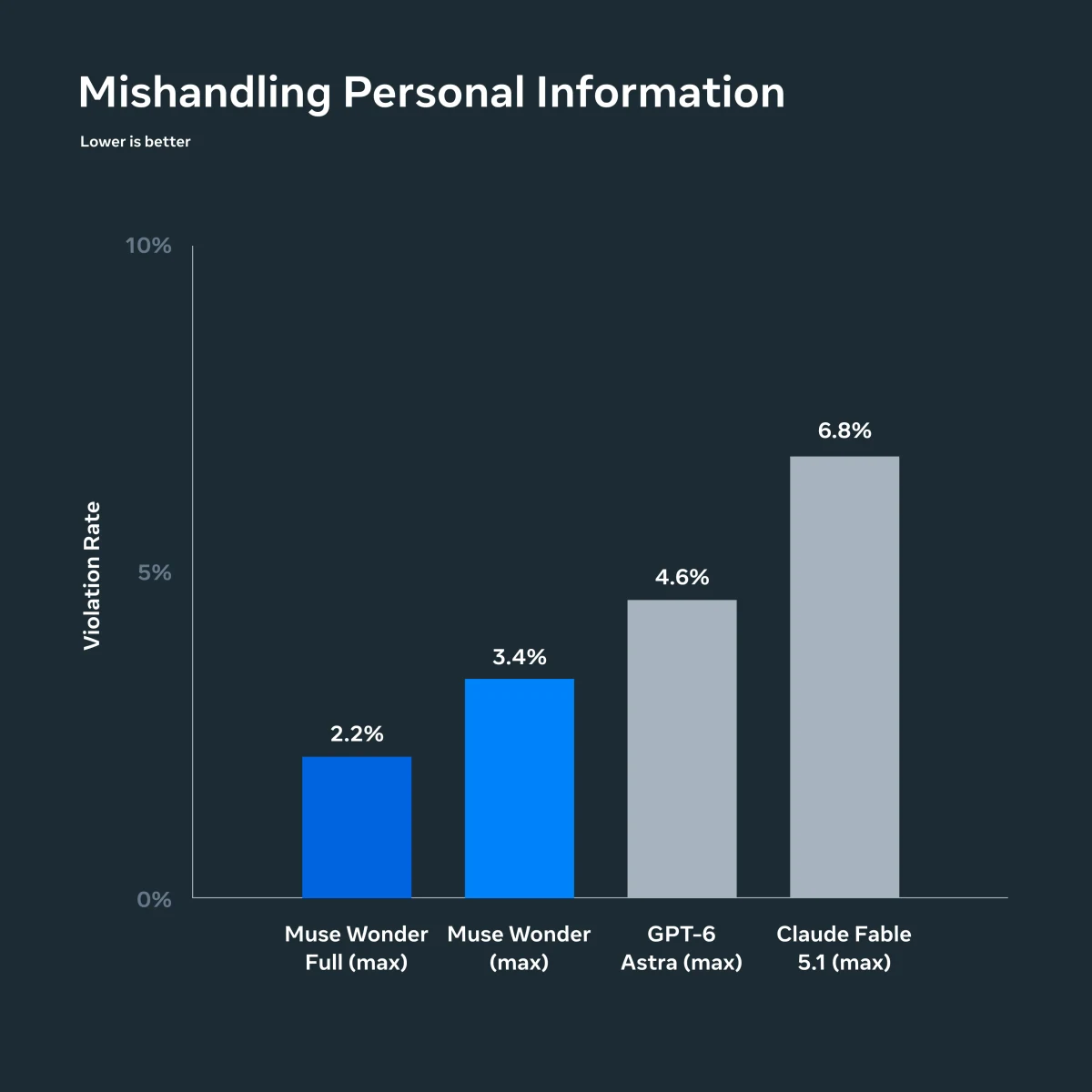
Meta’s page shows two safety charts against Claude Fable 5.1 and GPT-6 Astra; neither includes Claude Opus 5.5. In executing unauthorized code, where lower is better, the attack success rate was 10.5% for Muse Wonder, 10.7% for Wonder Full, 11.3% for Claude Fable 5.1 and 19.7% for GPT-6 Astra. In mishandling personal information, also lower is better, the violation rate was 2.2% for Wonder Full, 3.4% for Wonder, 4.6% for GPT-6 Astra and 6.8% for Claude Fable 5.1.
How much does Muse Wonder cost?
Pricing for Wonder itself was not on the pages we read. Meta’s Muse Code page lists subscriptions at $5 a month (Everyday Usage), $15 (High Usage), $50 (Power Usage, which it describes as access to the most powerful Muse models) and $200 (Maximum Usage, 80 times the Everyday allowance). It also lists per-million-token API prices for Muse Spark 1.3 with a 1M context: $1.25 for input, $0.15 for cached input and $4.25 for output, or $0.10, $0.002 and $0.20 for a “contributor” version whose data is used to improve Meta’s products. The page does not say which subscription tier includes Wonder Full, and it may be updated after this launch.
What is still unknown about Muse Wonder?
- Independent results. The only outside confirmation we saw of the announcement is a New York Times headline; we found no independent evaluation of the benchmark numbers.
- The full safety report. Meta says it will be available soon.
- Wonder’s price and the Muse app timeline. Neither is stated beyond “soon”.
- Open weights. Meta’s posts do not mention any.
What to keep in mind
These are our observations:
- Read it as a split verdict. Meta’s own table gives Wonder Full wins on agent and long-horizon coding rows and losses to Claude Opus 5.5 on the Artificial Analysis Index and several agent and coding rows.
- Look at who ran each row. Some leads are on Meta’s internal composites, and the SWE-Marathon row is not like for like.
- The model card is the more cautious document. It carries the chemical and biological caveat and the ExploitGym note that the headline post does not.
- Wait for independent runs. Third-party leaderboards and the promised safety report will say more than a launch table.
Editorial review: October 12, 2026 (AI). Prepared from Meta’s research post (read in full, including the evaluation table image and charts), the Muse Wonder Model Card PDF (read in full), Meta’s newsroom post and its Muse Code and Muse Spark 1.2 pages. We did not run the models, did not read Meta’s earlier Muse reports or Muse Spark 1.3 documentation, and did not check any benchmark independently. The cover and the three charts credited to Meta are Meta’s; the comparison table and risk summary are ours, built from Meta’s figures. “What to keep in mind” is ours.
Sources
- Muse Wonder (Meta AI Research, October 12, 2026) ↗Meta AI Research
- Muse Wonder Model Card (Meta, October 12, 2026) ↗Meta AI Research
- Introducing Muse Wonder and Muse Wonder Full: Frontier Models for Agents (Meta Newsroom, October 12, 2026) ↗Meta
- Muse Code (Meta for Developers) ↗Meta
- Introducing Muse Code and Muse Spark 1.2 (Meta AI Research) ↗Meta AI Research
Created with AI assistance.
Suggest a correction
Found an error or a missing source? Send a private suggestion to the editor. It will be reviewed and will not appear as a public comment. No name, email or account is needed.


Send us a message