What is Claude Haiku 5.5? Price, benchmarks and the Sonnet cache cut
Anthropic's Haiku 5.5 costs $0.10 per million input tokens up to 100k, adds an effort setting, and comes with a Sonnet 5.5 cache-read price cut.
In this article
Anthropic released Claude Haiku 5.5 on October 7, 2026, calling it its cheapest, fastest and most capable small model. The same announcement cuts Sonnet 5.5’s cache-read price and adds monthly API credits for Max and Team subscribers. Everything below is Anthropic’s own reporting; we have not benchmarked the model. We read the announcement in full. We did not read the system card or the migration guide, whose page did not load for us.
What does Haiku 5.5 cost?
The model ID is claude-haiku-5-5. Anthropic prices it by prompt size, per million tokens:
| Haiku 5.5, up to 100k | Haiku 5.5, over 100k | Haiku 4.5 | Sonnet 5.5 | |
|---|---|---|---|---|
| Input | $0.10 | $0.50 | $1.00 | $2.00 |
| Output | $0.50 | $2.50 | $5.00 | $10.00 |
| Cache reads | $0.01 | $0.05 | $0.10 | $0.10 (was $0.20) |
| Cache writes | $0.125 | $0.625 | $1.25 | $2.50 |
Anthropic says the headline “about 75% less to run” blends two cases: 90% lower than Haiku 4.5 for requests up to 100,000 tokens and 50% lower above that, weighted by the fact that 90% of Haiku 4.5 requests fell under the threshold. It also says the figure accounts for a new tokenizer, similar to Sonnet 5.5’s and Opus 5.5’s, that uses slightly more tokens per task. Your own saving depends on how many of your requests exceed 100,000 tokens.
What is it for?
Anthropic describes quick, repetitive workloads: summaries, compaction, database queries and classification. It says it pairs well as a subagent with Opus 5.5 and Sonnet 5.5, and suits speed-sensitive work such as live customer support and browser use. It is the first Haiku-class model with an adjustable effort setting, so you can trade cost against intelligence as with the larger models. Anthropic calls it its fastest model at each model’s standard speed, but slower than its Opus models in Fast Mode.
Anthropic also says plainly that Sonnet 5.5 and Opus 5.5 remain the better choice for complex agentic coding. Haiku 5.5 is meant for more narrowly scoped tasks that were previously too costly.
What do the benchmarks show?
Anthropic’s table compares Haiku 5.5 with Haiku 4.5, OpenAI’s GPT-6 Luna and, for reference, Sonnet 5.5:
| Benchmark | Haiku 5.5 | Haiku 4.5 | GPT-6 Luna | Sonnet 5.5 |
|---|---|---|---|---|
| GDPval-AA v2.1 (Elo) | 1620 | 735 | 1437 | 1840 |
| AA-Briefcase v1.1 (Elo) | 1578 | 614 | 1336 | 1824 |
| OSWorld 2.1, offline subset | 72.4% | 15.7% | 48.9% | 83.9% |
| Humanity’s Last Exam, no tools | 45.9% | 10.2% | not shown | 56.9% |
| Humanity’s Last Exam, with tools | 57.4% | 18.7% | not shown | 64.5% |
| Terminal-Bench 4.0 | 39.2% | 0.0% | 16.4% | 70.6% |
| FrontierCode 1.1 Main | 46.4% | not shown | 42.4% | 52.1% (Xhigh) |
| Chartography, no tools | 46.4% | 6.4% | 29.1% | 61.6% |
Anthropic’s page links its system card for how the evaluations were run, and we did not check those conditions. Two things to keep in mind. The Sonnet 5.5 column is “for reference” and a couple of its numbers differ from the ones in our Sonnet 5.5 coverage (for example GDPval-AA 1840 here against 1844 at launch, and a different OSWorld subset), so compare within this table, not across posts. And the gaps are large mainly against Haiku 4.5; against Sonnet 5.5 the table shows the trade-off Anthropic itself describes.
What do the effort-level charts show?
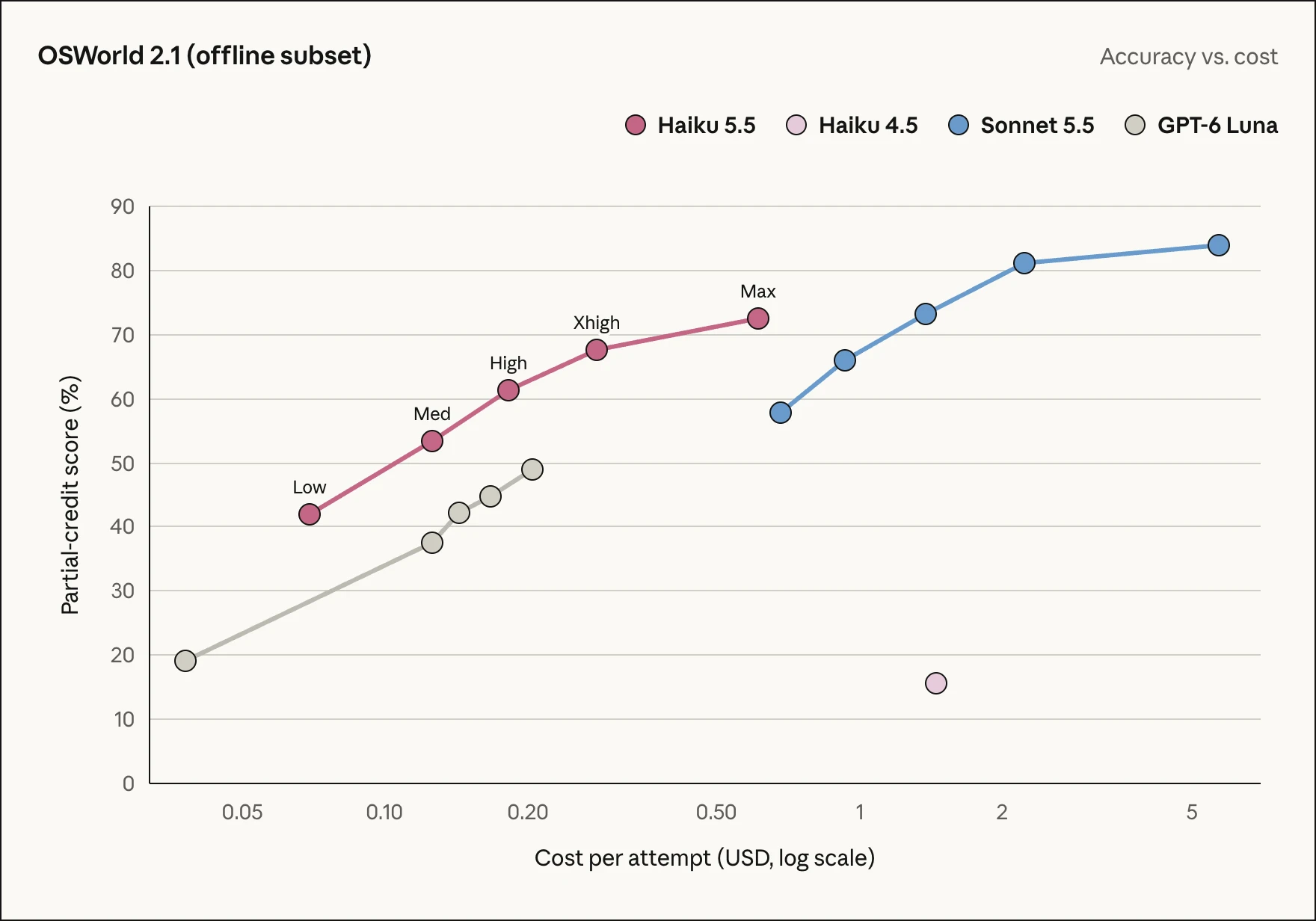
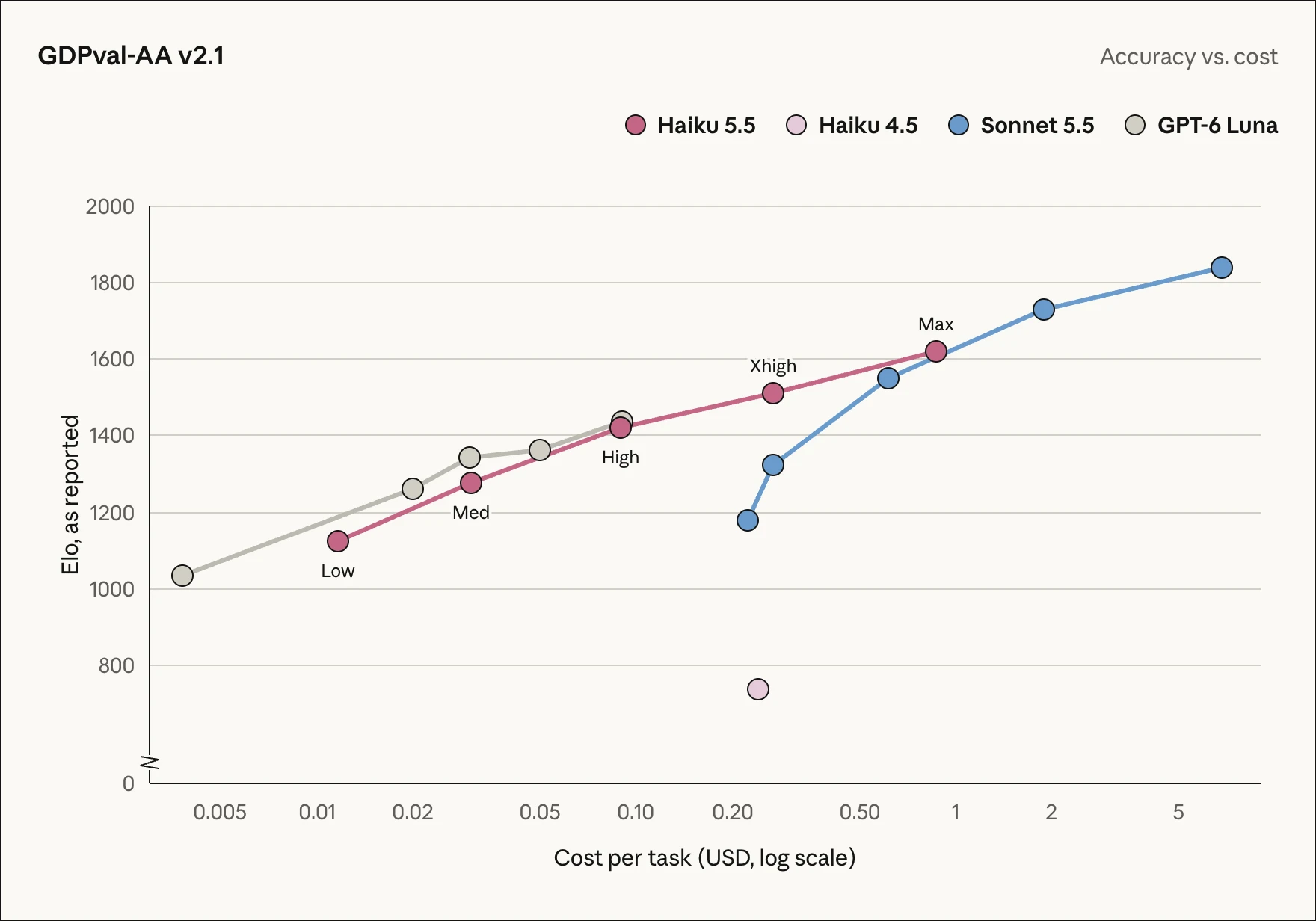
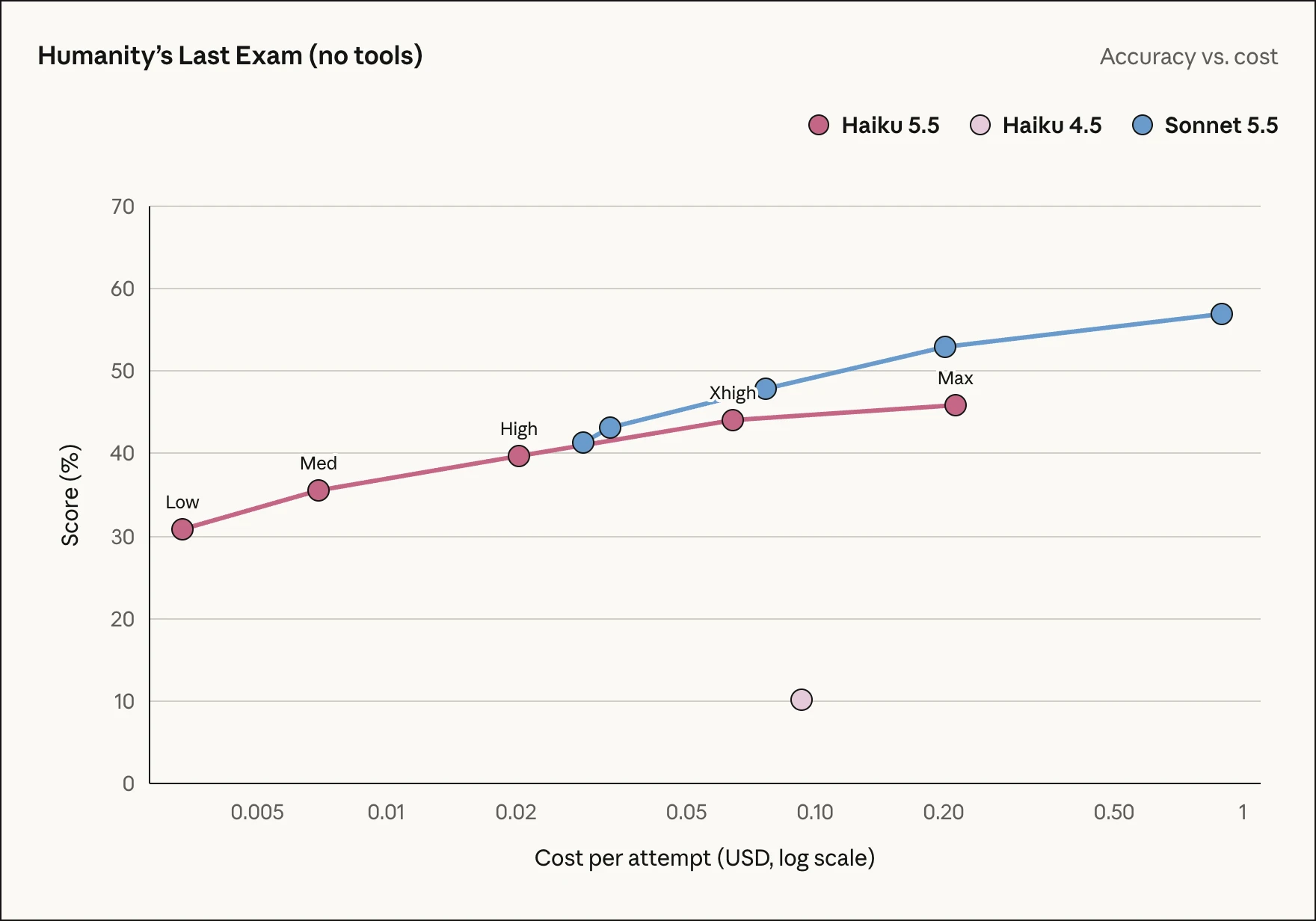
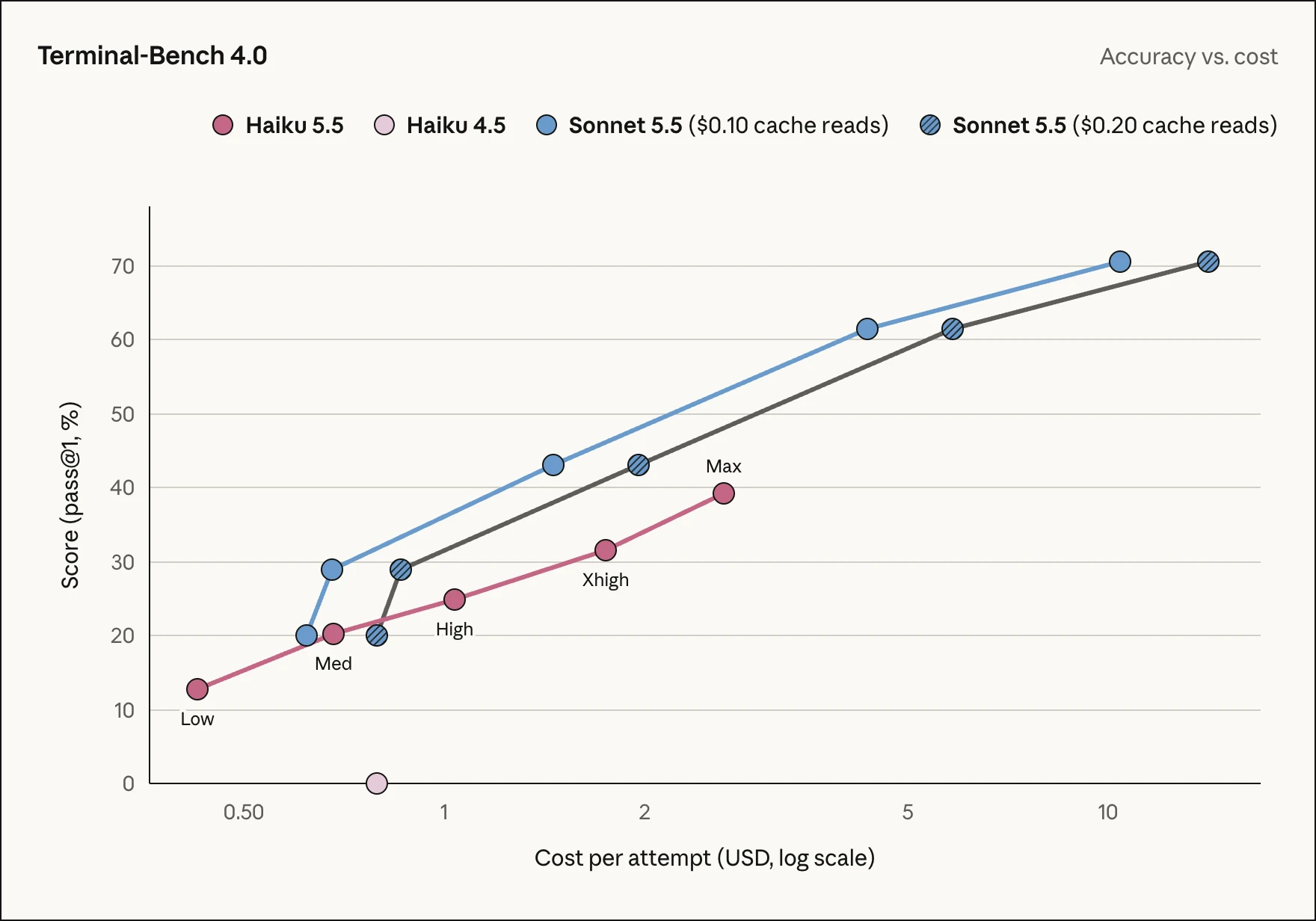
Anthropic’s page also plots Haiku 5.5 at each effort setting (Low, Med, High, Xhigh, Max) against cost on a logarithmic x-axis. Below are unaltered captures of its chart panels; the originals are interactive on the announcement page. We read approximate values off the charts, so treat our numbers as “about”, and each chart shows a snapshot of Anthropic’s own runs, not an independent test.
What to take from them, in our reading:
- Effort is a real cost dial on this model. Across the three panels the plotted cost of Haiku 5.5 spans roughly a factor of ten or more from Low to Max, with scores rising along the way and flattening toward Max.
- The cheap end is where Haiku 5.5 looks strongest. On OSWorld its curve sits well above Haiku 4.5’s single point and above the GPT-6 Luna points shown; on Humanity’s Last Exam it is close to Sonnet 5.5 at low spend.
- At high effort the larger model keeps its lead. On HLE and OSWorld, Sonnet 5.5 reaches scores Haiku 5.5 does not at any effort level.
What do customers say?
The announcement quotes six companies. These are customer statements published by Anthropic, not independent tests:
- Asana: over 30% lower latency on task completion and up to 2.5x faster inference per agent turn than its current model.
- HubSpot: 92.8% on its CRM simulation suite averaged over three runs, the best it has seen from a smaller model, with the fastest time and lowest false-positive rate on one audit task.
- AlphaSense: 0.84 against 0.76 for Haiku 4.5 on 400 queries for a feature that makes about 8 million production calls a week.
- Box: 11 points higher than Haiku 4.5 at about half the latency.
- Rogo: accurate enough to trust as a subagent pulling figures from a 10-K.
- Cognition: Devin Fusion with Haiku 5.5 as sidekick and Opus 5.5 as lead holds a FrontierCode score of 66.2 while cutting cost and latency.
What changed for Sonnet 5.5 and subscribers?
- Sonnet 5.5 cache reads are half price, $0.10 per million tokens instead of $0.20, from today. Anthropic says cache reads are a large share of consumption, so most agentic tasks get about 20% cheaper.
- New monthly API credit rolling out this week to Max and Team subscribers for the Claude Platform: $100 for Max 5x, $200 for Max 20x and up to $500, pooled, for Team. It works on any model. This is separate from the bonus credit covered in our cloud sessions guide, whose terms differ.
- SDKs: the Python and TypeScript SDKs add beta support for computer use and browser use, which Anthropic says Haiku 5.5 is well suited to.
Safety and availability
Anthropic says Haiku 5.5 shows major improvements on nearly all its alignment evaluations over Haiku 4.5, with fewer misaligned behaviors and less willingness to cooperate with misuse. Its cybersecurity safeguards are more restrictive than Haiku 4.5’s, somewhat less restrictive than those on other recent models, and allow a wider range of defensive tasks than Sonnet 5.5’s while still blocking penetration testing. Biology safeguards match Sonnet 5, Sonnet 5.5 and Opus 5. Organizations needing broader work can apply to the Cyber Verification Program or Life Sciences Verification Program.
It is available on all platforms, including Amazon Web Services, Google Cloud and Microsoft Azure.
What to keep in mind
These are our observations:
- Test on your own traffic. The saving depends on your prompt sizes and on the tokenizer’s extra tokens, and the benchmark gains are Anthropic’s.
- Use it where Anthropic says it fits. Summaries, classification, compaction and subagents are the claimed sweet spot; the company’s own table shows a wide gap to Sonnet 5.5 on terminal-style coding.
- The cache change helps larger models too. If your costs are mostly cache reads on Sonnet 5.5, the price cut matters as much as the new model.
Editorial review: October 7, 2026 (AI). Prepared from Anthropic’s announcement page (read in full the same day). We did not read the system card or migration guide and have not benchmarked the model. All figures and customer statements are Anthropic’s or its customers’. The cover is Anthropic’s launch card, credited. “What to keep in mind” is ours.
Sources
Created with AI assistance.
Suggest a correction
Found an error or a missing source? Send a private suggestion to the editor. It will be reviewed and will not appear as a public comment. No name, email or account is needed.


Send us a message