Claude Opus 5.5 launches: lower API prices, stronger coding results
Anthropic’s new flagship is live. API pricing, all nine launch benchmarks, official cover art and the integration changes developers should check.
Anthropic released Claude Opus 5.5 on 22 September, opening its new 5.5 family. The launch combines improved coding results with cheaper tokens. Sonnet 5.5 and Haiku 5.5 are planned for the coming weeks; they are not part of today’s release.
What does it cost?
The standard API rates below are in US dollars per million tokens. Cache reads have their own tariff; they should not be counted as uncached input.
| Token category | Opus 5.5 | Opus 5 | Reduction |
|---|---|---|---|
| Uncached input | $4 | $5 | 20% |
| Output | $20 | $25 | 20% |
| Cache read | $0.20 | $0.50 | 60% |
Anthropic’s separate 40% lower workload-cost claim combines pricing and token usage. It is not a blanket 40% token discount or a guaranteed saving for every application. The announcement also lists a faster mode at $8 input / $40 output, with up to 2.5× speed.
For a simple uncached request budget of 100,000 input and 20,000 output tokens, the standard tariff gives $0.80, versus $1.00 on Opus 5. This is arithmetic at equal token usage, excluding tools and other services—not a measured agent workload.
All nine launch benchmarks
These figures come from Anthropic’s comparison table. The charts are our own renderings of that numerical data, not independent measurements. Select any chart to enlarge it.
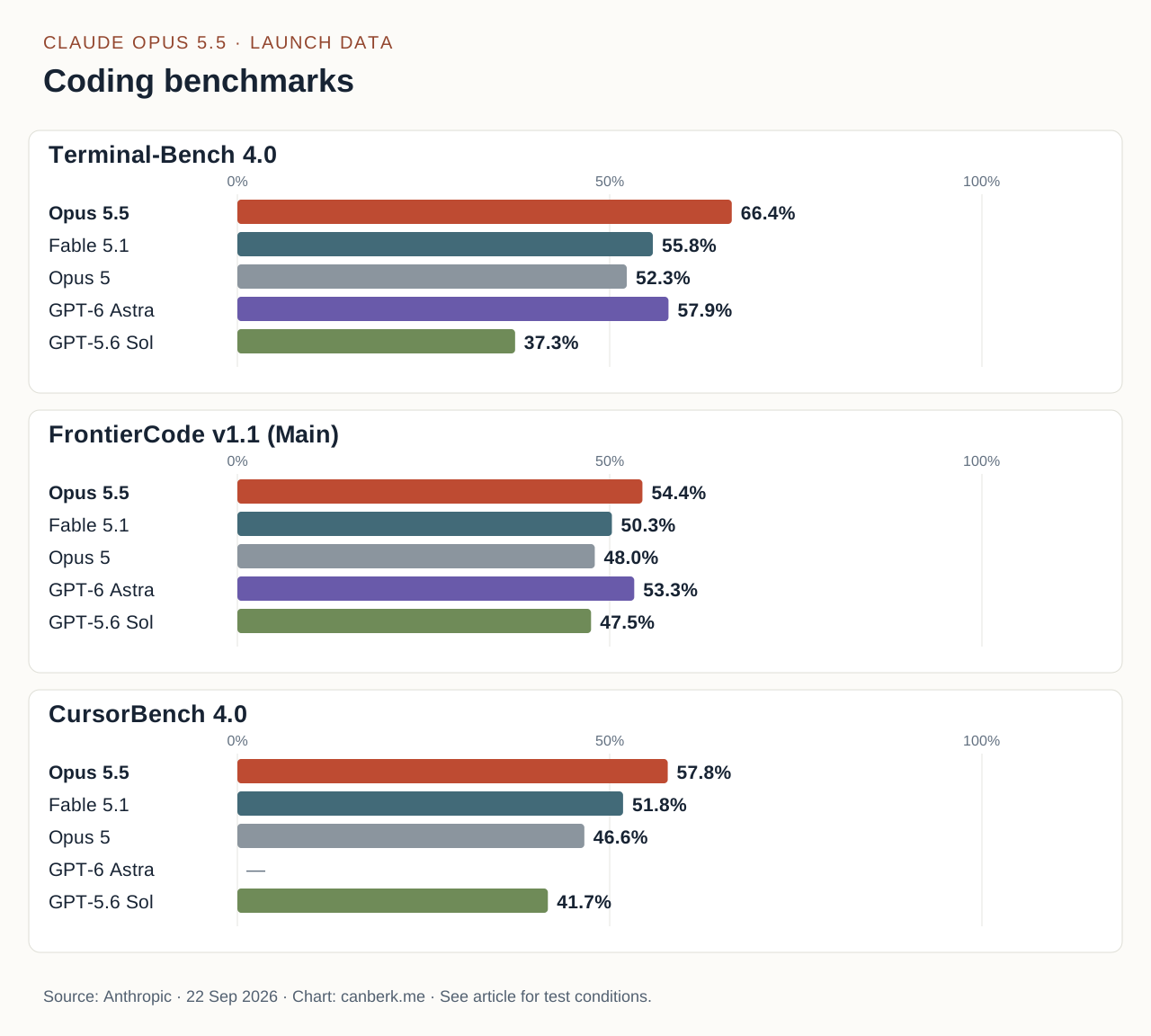
| Evaluation | Opus 5.5 | Fable 5.1 | Opus 5 | GPT-6 Astra | GPT-5.6 Sol |
|---|---|---|---|---|---|
| Terminal-Bench 4.0 | 66.4% | 55.8% | 52.3% | 57.9% | 37.3% |
| FrontierCode v1.1 (Main) | 54.4% | 50.3% | 48.0% | 53.3% | 47.5% |
| CursorBench 4.0 | 57.8% | 51.8% | 46.6% | — | 41.7% |
| GDPval-AA v2.1 (Elo) | 1846 | 1735 | 1708 | 1542 | 1588 |
| AutomationBench | 40.0% | 31.4% | 26.9% | 41.4% | 28.8% |
| Humanity’s Last Exam (with tools) | 67.7% | 65.6% | 63.6% | 57.2% | — |
| Terminal-Bench-Science 0.1 | 58.7% | 52.6% | 29.0% | 64.6% | 22.4% |
| OSWorld 2.0 (partial) | 81.8% | 80.7% | 74.0% | — | — |
| Chartography (with tools) | 89.0% | 88.4% | 83.4% | — | — |
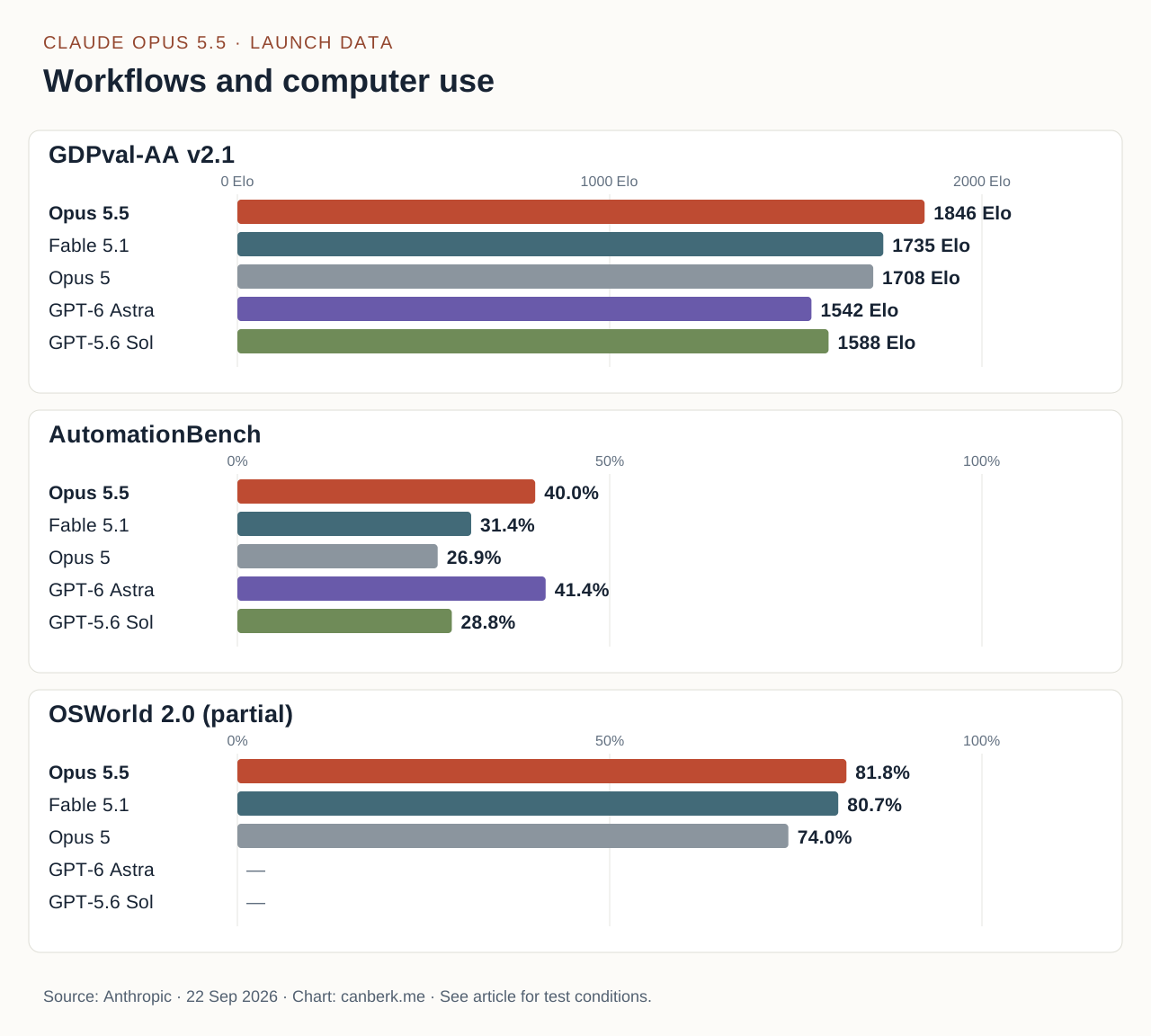
The table does not show an across-the-board winner: GPT-6 Astra leads AutomationBench and Terminal-Bench-Science. Those exceptions matter when selecting a model for a particular job.
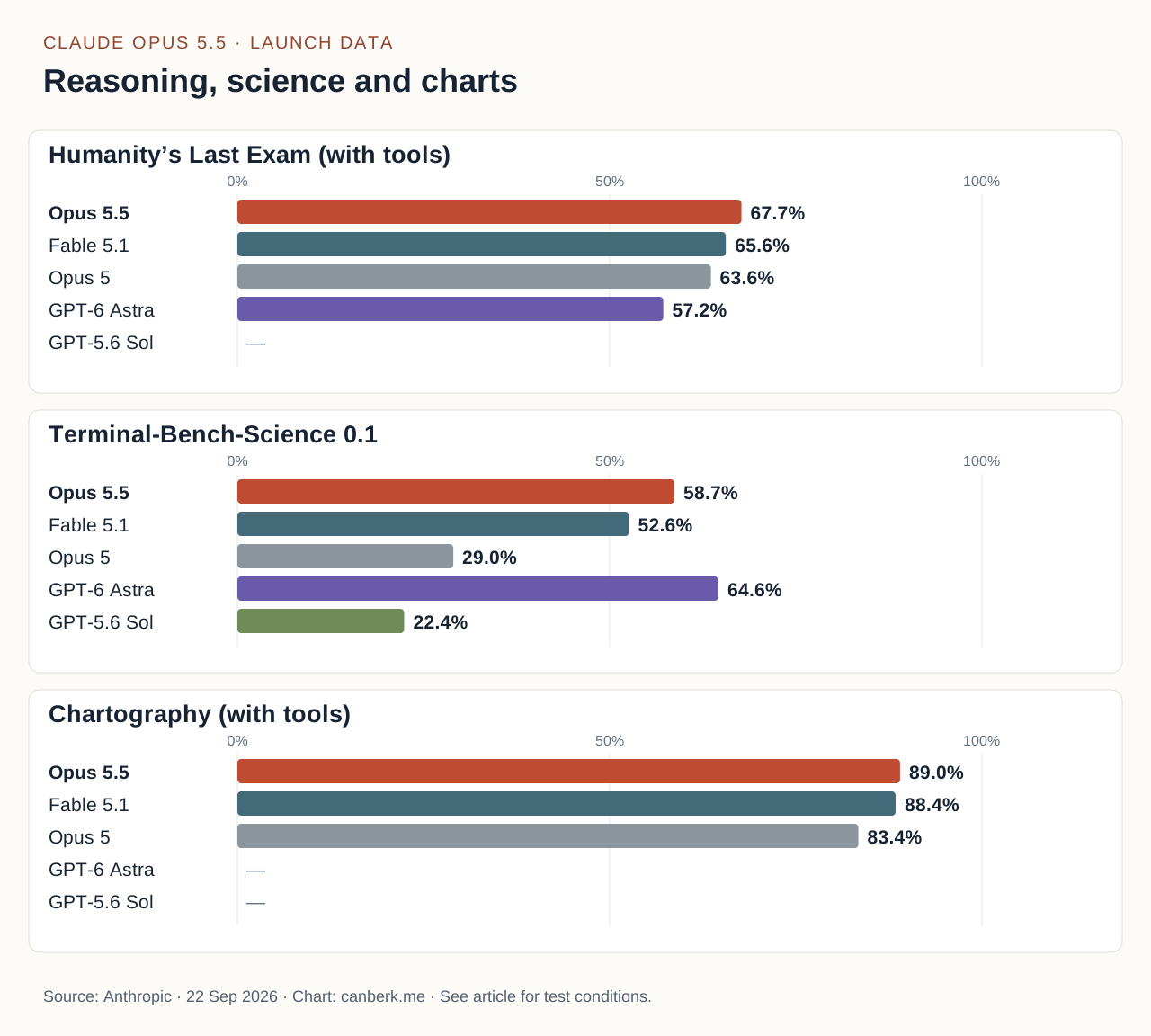
Conditions matter: most listed Opus 5.5 results use max effort; Terminal-Bench uses xhigh. Production safeguards can route certain tasks to older models. Zapier’s AutomationBench runs instead count safeguard interventions as failures. These are not uniform, default-setting head-to-head tests. The source provides further methodology and uncertainty notes.
Before changing your model ID
The model documentation lists claude-opus-5-5, a 1M-token context, 128K maximum output, text/image input and text output. Adaptive thinking is always enabled, with medium as the default effort.
Compatibility checks include forced tool selection, which returns an error, and the older computer_20251124 tool, which is unsupported on the Claude API and Google Cloud. Thinking blocks are bound to their model and conversation. An integration that changes context or reuses previous reasoning needs particular attention.
For an infrastructure team, our first comparison would be a small set of repository changes and incident-analysis tasks with clear acceptance checks. Record successful results, retries, latency and total spend together. A higher benchmark score is useful evidence; whether the model reduces rework in your own tooling is the purchasing decision.
Source-checked on 22 September 2026. canberk.me has not independently benchmarked this model. Cover artwork belongs to Anthropic; the three data visualizations were created for this article.
Sources
Created with AI assistance.
Suggest a correction
Found an error or a missing source? Send a private suggestion to the editor. It will be reviewed and will not appear as a public comment. No name, email or account is needed.


Send us a message