Grok 4.7 is here: API pricing, coding benchmarks and the Fast variant
xAI's September 21 release brings Grok 4.7 to coding tools and the API. Official charts, 500K context, Fast access, pricing tiers and source discrepancies.

In this article
Grok 4.7 launched on 21 September 2026, according to xAI’s API release notes. The release targets coding agents and knowledge work. The developer documentation confirms a 500,000-token context window and the public API identifier grok-4.7.
The useful questions go beyond the version number: how much reasoning effort improves a coding result, when the long-context tariff applies, and where the faster serving option is actually available. We checked the announcement against the developer documentation, model card and Cursor’s own evaluation table.
What changed from Grok 4.6?
The announcement describes a larger base model and a longer reinforcement-learning run, emphasizing difficult tasks that can take hours. xAI also reports improvements in checking completed work and maintaining useful context during extended tasks. These are the developer’s claims, not results from a canberk.me hands-on benchmark.
For an engineering team, that direction is relevant to repository migrations, debugging and investigations that involve several attempts. Our interpretation is that persistence only helps when the agent can verify progress: a longer run that repeatedly edits the wrong file is still a failure. Tests, accepted patches and recovery from failed commands remain useful measures.
Where it is available, and what the API supports
The developer overview lists the xAI API, Grok Build, Cursor and gateways including OpenRouter, Vercel and Cloudflare. Grok 4.7 Fast is the same model on faster infrastructure, available only in Cursor and Grok Build; it is excluded from Grok Build’s free tier and from the public xAI API.
The model card schedules consumer web, mobile and Grok-in-X availability for later. This launch should therefore not be read as confirmation that every consumer account already has the model.
| Specification | Published value |
|---|---|
| API identifier | grok-4.7 |
| Context window | 500,000 tokens |
| Input / output | Text and images / text |
| Tools and formatting | Function calling and structured outputs |
| Reasoning effort | low, medium, high, xhigh; default high |
| API interfaces | Responses and Chat Completions |
| Batch API | Listed as unsupported on the model page |
Sources: model specifications and developer overview. The overview lists no separate text-output cap; that does not remove the context window, request budgets or practical execution limits. Image input also does not mean native image or video generation.
Pricing: the context threshold matters
Published token rates below are USD per million tokens. The pricing page distinguishes these tiers:
| Serving option | Prompt size | Input | Cached input | Output |
|---|---|---|---|---|
| Standard API | Below 200K | $2.00 | $0.50 | $6.00 |
| Standard API | 200K or more | $4.00 | $1.00 | $12.00 |
| Fast | Below 200K | $4.00 | $1.00 | $12.00 |
| Fast | Above 200K | $6.00 | $1.50 | $18.00 |
The Standard threshold changes the rate for all tokens in the request. Fast’s section uses “above 200K”; its listed long-context rates should not be replaced with a blanket 2× calculation. Cursor bills Fast through its own plan. Reasoning and tool use also affect the final bill.
Our simple arithmetic example: 100,000 uncached input tokens and 20,000 billed output tokens cost $0.32 at the short-context Standard rates, before tool fees. This is a token-budget example, not a prediction of how many tokens a real task needs. A second attempt, a longer conversation or a different effort setting changes the total.
Coding benchmarks: compare the same effort level
The official launch chart below is a direct capture of the published figure, not a redrawn graph. Its horizontal cost axis runs from more expensive on the left to cheaper on the right.
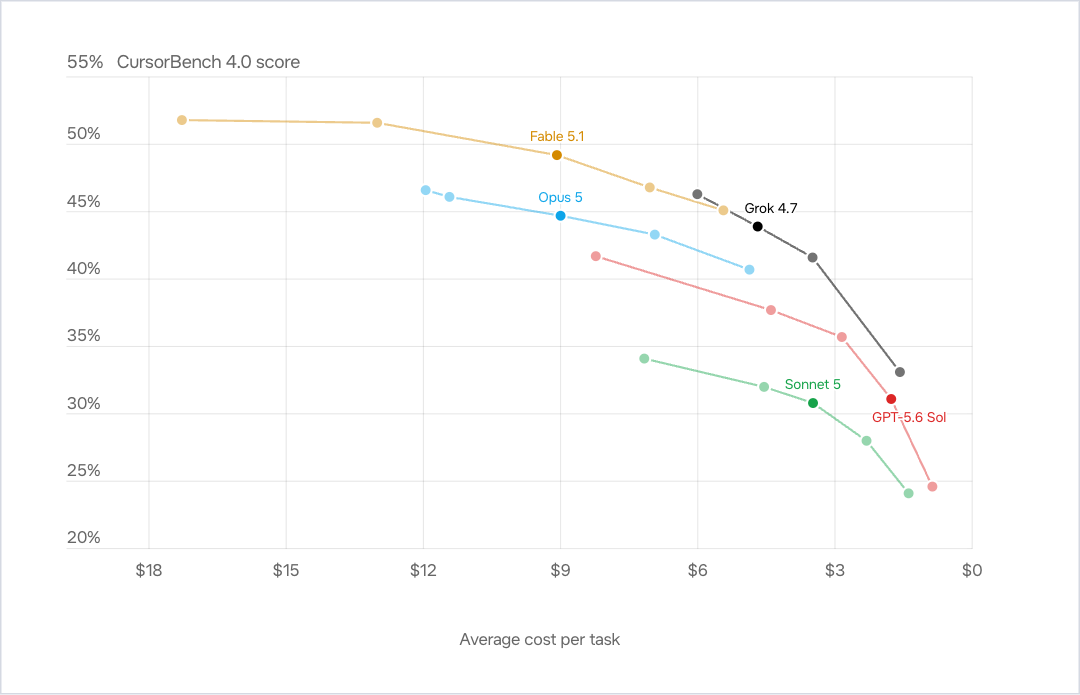
Cursor’s own results, checked on 23 September, give a useful comparison:
| Model / effort | CursorBench 4.0 | Average cost/task |
|---|---|---|
| Grok 4.6 / high | 40.4% | $5.20 |
| Grok 4.7 / high | 43.9% | $4.69 |
| Grok 4.6 / xhigh | 41.4% | $6.10 |
| Grok 4.7 / xhigh | 46.3% | $6.01 |
| Opus 5.5 / high | 56.0% | $3.97 |
Our calculation gives Grok a 3.5 percentage-point improvement at high and 4.9 points at xhigh. Comparing 4.7/xhigh with 4.6/high mixes effort settings. The live table also contains newer competitors absent from the launch chart, including Opus 5.5. These results do not establish an overall lead.
Cursor evaluates agents on multi-file tasks from real sessions and cautions that small score differences may not be statistically meaningful. Its costs are calculated from token usage and published prices. They are not subscription prices or a quote for your repository.
Office work and discrepancies worth keeping visible
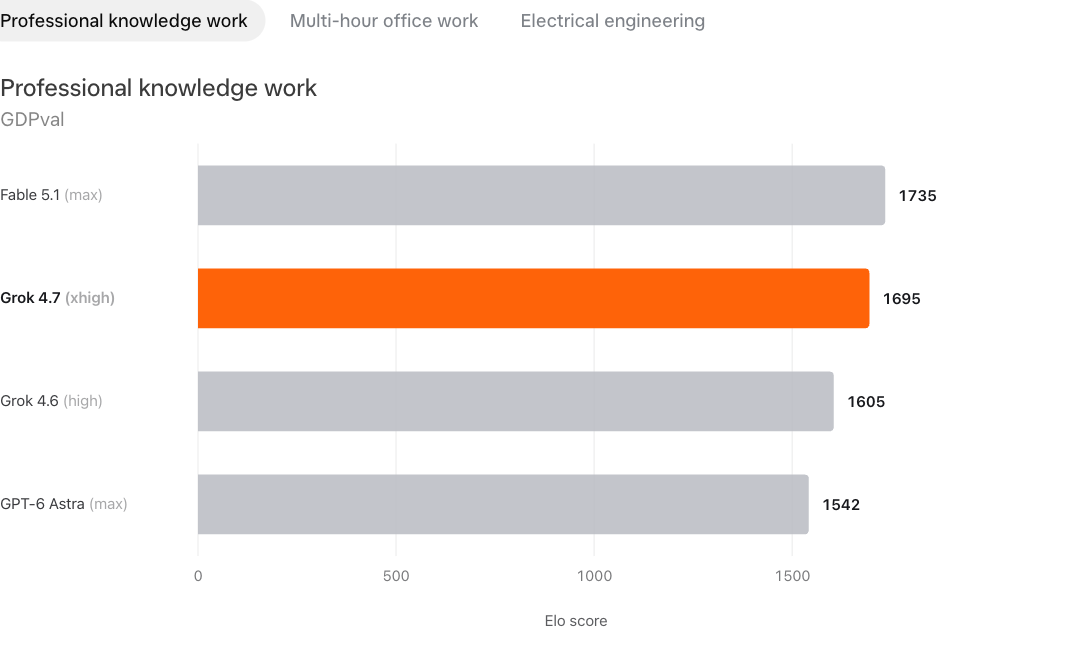
The launch table reports 71.0% on DeepSWE v1.1 at high effort. It also gives Grok 4.7 37.6% on Terminal-Bench 4.0 and 64.0% on EEBench. The model card instead reports 38.0% and 66.0%, respectively, at xhigh. The checked sources do not explain both discrepancies, so we have not silently chosen a single value.
There is a similar documentation mismatch around freshness: the developer overview says May 2026 for the knowledge cutoff; the model card describes June 2026 pretraining data and supplemental data through August 2026. These descriptions should not be collapsed into an unqualified cutoff date.
The model card also documents safeguards and safety evaluations. Our operational takeaway is to retain review and tool permissions when adopting a more capable agent. A benchmark measures a particular setup; it does not authorize a model to make production changes independently.
Integration details that can change the outcome
The reasoning guide says reasoning cannot be disabled. On Responses, Grok 4.7 returns encrypted reasoning items automatically; when managing conversation history yourself, pass those items back unchanged. That is conversation state, not readable chain-of-thought.
For repeated repository context, the caching guide recommends a stable prompt_cache_key on Responses, or x-grok-conv-id on Chat Completions, to keep requests routed for reuse. Measure actual cached tokens rather than assuming every repeated prompt receives the discount.
The separate compaction API can reduce accumulated history during longer agent loops. It needs to run while the conversation still fits the context window; it cannot rescue an already oversized request. Preserve the returned opaque item unchanged when continuing.
For teams with location requirements, the US regional endpoint adds 10% to token rates. Its scope excludes Files, Collections and server-side tools, so choosing a regional base URL is not a guarantee covering every attached service. Separately, the API security documentation describes default 30-day retention and says API inputs/outputs are not used for training without permission. Data retention and training use are different decisions.
Our first evaluation would pair Grok 4.6 and 4.7 on the same small set of repository fixes, with matching effort, tools and acceptance checks. Record accepted changes, time to completion, retries and total spend. Then compare the strongest candidate with the newer GPT-6 models and Opus 5.5 using that same task set. The launch evidence justifies a trial; it does not replace one.
Sources checked on 23 September 2026. The cover is an AI-generated editorial illustration. The three images inside the article are official artwork or direct captures of official charts, with attribution. No independent model benchmark was run for this report.
Sources
- Introducing Grok 4.7 ↗SpaceXAI
- API release notes — September 21 ↗SpaceXAI
- Grok 4.7 developer overview ↗SpaceXAI
- Grok 4.7 model specifications ↗SpaceXAI
- API and Grok 4.7 Fast pricing ↗SpaceXAI
- Grok 4.7 model card — revision 2026-09-21 ↗SpaceXAI
- CursorBench 4.0 results and methodology ↗Cursor
- Reasoning effort and encrypted reasoning ↗SpaceXAI
- Maximizing prompt cache hits ↗SpaceXAI
- Context compaction ↗SpaceXAI
- Regional endpoints ↗SpaceXAI
- API security and data retention ↗SpaceXAI
Created with AI assistance.
Suggest a correction
Found an error or a missing source? Send a private suggestion to the editor. It will be reviewed and will not appear as a public comment. No name, email or account is needed.


Send us a message