Claude Sonnet 5.5 launches at Sonnet 5 prices, with faster output
Anthropic’s new Sonnet model is available across platforms. Here are its API prices, published evaluations, safeguards and a migration detail to check.
In this article
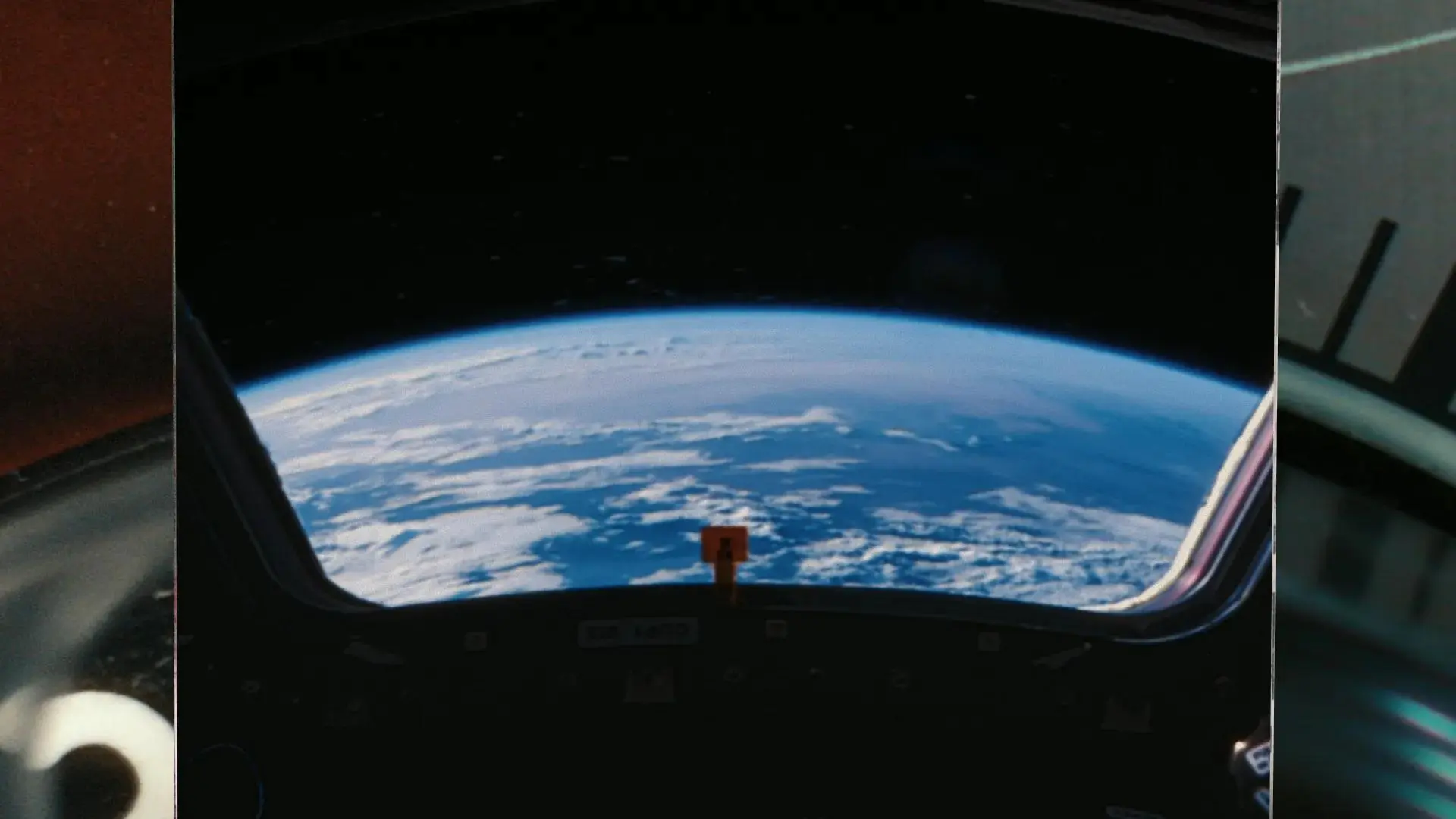
Anthropic introduced Claude Sonnet 5.5 on 28 September 2026, six days after Opus 5.5. The second member of the 5.5 family is positioned for routine agent work, bug fixes and polished documents, slides and spreadsheets. Opus 5.5 remains Anthropic’s choice for more open-ended work that needs sustained judgment. This is a separate model release from the Opus 5.5 launch.
The practical distinction is between price per token and cost per completed task. Anthropic has kept the former steady while claiming gains in speed, token efficiency and several evaluations. The figures below come from its announcement and 148-page system card; they are not measurements made by canberk.me.
Access and price
Anthropic says Sonnet 5.5 is available on its platforms and through Amazon Web Services, Google Cloud and Microsoft Azure. The Claude Platform model ID is claude-sonnet-5-5. Its standard API prices match Sonnet 5: $2 per million input tokens, $10 per million output tokens, $0.20 per million cache-read tokens and $2.50 per million cache-write tokens. Zero data retention is available, according to the announcement.
Anthropic says output is generated more than 30% faster than Sonnet 5 and that task cost falls up to 30% in its tests because the model typically needs fewer tokens. A fixed-token request would still face the same Sonnet tariff. End-to-end cost depends on workload, effort, cache hits, tool calls and retries; the release figures do not promise a 30% saving for every application.
Effort is part of that equation. Anthropic sets Medium as the default in Claude Code and its apps, while the Claude Platform defaults to High. Lower settings can be quicker and cheaper; higher ones allow longer reasoning and review. Comparing two models without matching their effort and task setup can obscure the trade-off.
What the published evaluations show
Anthropic’s launch table reports these results. Percentages are task scores; GDPval-AA and AA-Briefcase use Elo-style scores. A higher number within the same row is better, but rows test different skills and conditions.
| Evaluation | Sonnet 5.5 | Sonnet 5 | Opus 5.5 |
|---|---|---|---|
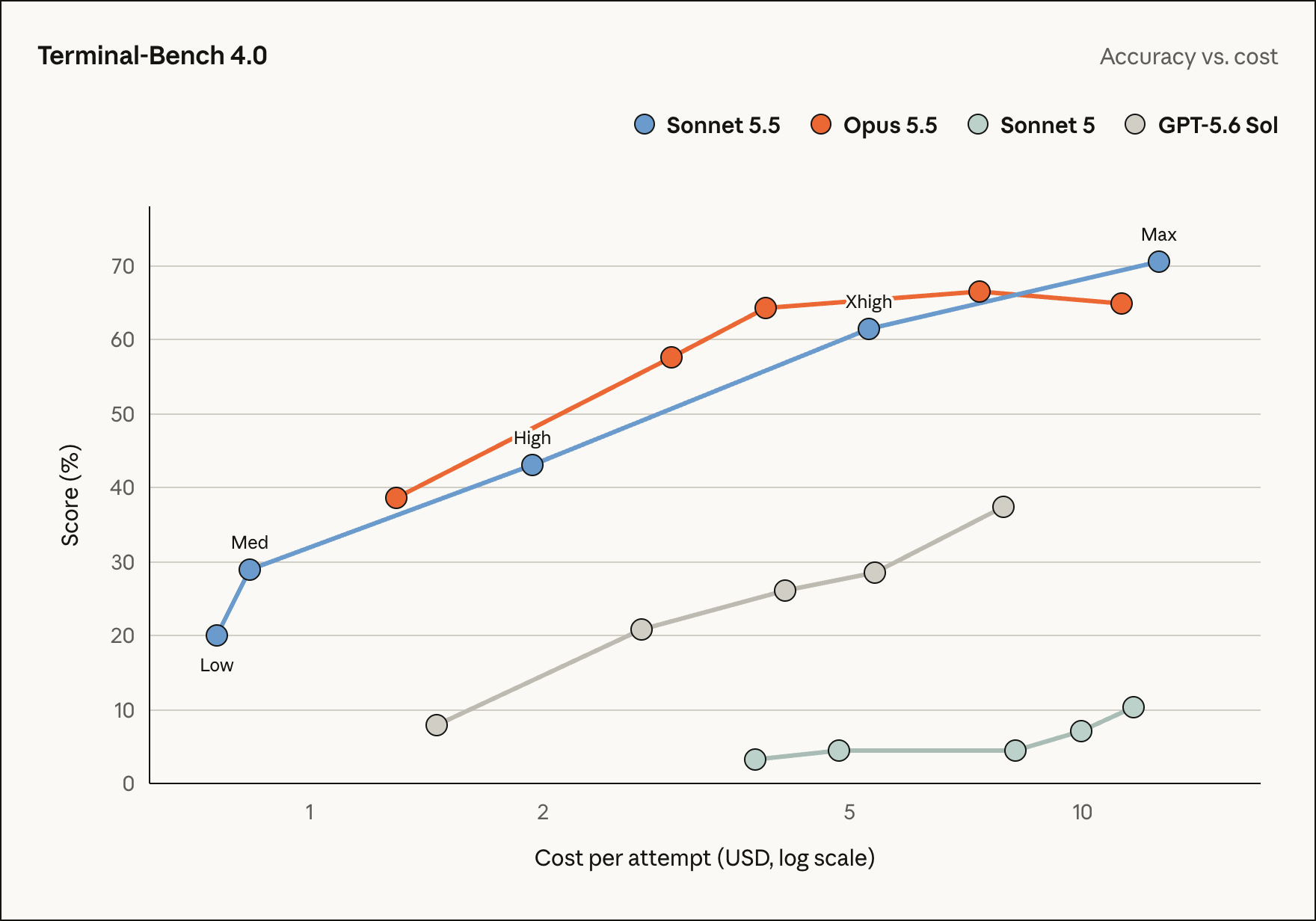
| Terminal-Bench 4.0 | 70.6% | 10.3% | 66.4% |
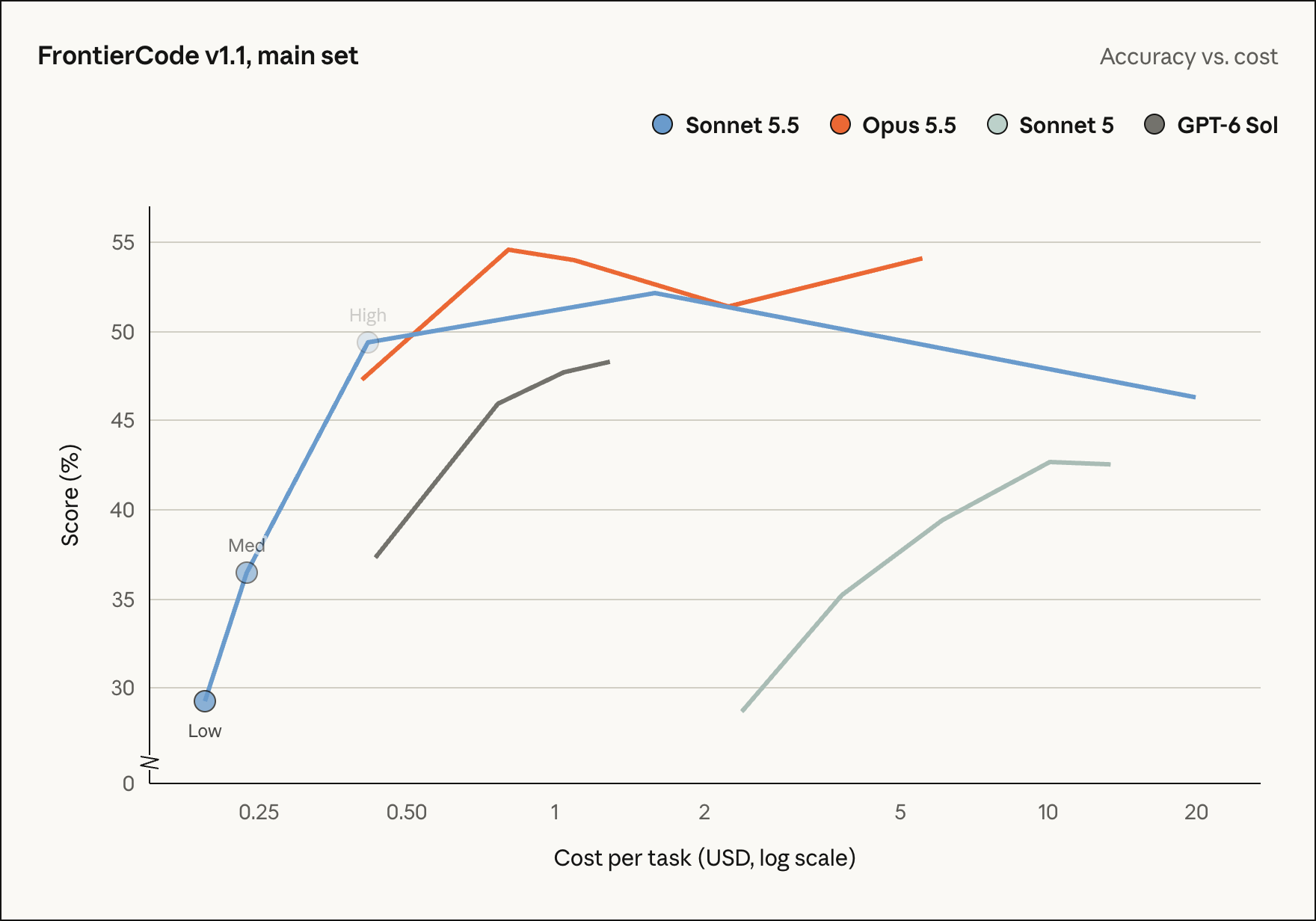
| FrontierCode 1.1 Main | 46.2% at Max; 52.1% at Xhigh | 42.4% | 54.4% |
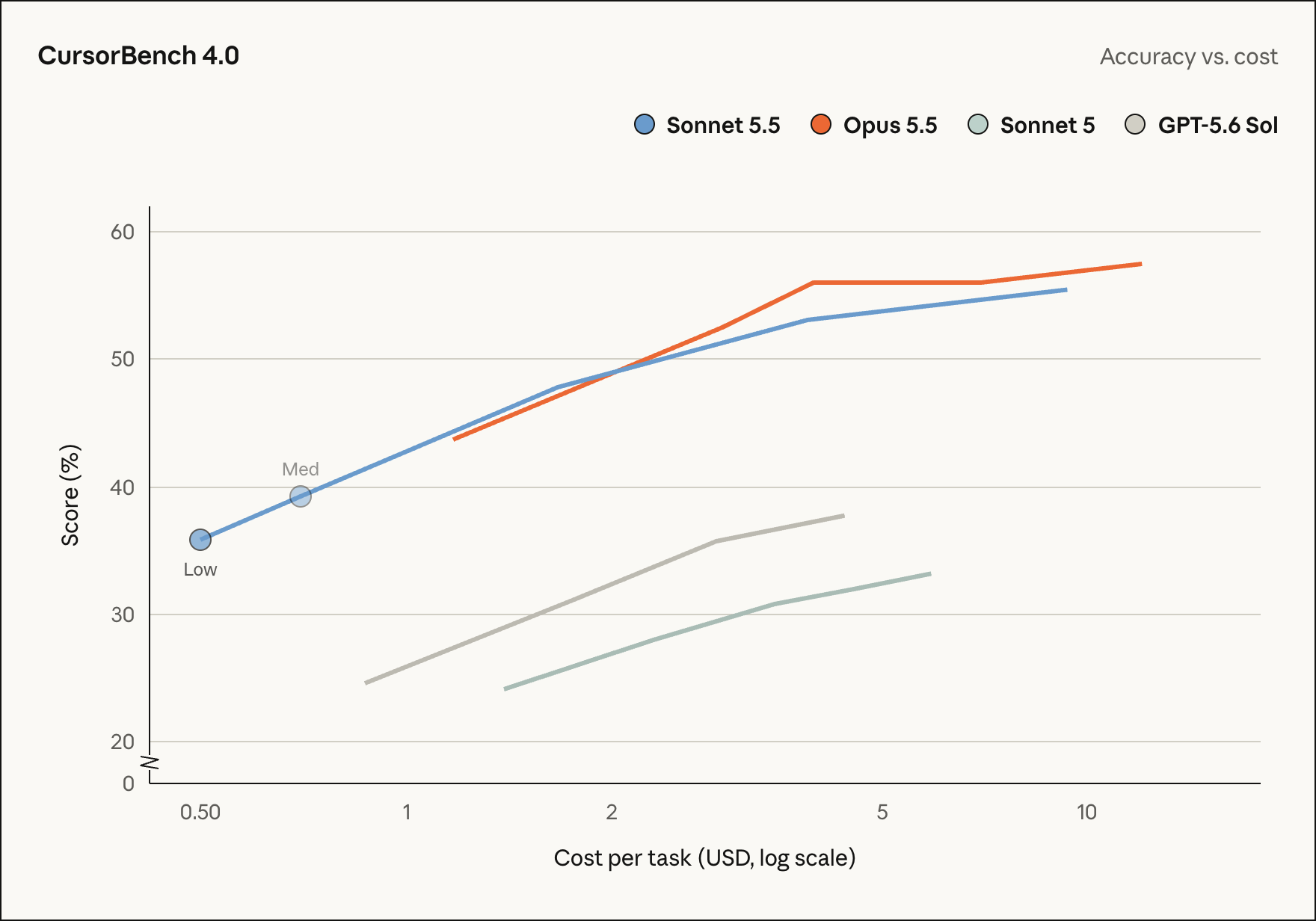
| CursorBench 4.0 | 55.5% | 34.1% | 57.8% |
| GDPval-AA v2.1, Elo | 1844 | 1449 | 1846 |
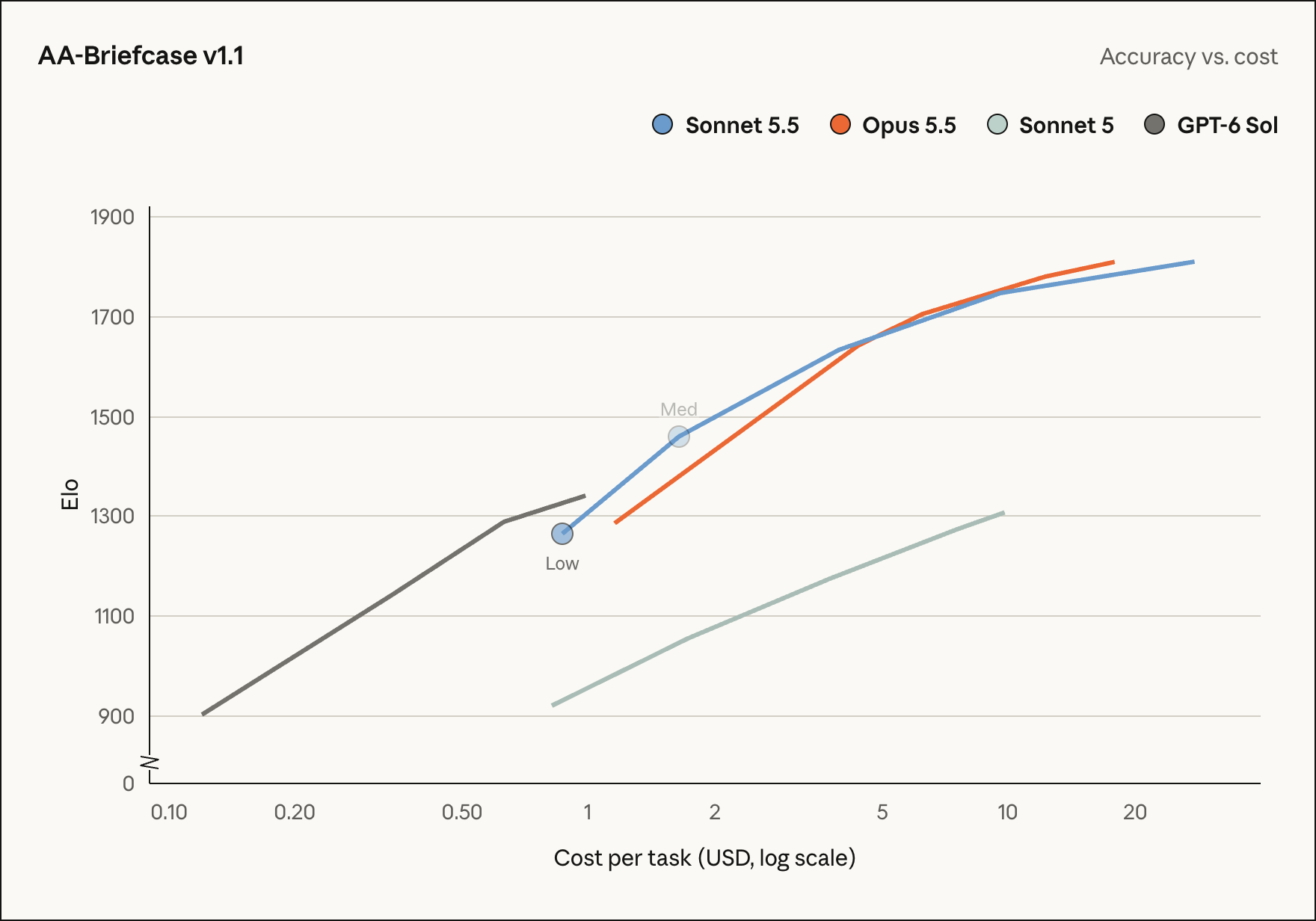
| AA-Briefcase v1.1, Elo | 1811 | 1359 | 1822 |
| Humanity’s Last Exam, with tools | 64.5% | 54.9% | 67.7% |
| OSWorld 2.1 | 80.1%, partial | 57.0%, partial | 81.8%, partial |
| Chartography, without tools | 61.6% | 15.6% | 64.4% |
The largest jump in this selection is Terminal-Bench 4.0, from 10.3% to 70.6%. The system card’s methodology describes 66 containerized terminal tasks and five trials per task for Sonnet 5.5. Its 70.6% is a Max-effort result, while the 66.4% Opus 5.5 comparison uses Xhigh. Anthropic reports standard errors of about 2.5 and 2.6 percentage points respectively; that narrow lead is not a decisive general ranking. The test allowed no internet access, used cached task resources and kept safeguards and server-side fallback active. A fallback handled 1.2% of Sonnet requests, touching 1.5% of its trials.
In coding, FrontierCode checks whether software changes could be merged without human edits. Anthropic reports 52.1% at Xhigh but 46.2% at Max for Sonnet 5.5. Its footnote attributes part of the reversal to extra code review that timed out or made out-of-scope edits in two inspected cases. CursorBench’s 55.5% at Max comes from tasks run and scored independently by Cursor in its production agent harness; Anthropic estimated Sonnet 5.5’s per-task costs from Cursor’s token counts at list prices. Those distinctions matter when reading the cost curves.
For knowledge work, the 1844 GDPval-AA result is almost level with Opus 5.5’s 1846 in this reported evaluation. Artificial Analysis ran GDPval-AA and AA-Briefcase on a pre-release Sonnet deployment that Anthropic says had a structured-output bug. The company expects any impact to be small, but the precise effect is unmeasured here. Anthropic separately says Opus 5.5 remains stronger in complex, open-ended work, so a near tie on one test is not a blanket equivalence claim.
Read the original score–cost charts
These are unaltered captures of Anthropic’s four interactive chart panels, taken from the launch page. The x-axis shows estimated dollars per attempt or task on a logarithmic scale; the y-axis shows score. Each point represents an effort level. A point farther up and left gives a higher score at a lower plotted cost under that evaluation’s assumptions. Open the source to switch the live panels and inspect its full explanations. The images below preserve a snapshot, not a live or independent benchmark.
Anthropic also publishes three animated side-by-side coding demonstrations: a 400-starling murmuration, sand dunes and a clock made of clocks. They show how its chosen runs progressed from prompt to generated result. They are useful visual examples, not a controlled latency comparison or proof that every prompt will run faster.
Safeguards and migration
The system card finds Sonnet 5.5 below Opus 5.5 overall in its Responsible Scaling Policy evaluations and says it crosses no new thresholds. It also reports stronger cyber capabilities than Sonnet 5, prompting a three-stage cyber safeguard similar to Opus 5.5. In Anthropic’s first-party products, some higher-risk cyber requests visibly fall back to Sonnet 5. The card specifies that API fallback depends on developer opt-in and behavior through other providers may differ. Routine software development is intended to continue normally.
The card says biological misuse classifiers remain comparable to the earlier deployment, while its executive summary notes some multi-turn harmlessness regressions and stronger prompt-injection resistance, especially in coding and browser environments. Anthropic’s automated alignment audit covers roughly 1,850 scenarios; the company says Sonnet 5.5 matches or improves on Sonnet 5 on most measures, while Opus 5.5 remains slightly stronger overall. These are Anthropic assessments, not a guarantee against failure. The launch also adds safeguards against reasoning extraction and extends preserved thinking, which can affect workflows moving conversations between accounts.
For developers running Sonnet with thinking disabled, the migration guide calls for the new between_tools setting before moving to Sonnet 5.5. Test this alongside any preserved-thinking or fallback behavior that your application relies on.
The most useful local comparison is a set of representative jobs with the same success criteria: completed tasks, human corrections, total tokens, cache use, tool calls, latency and dollars per accepted result. Run at the effort levels you actually plan to use. That will show whether the published speed and task-cost gains survive your prompts and tools.
Sources checked on 28 September 2026. canberk.me has not independently benchmarked Sonnet 5.5. The launch cover and chart captures are Anthropic material shown for editorial reporting; the original interactive charts and the other animated demonstrations remain on Anthropic’s site; the embedded example loads Anthropic-hosted animations on demand.
Sources
Created with AI assistance.
Suggest a correction
Found an error or a missing source? Send a private suggestion to the editor. It will be reviewed and will not appear as a public comment. No name, email or account is needed.


Send us a message