Anthropic says Claude beat published quantum circuit designs
Anthropic says Claude's closed-loop designs beat published quantum circuits: 17x fewer gates for point addition, 12x for a DQI decoder. Claims, limits.
In this article
- What did Anthropic report about Claude and quantum circuits?
- How did Claude find the elliptic-curve point addition design?
- What did Claude do for the DQI decoder?
- What does this have to do with ECDSA and cryptography?
- Which results were Claude’s and which were earlier work?
- How were the results checked?
- What are the limits of the claim?
- What is still unknown about Claude’s quantum circuits?
- What to keep in mind
Anthropic says an AI model can now design quantum circuits better than the published record. On October 16 its Science team reported that Claude Mythos 5, working in a closed loop with an automated checker, found circuits that beat the best published designs on all eight tasks it was given. We read the post in full. This article sets out the results, how they were checked, why elliptic-curve point addition matters and where the claims stop.
What did Anthropic report about Claude and quantum circuits?
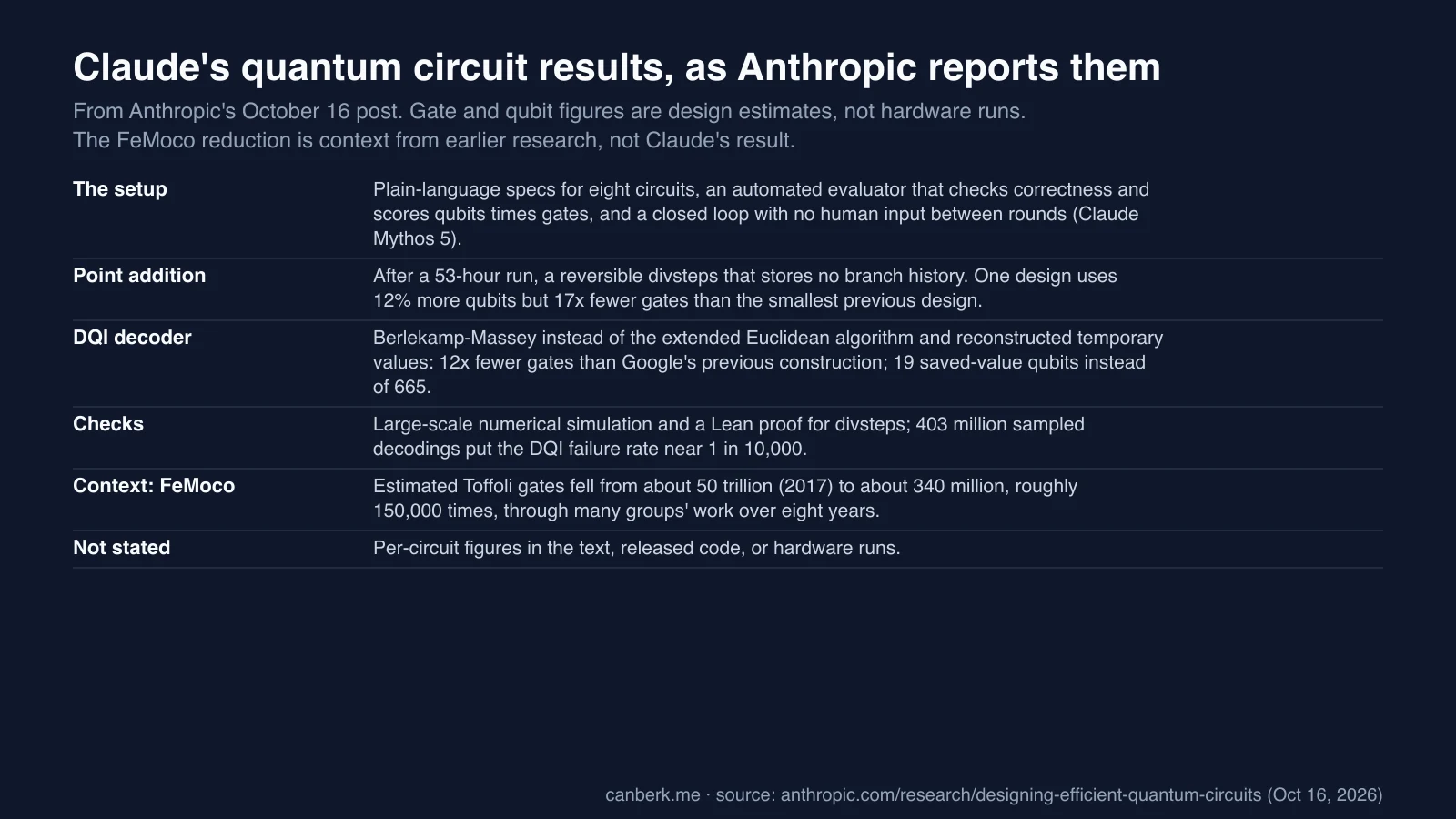
That Claude found improved designs across all eight tasks; for point addition the improvement is a better trade-off between qubits and gates, not fewer of both. Anthropic gave Claude plain-language specifications for eight computational primitives across chemistry, optimization, quantum simulation, number theory and numerical computing, plus an evaluator that checks each design for correctness and scores it by qubits multiplied by gates, a proxy for runtime. Working “largely on its own,” Claude found designs with fewer qubits and fewer gates than the best previously published, “in some cases by an order of magnitude or more.” The work was led by Andi Gu in Anthropic’s STEM Fellows Program, with mentorship from Alek Kemeny and in collaboration with Susanne Yelin and Mikhail Lukin of Harvard. The full paper is arXiv:2610.22367.
How did Claude find the elliptic-curve point addition design?
By getting around a memory problem that had blocked a classical method. Anthropic’s first task was point addition, the core step of quantum algorithms for the discrete logarithm problem on elliptic curves, where a large enough quantum computer could solve what ordinary computers cannot. Most of its cost is modular inversion, and a classical method called divsteps had not produced a practical quantum circuit because it must record which operation it chose at each iteration, and a quantum circuit cannot discard that record. After 53 hours with minimal human input, Claude reasoned that the record might not need storing: it could be decoded from the pair of numbers after each iteration. Its first simple rules failed at the full 256-bit size, so it proved a series of results, including new algebraic identities, derived a precise decoding rule, checked it with large-scale numerical simulation and formalized it in Lean. The result is, in the post’s words, the first reversible implementation of divsteps with no stored branch history. By varying when the circuit stores rather than decodes, it produced a family of designs; one uses 12% more qubits but 17 times fewer gates than the smallest previous design.
What did Claude do for the DQI decoder?
It made the costliest step of a leading quantum optimization algorithm about 12 times cheaper in gates. Decoded quantum interferometry (DQI) is one of the strongest candidates for a superpolynomial quantum speedup, and most of its cost is a Reed-Solomon decoder. Claude replaced the extended Euclidean algorithm the previous design used with Berlekamp-Massey decoding, which does the same step in every round and suits a quantum circuit’s fixed gate sequence. It then reconstructed most temporary values from the circuit’s current state rather than storing them, and ran 403 million simulated decodings to measure how often exceptions occurred. Instead of reserving 665 qubits for the worst case, the circuit sets aside 19 qubits for one saved value and fails about once in 10,000 runs, which Anthropic says is within the task’s error budget. Together this cut the decoder’s gates by a factor of 12 against Google’s previous construction.
What does this have to do with ECDSA and cryptography?
The same elliptic-curve step that quantum attacks rely on. The post presents point addition as the core of the quantum discrete-log algorithms for elliptic curves, noting that large curves resist ordinary computers but not a sufficiently large quantum computer, and calls point addition a standard benchmark. Our reading, not Anthropic’s, is that this connects to the ECDSA seed story we covered from the same lab: a cheaper point addition circuit is one input into how large a quantum computer would need to be to attack elliptic-curve cryptography. The post does not make that claim, and it does not estimate when such an attack could happen.
Which results were Claude’s and which were earlier work?
Only the circuit designs are Claude’s. The post opens with FeMoco, the iron-sulfur cluster at the heart of nitrogenase, where estimates for computing its ground-state energy fell from about 50 trillion Toffoli gates in 2017 to about 340 million, roughly a 150,000-fold drop, which it says corresponds to a few hours on a machine with about three million physical qubits. Those reductions came, in the post’s words, from “a series of algorithmic advances” by research groups over eight years. Claude’s contribution is a different set of circuits, and the FeMoco figure is context for why circuit design matters.
How were the results checked?
By machine, in layers. An evaluator program checked each proposed circuit’s correctness, which is feasible because these algorithms give one definite output per input that an ordinary computer can verify, and scored it by qubits times gates. For the divsteps design, Claude’s reasoning was checked by large-scale numerical simulation and formalized in Lean, and for the DQI decoder by 403 million sample decodings. Anthropic points to Table 1 and Figure 2 for per-circuit comparisons with the best published designs, drawn from Schrottenloher (2026) and Luo et al. (2026) for point addition. We could not read those values from the page text. The post does not link released code.
What are the limits of the claim?
It is a design result, not a machine. Anthropic says circuit design is only one part of building a useful quantum computer, since qubits are fragile and the machine also needs error-correcting codes, fast decoders and hardware control. The gate and qubit counts are design figures, not runs on quantum hardware. Anthropic also reports that Claude was conservative: it second-guessed results that were already well supported and tended to favor known methods, so the team required parallel, qualitatively different approaches and sometimes prompted it to search more broadly. Its statement that “practical quantum computers could arrive sooner than previously anticipated” is the authors’ projection, and they raise the idea of AI optimizing the whole error-corrected stack jointly as a possibility, not a result.
What is still unknown about Claude’s quantum circuits?
- Per-circuit numbers. The post’s text does not give them for all eight tasks.
- Independent verification. We saw none beyond Anthropic’s own checks and the paper.
- Released code. The page links the paper but not code.
- Hardware performance. None; these are estimates.
- How much the 53-hour run cost or how many runs preceded it.
What to keep in mind
These are our observations:
- Credit the right result. The 150,000-fold FeMoco drop is earlier research; Claude’s results are the new circuits.
- Machine-checkable tasks suit AI. Anthropic says the approach fits because every output can be verified by an ordinary computer.
- Estimates, not hardware. Wait for independent reproductions and hardware numbers.
- The timeline claim is a forecast. Read it as the authors’ projection.
Editorial review: October 18, 2026 (AI). Prepared from Anthropic’s post (read in full as text; its figures and tables were not extractable as data). We did not read the arXiv paper, did not run any circuits and did not use secondary reporting.
Sources
Created with AI assistance.
Suggest a correction
Found an error or a missing source? Send a private suggestion to the editor. It will be reviewed and will not appear as a public comment. No name, email or account is needed.


Send us a message