Microsoft Maia 300 chip: specs, claims and what Microsoft left out
Maia 300 gives each chip 288 GB of HBM4 and 18 TB/s, 96 per rack, from 2027. Specs, Microsoft's 40% claim and what it does not disclose.
In this article
- What did Microsoft announce about Maia 300?
- What are the Maia 300 specs?
- How does Maia 300 compare with Maia 200?
- How is a Maia 300 rack built?
- Can you trust Microsoft’s 40% and 7x claims?
- Is Maia 200 already in production?
- When can customers use Maia 300?
- What is still unknown about Maia 300?
- What to keep in mind
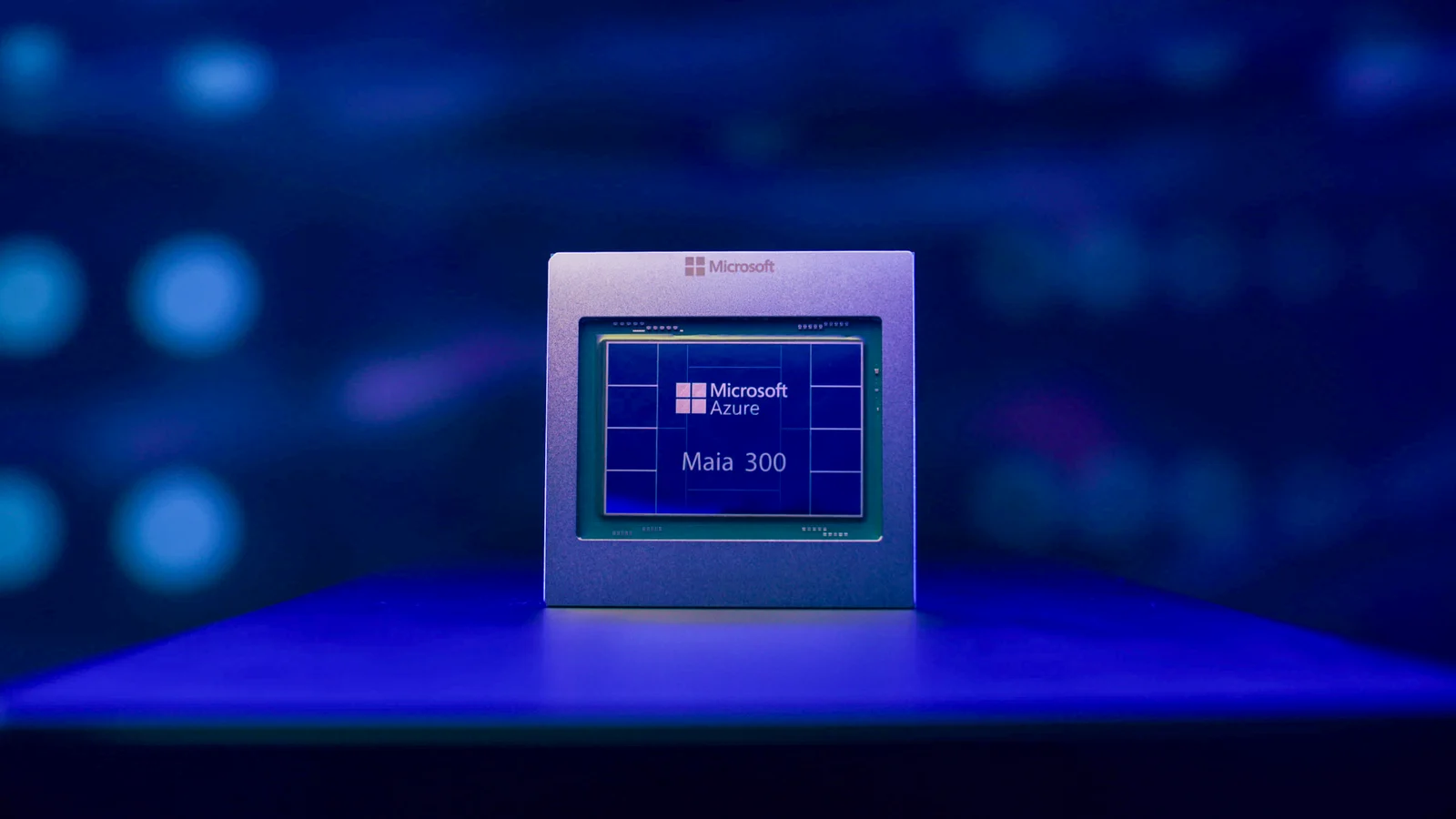
Microsoft has put numbers on its next inference chip, and the most striking ones are about memory and rack density, not raw compute. On October 12 Microsoft said it will scale its Azure Maia family to multi-gigawatt deployments from 2027 and make Maia “the primary inference system for Microsoft products and services.” We read Microsoft’s announcement and the Azure architecture deep dive in full. This article sets out the specifications, separates what Microsoft states from what we calculated, and lists what it left out.
What did Microsoft announce about Maia 300?
A third-generation chip, a rack built around it and a deployment plan. Scott Guthrie’s post is headed “Azure Maia 200 now in production; Azure Maia 300 coming in 2027.” Microsoft describes Maia 300 as “a complete intelligent system” with an inference-first architecture for long-context reasoning, latency-sensitive conversation and sustained multi-step agentic tasks. It says Maia 300 “will begin production deployments in 2027” and promises more detail at Microsoft Ignite in San Francisco next month. A separate Azure post by Rani Borkar and Saurabh Dighe covers the architecture.
What are the Maia 300 specs?
Microsoft lists these peak figures for each accelerator, per its specifications slide and the two posts:
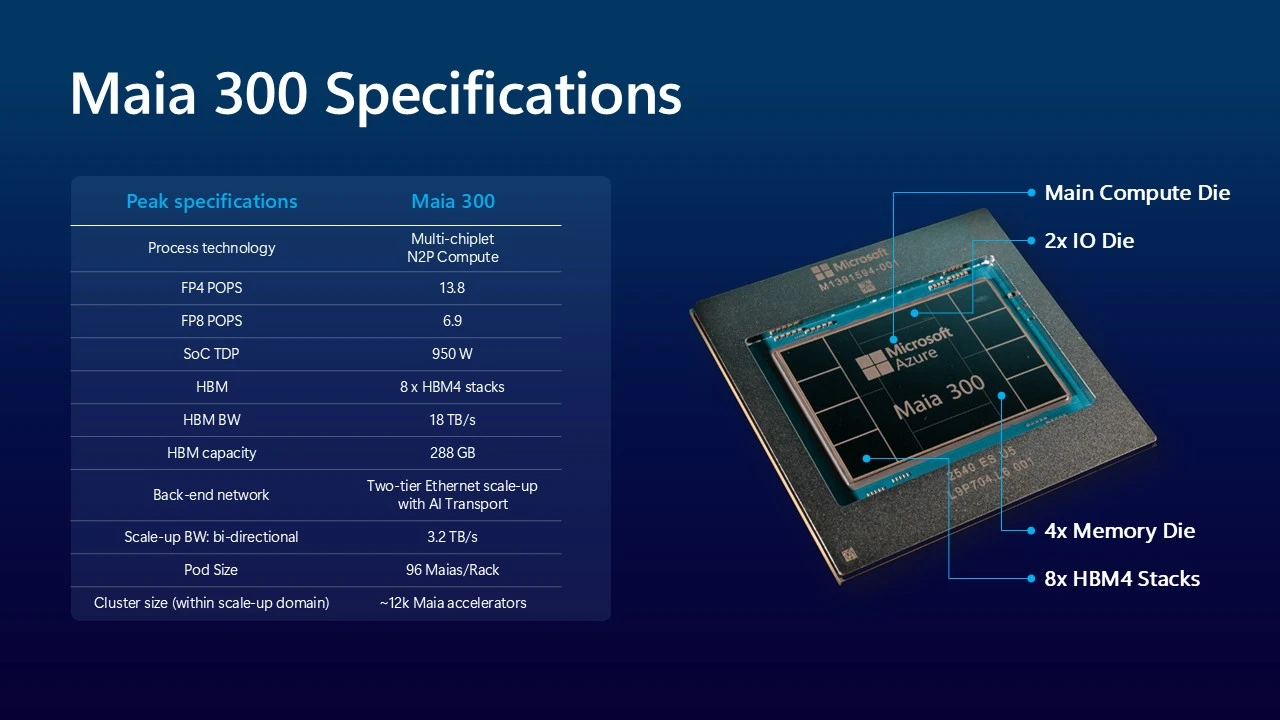
- Compute. Multi-chiplet design with the compute dies on TSMC’s N2P process. The slide shows 13.8 FP4 POPS and 6.9 FP8 POPS, and the Azure post adds enhanced MXFP4 and sub-3-bit storage formats.
- Memory. Eight HBM4 stacks give 288 GB and 18 TB/s, plus software-managed on-die SRAM. Microsoft’s slide shows one main compute die, two I/O dies and four memory dies.
- Power. 950 W TDP per chip.
- Network. An Ethernet-based custom AI transport, with 3.2 TB/s of bi-directional scale-up bandwidth per accelerator and up to 750 GB/s to any single peer in the superpod when only some accelerators are communicating across racks.
How does Maia 300 compare with Maia 200?
Microsoft states the gains as multiples of Maia 200, and they are uneven. Compute is up 36%, scale-up bandwidth 14%, HBM capacity 33% and HBM bandwidth 2.5 times; HBM bandwidth per watt is “approximately 2 times.” At rack level Microsoft says Maia 300 delivers “more than 2.5 times the performance per watt” and up to 7 times the token throughput of Maia 200.
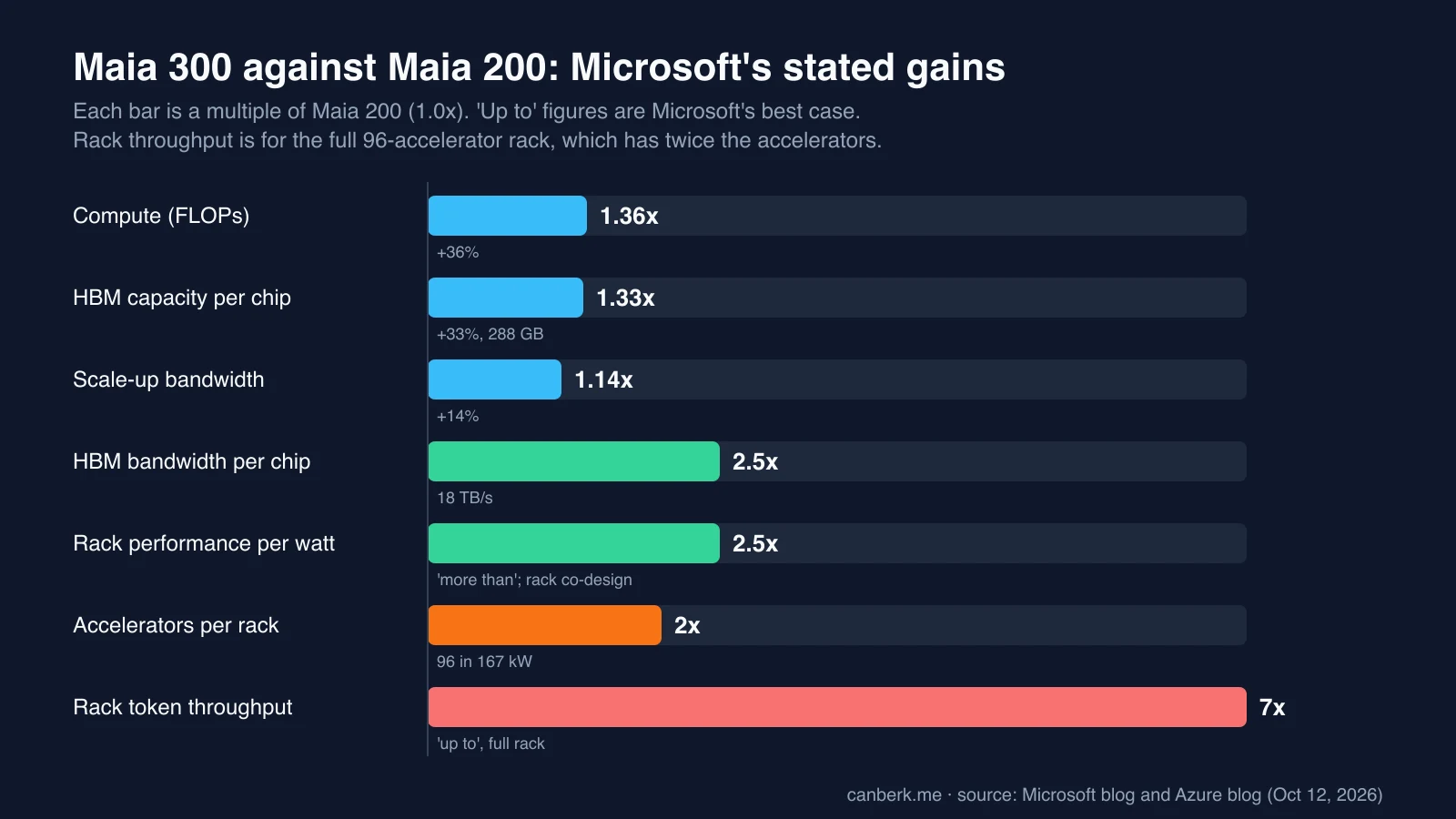
The pattern is that memory moved most. Microsoft says moving data, not raw arithmetic, is “increasingly the bottleneck in large inference systems,” and the Azure post says Maia 300 changes memory from a uniform to a non-uniform organization across chiplets so software can place data near the compute that uses it. The Maia 200 baselines are not printed in either post; the capacity and bandwidth multiples imply roughly 216 GB and 7.2 TB/s for Maia 200, which is our arithmetic.
How is a Maia 300 rack built?
Around 96 accelerators in 167 kW. The rack uses 24 four-accelerator trays, each with its own host processor, memory, storage and cooling, so there are no separate host trays. Six switch ASICs sit in three liquid-cooled switch trays, power comes from a 50 V busbar with dual feeds, and Microsoft says liquid cooling removes more than 80% of the rack’s thermal load. It can connect to facility water or use a heat-exchanger unit in air-cooled datacenters.
Microsoft totals the rack at 27.6 TB of HBM and 1.7 PB/s of aggregate HBM bandwidth. Both match 96 chips at 288 GB and 18 TB/s, so they add no new information. Our arithmetic shows the chips alone would draw about 91 kW at TDP, which is 55% of the 167 kW rack envelope.
Beyond the rack, a second optical switching tier joins up to 128 racks into a “superpod” of up to 12,288 accelerators. Microsoft describes three latency domains: a directly connected pair, any accelerator within a rack (one switch hop) and any accelerator across racks (three hops). It says jobs can place tensor parallelism inside a rack and spread expert and pipeline parallelism across racks, and that prefill and decode can run on separate workers that exchange KV state over the same fabric.
Can you trust Microsoft’s 40% and 7x claims?
Treat them as Microsoft’s estimates until a test method appears. Four numbers matter, and none of them names its comparison:
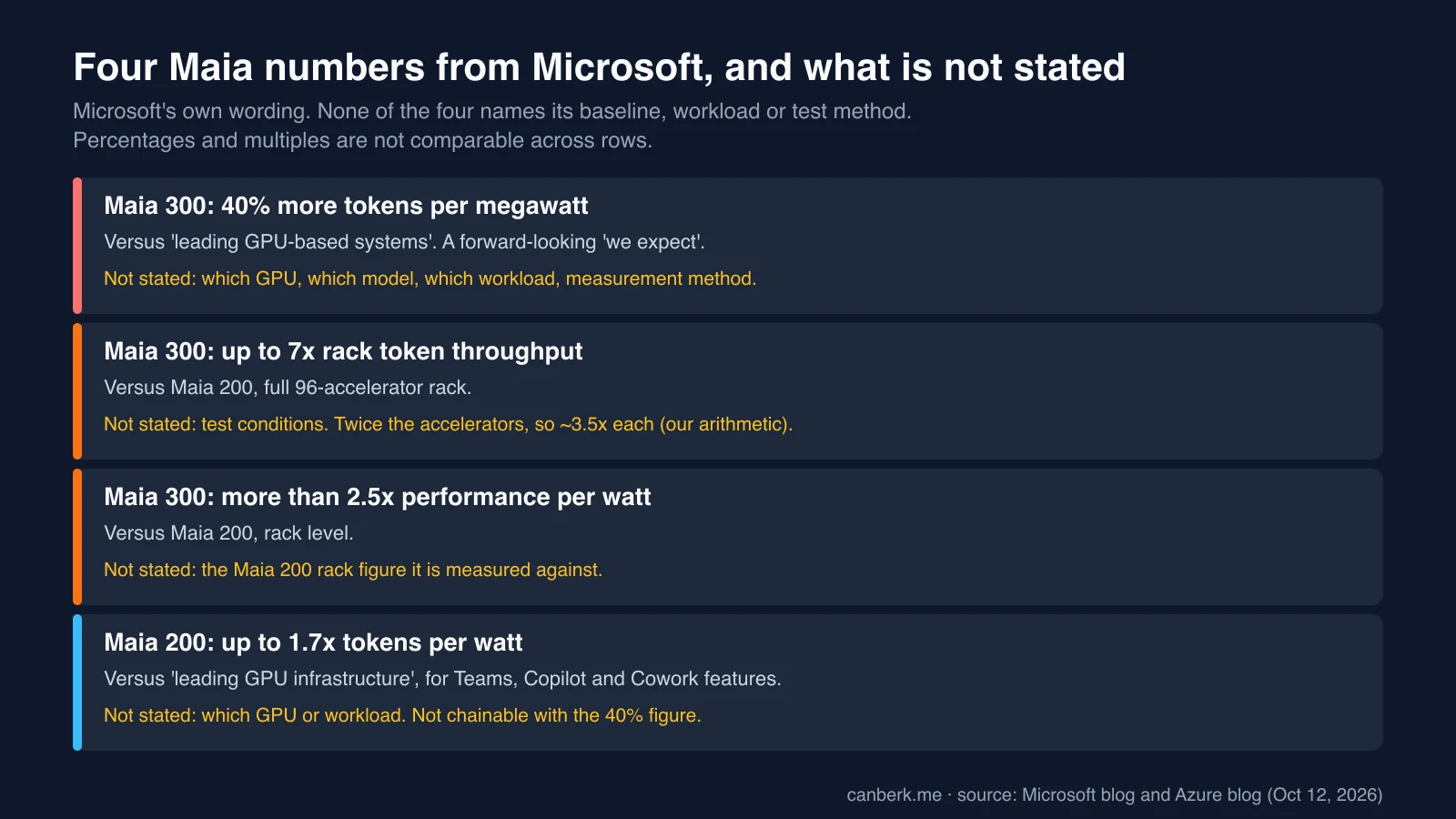
- 40% more tokens per megawatt is compared with “leading GPU-based systems,” in the future tense (“we expect”). The post does not say which GPU, model, workload or measurement method.
- Up to 7x rack token throughput is Maia 300’s full rack against Maia 200. Because the rack has twice the accelerators, that implies about 3.5 times per accelerator (our arithmetic), and “up to” signals a best case.
- More than 2.5x performance per watt is also against Maia 200, at rack level, without the Maia 200 figure it is measured against.
- Maia 200’s 1.7x tokens per watt is for Teams, Copilot and Cowork features against “leading GPU infrastructure.” It is a different baseline and workload from the 40% figure, so the two cannot be multiplied.
Is Maia 200 already in production?
Yes, per Microsoft. The post says Maia 200 is serving production workloads including Microsoft Copilot and supporting the MAI team’s model development, with GitHub Copilot and Microsoft Foundry to follow by the end of the year. It runs OpenAI models, Microsoft’s own MAI models and open-source families, and is deploying across the United States, Europe and Australia. Microsoft’s September launch of the new Copilot with Home, Code and Autopilot is the kind of service this inference capacity is meant to serve, though the post does not tie the two together.
When can customers use Maia 300?
Not yet, and the post does not say how. Production deployments start in 2027. Microsoft names Copilot, GitHub Copilot, Foundry, the MAI team and Dragon Copilot as uses for the Maia family, several of them as planned rather than current. It does not say when or whether Azure customers can rent Maia 300 capacity directly, or at what price.
What is still unknown about Maia 300?
- The comparison behind 40%. Which GPU system, which model and which measurement.
- Maia 200’s rack figures. Needed to turn the “up to 7x” and “more than 2.5x” claims into absolute numbers.
- Volume and the gigawatt total. “Multi-gigawatt” has no number, and the post gives no chip count.
- Customer access and pricing. Nothing is said about Azure instances or rates.
- Independent results. We found none; Microsoft says more will come at Ignite next month, and a link to a technical paper leads to the Azure architecture post.
What to keep in mind
These are our observations:
- Read the memory numbers first. Per-chip bandwidth is 2.5 times higher and capacity a third higher, while compute rose 36%. That fits Microsoft’s own argument that data movement limits inference.
- Treat “up to” and “we expect” literally. The 7x and 40% figures are best-case or forecast, and neither names its baseline.
- Scale is a 2027 story. Maia 200 is the chip serving workloads now.
- Wait for a test method. Ignite and independent measurements will say more than a launch post.
Editorial review: October 12, 2026 (AI). Prepared from Microsoft’s announcement post (read in full), the Azure Maia 300 architecture post (read in full) and the Maia 300 specifications slide (read as an image). We did not run or test Maia hardware, did not read the Maia 300 site’s video or press materials, and did not use secondary reporting such as chip-volume estimates.
Sources
- Microsoft to expand Azure Maia system to multi-gigawatt deployments (Scott Guthrie, The Official Microsoft Blog, October 12, 2026) ↗Microsoft
- Deep dive into Azure Maia 300 architecture (Rani Borkar and Saurabh Dighe, Microsoft Azure Blog, October 12, 2026) ↗Microsoft Azure
- Maia 300 site (Microsoft) ↗Microsoft
Created with AI assistance.
Suggest a correction
Found an error or a missing source? Send a private suggestion to the editor. It will be reviewed and will not appear as a public comment. No name, email or account is needed.


Send us a message