Microsoft MAI-Base-2: a 2.8T model and its efficiency claim
Microsoft finished pre-training MAI-Base-2, a 2.8T mixture-of-experts model. The 4 to 12x efficiency claim, and what is public and what is not.

In this article
Microsoft says it can now pre-train a frontier-scale model entirely in-house, and that it did so far more cheaply than the strongest open base model. On October 15 Microsoft AI published a “Lab Notes” post announcing that it finished pre-training MAI-Base-2, a 2.8T-parameter mixture-of-experts model. We read the post in full as text. This article covers the training run, the 4 to 12x efficiency claim, how it was measured and what Microsoft left out.
What did Microsoft announce about MAI-Base-2?
A finished base model that is not yet usable. Microsoft AI says MAI-Base-2 is a mixture-of-experts model with 80B active and 2.8T total parameters, larger and sparser than MAI-Base-1 and trained on more data. Pre-training is complete and post-training is underway. The post says the model “outperforms every open-weight model we tested on our held-out evaluations,” and that preparations for MAI-Base-3 have begun.
How was MAI-Base-2 trained?
On 16,000 GB200 GPUs for 38 days in August and September 2026. Microsoft reports an average model FLOPs utilization of 21%, normalized to 2.5 PFLOPS GB200 BF16 peak and excluding rematerialization and optimizer FLOPs, and a goodput of 89%.
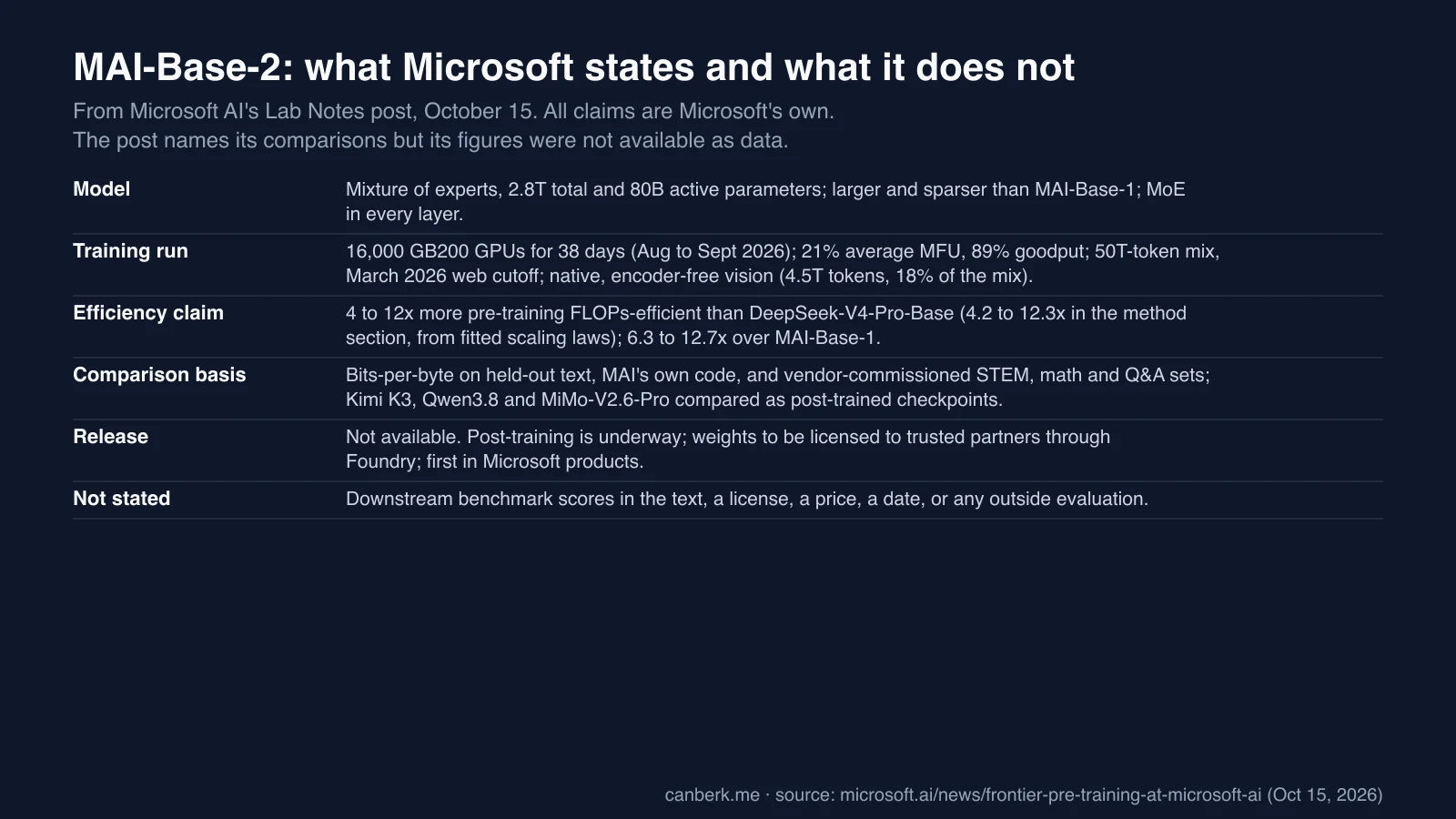
- Data. A 50T-token mixture, with unique tokens up about 36% from MAI-Base-1 and a March 2026 knowledge cutoff for web data. Microsoft says the data is organic, processed in-house, and does not involve distillation from other models.
- Vision. MAI-Base-2 is pre-trained natively with vision using an encoder-free architecture, which MAI-Base-1 lacked. The vision-language corpus has 4.5T unique tokens and makes up 18% of the mixture with repetition.
- Architecture and optimization. MoE is now in every layer, where MAI-Base-1 alternated dense and MoE layers, lifting MoE-layer utilization from 24% to 35%. Microsoft uses the Muon optimizer, which it says is more stable and efficient than AdamW at this scale, plus gradient clipping at selected activations, which it says also caught a preprocessing bug in license headers.
- Method. Smaller “scaling ladder” models set hyperparameters and forecast results for the full run.
What is the 4 to 12x efficiency claim?
That MAI-Base-2 reached its quality with far fewer training FLOPs than DeepSeek-V4-Pro-Base, which Microsoft calls the strongest open base model. The introduction says 4 to 12x more pre-training FLOPs-efficient; the methodology section says 4.2 to 12.3x, estimated by fitting per-benchmark scaling laws. Against its own MAI-Base-1, Microsoft claims a 6.3 to 12.7x improvement. Microsoft says it put the savings into training a larger model rather than a cheaper one.
Can you trust Microsoft’s comparison?
Treat it as a lab result, not a verified one. The post sets out its basis:
- A narrow metric. Comparisons use bits-per-byte on held-out text, which is tokenizer-agnostic, not scores on public downstream benchmarks. Bits-per-byte measures how well a model predicts text, which does not by itself say how it performs on tasks.
- Microsoft’s own data. Held-out code comes from Microsoft’s own codebase, and STEM, math and Q&A sets were commissioned from vendors. Microsoft says all were decontaminated against training data.
- Different kinds of models. DeepSeek-V4-Pro-Base is a base model, but Kimi K3, Qwen3.8-2.4T-A95B and MiMo-V2.6-Pro-RL are open-weight post-trained checkpoints only, so Microsoft notes post-training may affect results.
- An estimate. The efficiency multiple comes from fitted scaling laws, not from training the other models again.
- Figures we could not read as data. The post refers to ten figures, but the text gives no values behind them.
Can you use MAI-Base-2?
Not yet, and probably not directly. Post-training is underway, and Microsoft says it will first ship models in its own products. Because it owns the full pipeline and data provenance, it plans to license weights to trusted partners through Foundry. No license terms, price, date or checkpoint were given. This pairs with Microsoft’s Maia 300 chip plan, which it describes as the primary inference system for its products from 2027.
What is still unknown about MAI-Base-2?
- Downstream performance. No benchmark scores in the text, and no post-trained model results; Microsoft says more are coming “soon.”
- Independent verification. None; the 4 to 12x figure rests on Microsoft’s scaling-law fits.
- Release and licensing. No date, price or license terms.
- How it compares with frontier closed models. The post compares only with open-weight models. Press reports say Mustafa Suleyman told staff the model beats the one behind OpenAI’s GPT-5.6 with a quarter of the compute, but that claim is not in the post and we did not verify it.
What to keep in mind
These are our observations:
- It is a pre-training result. A base model’s text-prediction score is an early signal, not a product.
- The efficiency headline is a range with a method. Read 4 to 12x as an estimate from scaling laws against one open base model.
- Access will be narrow. Weights to trusted partners via Foundry, not a public download.
- Watch the post-training results. They will show what the model can do.
Editorial review: October 16, 2026 (AI). Prepared from Microsoft AI’s Lab Notes post (read in full as text; its ten figures and chart images were not available as data). We did not run or test the model, did not read the underlying evaluations and did not verify press reports of internal remarks.
Sources
Created with AI assistance.
Suggest a correction
Found an error or a missing source? Send a private suggestion to the editor. It will be reviewed and will not appear as a public comment. No name, email or account is needed.


Send us a message