OpenAI and Anthropic cut LLM prices: the timeline and the S-1
Since June, OpenAI and Anthropic have cut token prices again and again. One analysis lines the cuts up; Anthropic's S-1 adds context. What holds up.
In this article
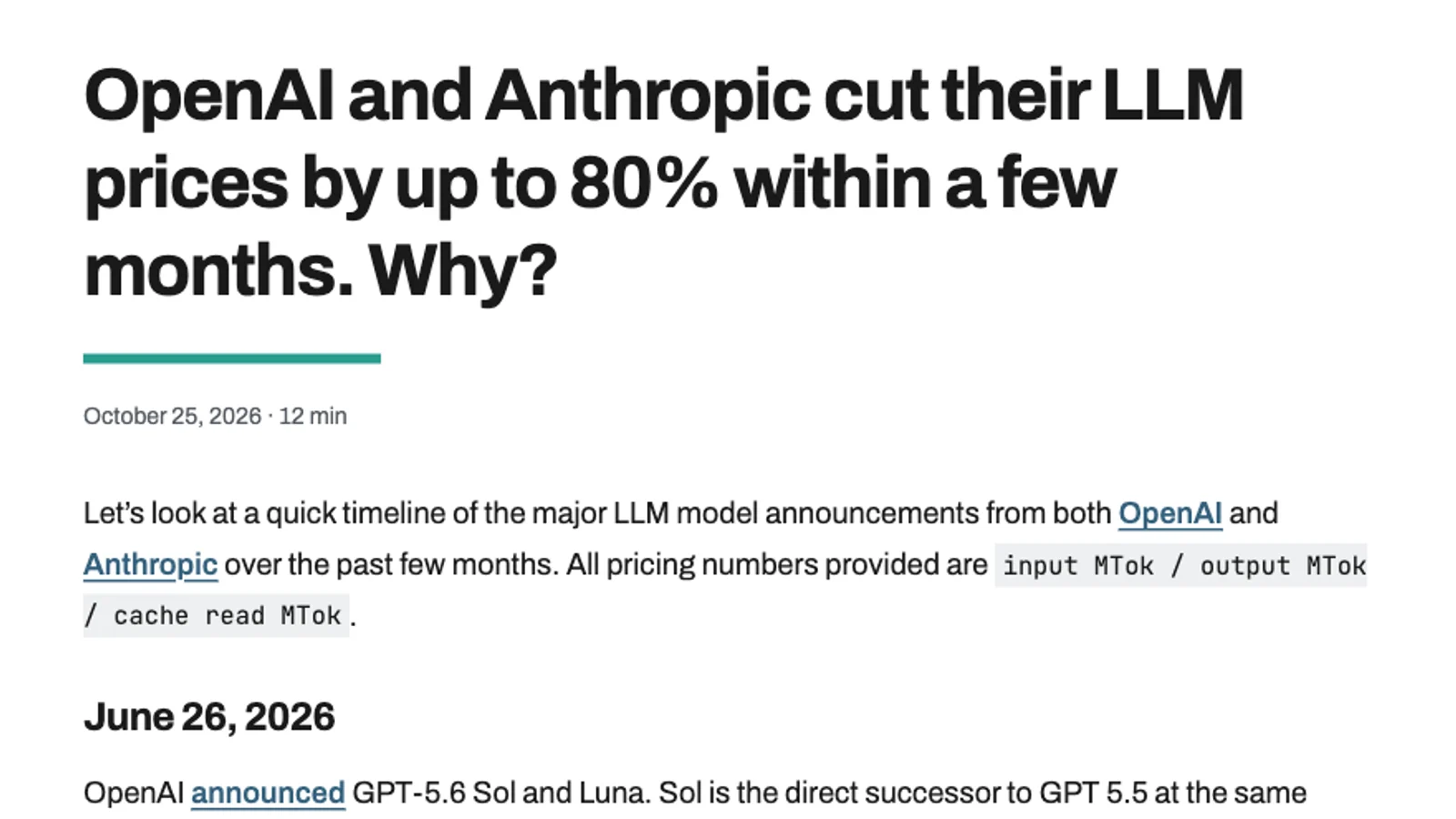
Over four months, OpenAI and Anthropic have cut what their models cost several times, sometimes by large amounts. Max Woolf, a developer who writes about LLM tooling, put the cuts in one timeline on October 25 and asked why. A day later Anthropic’s S-1 became public and speaks to part of the question. This article sets the two side by side. Prices and dates for OpenAI and for the open-weight models come from Woolf’s post; we did not check them against vendors’ pages, except for Anthropic’s, which match our own earlier reports. The S-1 figures come from the filing. Mind the gap between the two: his post is an opinionated analysis, the filing is a company document.
What does the timeline show?
Prices below are dollars per million tokens as input / output / cache read, as Woolf lists them.
| Date | Change |
|---|---|
| Jun 26 | GPT-5.6 Sol $5/$30/$0.50, GPT-5.6 Luna $1/$6/$0.10 |
| Jun 30 | Claude Sonnet 5 at $2/$10/$0.20, a launch price said to be temporary |
| Jul 24 | Claude Opus 5 at $5/$25/$0.50 |
| Jul 30 | OpenAI cuts GPT-5.6 Luna 80% to $0.20/$1.20/$0.02 |
| Aug 10 | Anthropic makes the Sonnet 5 price permanent |
| Aug 21 | GPT-5.6 Sol cut about 20% to $4/$20/$0.40 for three months |
| Sep 1 | Fable 5.1 at $10/$50/$0.25; Fable 5 was $10/$50/$1 |
| Sep 22 | GPT-6 Sol $2/$10/$0.20 and GPT-6 Luna $0.10/$0.50/$0.01; the same day Claude Opus 5.5 at $4/$20/$0.20 |
| Sep 29 | GPT-6.1 Sol keeps $2/$10, cache read halved to $0.10 |
We can speak to Anthropic’s rows. Our own Opus 5.5 and Sonnet 5.5 reports list $4/$20 and $2/$10 as standard prices, which matches. The OpenAI rows are his word.
Why do cache reads matter so much?
Woolf’s argument is that in agentic coding the model re-reads the whole conversation on every turn, so cache reads make up 96% to 99% of token spend and the cache hit rate is typically 90% to 100%. On that basis he reads a 75% cache-read cut as a 70% to 75% cut in real cost, and says the headline input and output prices are the smaller part of the bill. These are his figures. The real split depends on the workload, the harness and the provider’s caching, so treat 96% to 99% as one developer’s estimate of coding agents, not a general rule. He also cites Vercel’s AI gateway data, which he says shows cost per token at 43.3% of April 2026 levels while total spend keeps rising.
What about open-weight models?
He points to DeepSeek V4.1 Flash at $0.15/$0.60/$0.003 (our DeepSeek report lists the same input and output prices) and counts 29 providers listing it on OpenRouter, up from 13 for the earlier V4 Flash. Kimi K3.1 Pro is $2/$10/$0.20 against $3/$15/$0.30 for Kimi K3, with weights due by November 4 according to Moonshot (see our Kimi report). His claim is that many hosts competing on cheap, similar models limit what the two big labs can charge, and he rejects the idea that prices will suddenly jump. That is an argument, not a measurement. He also notes that the cheapest models hold only a minority of total token share, and quality or terms may differ from the closed models.
What does Anthropic’s S-1 add?
The S-1 does not mention Woolf, but it speaks to the same cuts. In its discussion of customer expansion it says that with Claude Fable 5.1 in September 2026 it “reduced the cost of typical workloads by approximately 25%” against Fable 5, with savings of up to 45% for complex coding and highly agentic tasks, and that Opus 5.5 reduced customers’ cost per task by about 40% against Opus 5. It adds that “in each case, the reduction was a combination of a lower price and improved efficiency, the contributions of which depend on the task”, and that the improvements came “while preserving our margins”.
It also gives a history it ties to an earlier cut: Opus 4.5 launched in November 2025 at a lower price and cost per task, and quarter-over-quarter revenue growth went from 48% to 132% the following quarter. The filing attributes that to several factors, lower prices among them. In its risk factors, pricing pressure and the chance that competitive dynamics stop it from pricing products at levels that cover costs are listed as risks.
What do the margins look like?
The filing does not define a gross margin, so this is our arithmetic. It reports cost of revenue by function, and says substantially all of it is compute and infrastructure for customer-serving workloads. Against revenue, in millions of dollars:
| Cost of revenue | Revenue | Share | |
|---|---|---|---|
| 2025 | 2,773 | 4,585 | about 60% |
| H1 2025 | 1,019 | 1,163 | about 88% |
| H1 2026 | 2,380 | 16,286 | about 15% |
Two limits apply. Training compute sits in research and development, not in cost of revenue, so this is a serving-cost ratio and not a profit measure. And the first half of 2026 ended on June 30, before the Fable 5.1 cut on September 1 and the Opus 5.5 cut on September 22. The third-quarter revenue figure is blank in the filing, so the S-1 cannot yet say what the September cuts did to the ratio. Woolf wrote that he was curious about inference margins once the prospectus arrived; this answers part of it for the period before the cuts and none of it after.
What to keep in mind
These are our observations:
- Check effective cost, not list price. If your workload is an agent that re-reads long contexts, the cache-read rate and your hit rate may matter more than the input and output rates.
- The S-1 describes lower customer cost, not lower price. Anthropic’s own wording splits the reduction between price and efficiency and does not say how much each contributed.
- The cuts coincide with a listing. Woolf finds it odd to cut revenue before an S-1; the filing says efficiency paid for it. We cannot verify either reading from outside.
- For the company’s full picture see our piece on the S-1. We use Claude in our workflow, which we mention because Anthropic is a party here.
What is still unknown?
- How the September cuts show up in the margins. The filing’s third-quarter figures are blank.
- OpenAI’s side. We have not seen OpenAI’s own account of its cuts and did not check its price pages.
- Whether low open-weight prices hold once demand shifts to them, and whether providers keep serving them at those prices.
- How representative Woolf’s usage is. He says he cut his own Codex plan after the cheaper pricing, which is one data point.
Editorial review: October 26, 2026 (AI). Prepared from Max Woolf’s post on minimaxir.com (read in full from the page text), the Form S-1 text on SEC EDGAR (the results of operations, the customer-expansion discussion, the cost-of-revenue note and the risk-factor passages around pricing; not the whole document), and our own earlier reports on Claude Opus 5.5, Claude Sonnet 5.5, DeepSeek V4.1-Flash-1017 and Kimi K3.1 Pro. We did not check OpenAI’s or the open-weight providers’ price pages. The cost-of-revenue shares are our arithmetic. The post and the filing may change.
Sources
- OpenAI and Anthropic cut their LLM prices by up to 80% within a few months. Why? (Max Woolf) ↗Max Woolf's Blog
- Anthropic, PBC, Form S-1 registration statement (filed October 26, 2026) ↗U.S. Securities and Exchange Commission (EDGAR)
- Claude Opus 5.5 launches: lower API prices, stronger coding results (our report) ↗canberk.me
Created with AI assistance.
Suggest a correction
Found an error or a missing source? Send a private suggestion to the editor. It will be reviewed and will not appear as a public comment. No name, email or account is needed.


Send us a message