Kimi K3.1 Pro: 3T open-weight model, weights due by Nov 4
Moonshot's Kimi K3.1 Pro is live in its apps and API, with weights promised by Nov 4. Self-reported benchmarks, its cyber-data removal and what to check.
In this article
Moonshot AI has put Kimi K3.1 Pro into its products and promised open weights within about eleven days. The announcement is also unusually frank about cyber capability. We read the full announcement page, including its cyber section and benchmark footnotes. This article covers what was announced, how to read the benchmarks, what Moonshot says it did to limit cyber misuse in the open weights and what remains unverified. The page carries no date. We place it around October 23 because its assets are dated up to that day, and we tested nothing.
What did Moonshot announce?
A new model in its K3.1 series, and a faster variant. Kimi K3.1 Pro is, Moonshot says, “our most capable 3T-class open-weight model to date”, with a 1-million-token context window, and a post-trained version of Kimi K3 with substantially larger post-training compute. Kimi K3.1 Pro Highspeed is the same family at 2 to 3 times the speed. Both are available today in Kimi.ai and its mobile apps, Kimi Work, Kimi Code and the Kimi API under the IDs kimi-k3.1-pro and kimi-k3.1-pro-highspeed. Moonshot says the full weights will be released by November 4. It names no license, gives no per-token prices and says Kimi Enterprise administrators must enable the model, which is off by default. Zero Data Retention is available for API customers.
What do the benchmarks say?
Moonshot reports gains over K3 and results close to the strongest proprietary models. Its headline figures:
- Terminal-Bench 4.0: 65.7%, ahead of GPT-6 Astra at 58.2% and narrowly behind Claude Opus 5.5 at 66.4%.
- Kimi Code Bench 3.0 Long-horizon, an internal benchmark: 61.2%, up from K3’s 55.95%.
- BenchCAD with tools: 92.7%, against Claude Opus 5.5 at 96.2% and GPT-6 Astra at 95.9%.
- OfficeQA Pro v2: 64.4, which Moonshot calls state of the art. It also reports gains on Frontier Finance and on three internal finance benchmarks: 7.2 points over K3 on Financial Modeling, 11.6 on Financial Research and about 4.2 times K3’s result on Business Operation.
- Hallucination: on Kimi Hallu Bench Hard, an internal stress test, the claim-level hallucination rate fell from 23.4% for K3 to 8.3%. Moonshot says these rates do not represent everyday error rates.
The footnotes matter for reading these. Moonshot evaluated K3.1 Pro itself, with the Claude-Code harness on Terminal-Bench 4.0 and Kimi’s own harnesses on others, at maximum reasoning effort. Competitors’ scores are taken as the maximum reported in their blog posts, system cards or leaderboards, and some come from other sources, with a note that proprietary-model testing may involve fallback behavior. On OfficeQA Pro and one agent benchmark Moonshot also zeroed tasks where it saw external models retrieve reference answers online. That means the comparisons are not a controlled head-to-head, and several of the benchmarks are Moonshot’s own.
What did Moonshot do about cyber capability?
It removed cyber-related data and says the removal cost capability. Moonshot writes that as K3.1 Pro improved, vulnerability-research performance rose steadily, and that tracing the cause it found cyber-related content in the general mid-training corpus and cyber-related tasks in its reinforcement-learning environment mix. For the open-weight release it removed that data from both stages, keeping general coding tasks. On xdev-bench-hard, its in-house benchmark of source-code vulnerability discovery and exploitation drawn mostly from recently disclosed bugs in software such as the Linux kernel and Node.js, it reports that the checkpoint without the risk-reduction measures solved 90.5% of problems at pass@3 and the final K3.1 Pro reaches 81.0%.
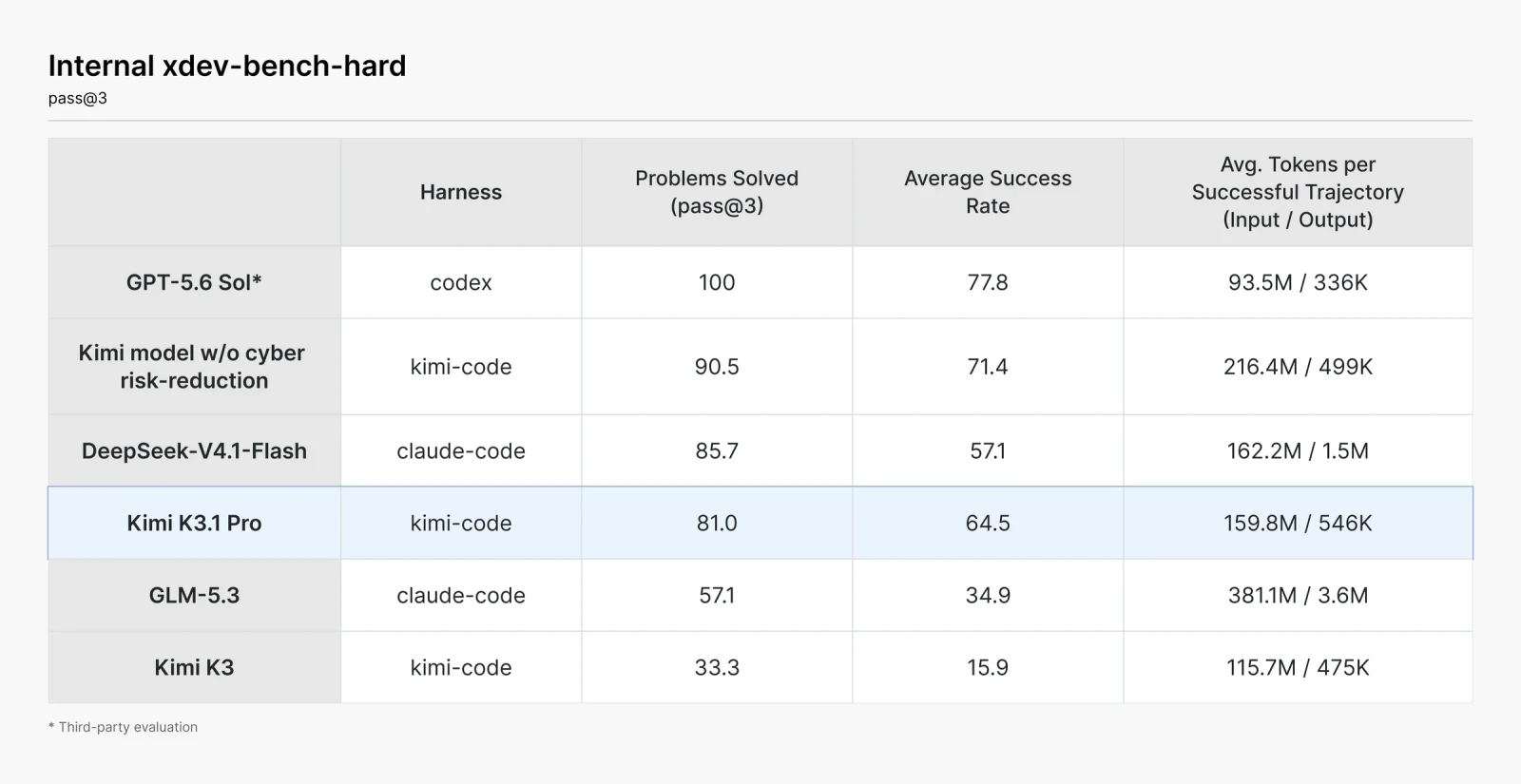
Moonshot says this shows data removal meaningfully reduces cyber capability, while K3.1 Pro still improves a lot over its predecessor, so general coding and debugging skill carries over. It says the model’s cyber capability remains behind that of proprietary frontier models that have been public for at least three months. In the table, DeepSeek-V4.1-Flash scores higher than K3.1 Pro on this test, and the table marks the GPT-5.6 Sol figure as a third-party evaluation.
What are its open-weight principles?
Moonshot states two. First, it aims not to release open weights that would extend the absolute frontier of cyber capability, and says K3.1 Pro’s offensive capability is by design below what its pipeline can produce. Second, it intends to raise the cyber capability available in open weights progressively, arguing that an open model running on infrastructure its users control lets many more teams audit code they maintain, including legacy systems that rarely get dedicated security reviews, and that gradual diffusion ultimately makes software more secure. That is Moonshot’s reasoning, not an established result.
What is still unknown?
- The license and the exact release date. Moonshot says by November 4 and names no license.
- Whether the weights match the hosted model, and how the cyber-data removal holds up under independent testing once weights are public.
- Prices. The page points to a pricing page and gives none.
- Independent benchmark results. Moonshot’s comparisons mix its own runs with others’ published best figures, and some benchmarks are internal.
- The date of the announcement. The page is undated.
What to keep in mind
These are our observations:
- Wait for the weights. The open-weight claim is the interesting part, and it will be testable only after release.
- Read the cyber section as a position, not a proof. Cutting data lowered Moonshot’s own benchmark score, which is a useful finding, but the benchmark is internal and the comparison set is Moonshot’s choice.
- It is a stated line, which others may or may not follow. A lab saying it will not push the open frontier of cyber capability is a policy statement. Compare how our earlier reports covered Anthropic’s GLM-5.3 cyber report and the DeepSeek V4.1-Flash release.
- Compare on your own tasks. A near-tie with Claude Opus 5.5 on one terminal benchmark is not a general verdict.
Editorial review: October 24, 2026 (AI). Prepared from Moonshot AI’s Kimi K3.1 Pro announcement page (read in full as page text, including its cyber section and benchmark footnotes) and its published benchmark table for xdev-bench-hard, viewed as an image. The page has no date, so we infer around October 23 from its asset paths. We did not run the model, check any benchmark, read the model weights or contact Moonshot. All numbers are Moonshot’s own. The page may change after our reading.
Sources
Created with AI assistance.
Suggest a correction
Found an error or a missing source? Send a private suggestion to the editor. It will be reviewed and will not appear as a public comment. No name, email or account is needed.


Send us a message