Gemini 4 Argon is now available: price, access and what changed
Gemini 4 Argon is open to developers and Pro and Ultra users, $2 and $10 per million tokens until Nov 30. Access, limits and Google's claims.
In this article
- What changed since the September 30 announcement?
- Who can use Gemini 4 Argon now?
- How much does Gemini 4 Argon cost?
- What are the limits and new developer features?
- What does the Gemini app get?
- What does Google claim Argon can do?
- What safety claims does Google make?
- What is still unknown about Gemini 4 Argon?
- What to keep in mind
Gemini 4 Argon is no longer limited to trusted cyber defenders. On October 13, two weeks after its September 30 announcement, Google opened the model to developers, enterprises and paying Gemini app users, and confirmed the price. We read Google’s three October 13 posts and its pricing page. This article covers what is available, what it costs, what changed since September 30 and which claims are Google’s.
What changed since the September 30 announcement?
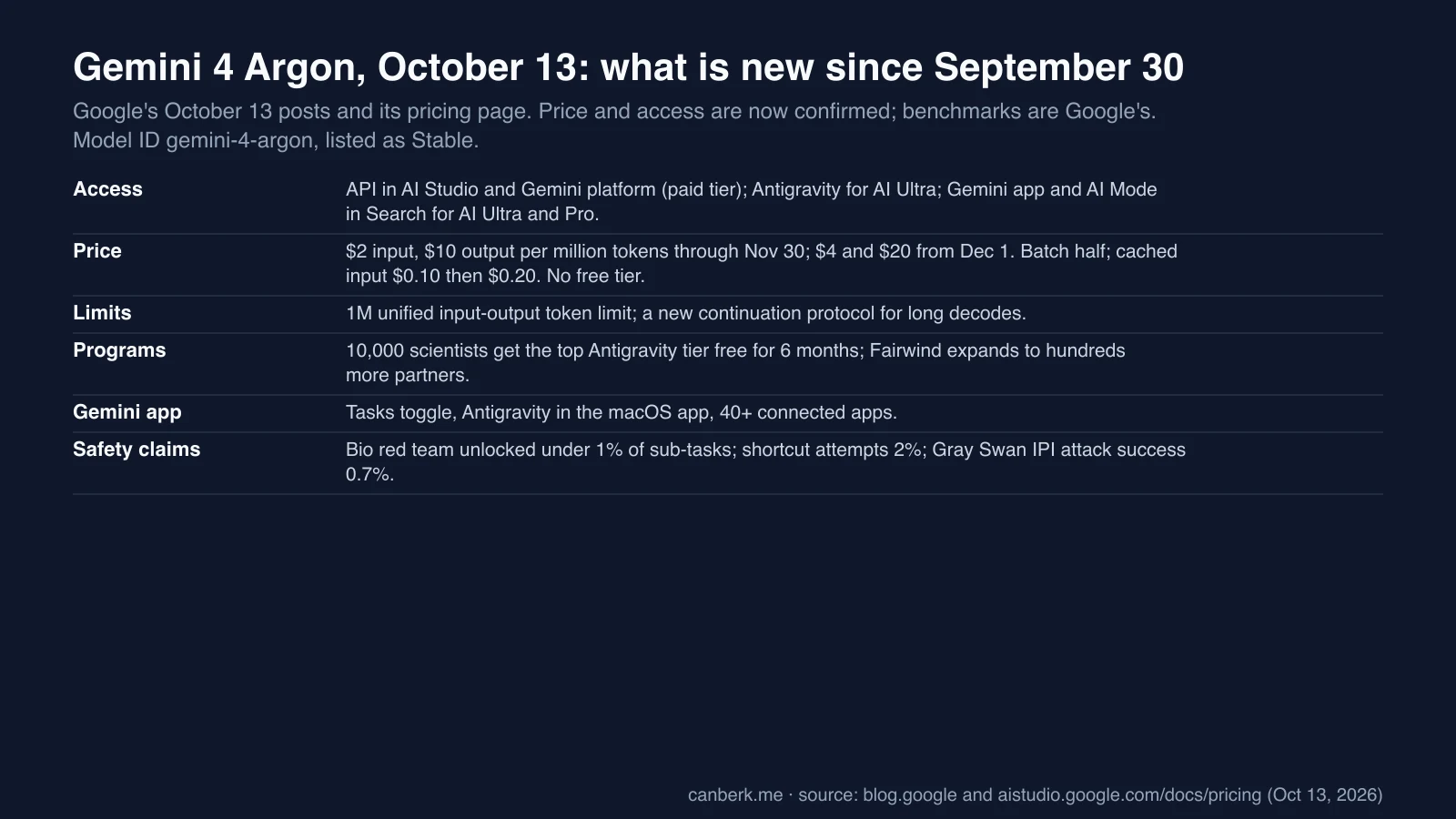
Access, price and a set of new claims. On September 30 Argon went only to the Fairwind Program, with broader access promised later. The October 13 post says Argon is now “globally available today” and the pricing is no longer a plan. The October 13 post does not repeat the benchmark table from September 30, so the earlier article’s table still stands as Google’s comparison.
Who can use Gemini 4 Argon now?
Paying developers, enterprises, and Google AI Pro and Ultra subscribers. Per Google’s posts:
- Developers. The Gemini API paid tier in Google AI Studio and Android Studio; AI Ultra subscribers can also try it in AI Studio and Google Antigravity. The model ID is
gemini-4-argon, listed as Stable. - Enterprises. Gemini for business, the API and Antigravity.
- Everyday users. The Gemini app and AI Mode in Search for AI Ultra and Pro subscribers.
- Scientists. 10,000 scientists can apply to get the highest Antigravity usage tier free for six months, subject to eligibility, capacity and selection.
- Cyber defenders. The Fairwind Program, which gives access to Argon without cyber guardrails, is expanding to hundreds of additional partners starting October 13.
How much does Gemini 4 Argon cost?
$2 per million input tokens and $10 per million output tokens, but only for now. The pricing page lists these through November 30, 2026, and $4 and $20 from December 1. Batch is half price ($1 and $5, then $2 and $10), cached input is $0.10 then $0.20 per million, and the page lists no free tier and no extra price for long prompts. Output includes thinking tokens, and only implicit caching is supported. Google’s blog calls the price “introductory”; its September 30 post said the same. The pricing page also says Argon “is not available on the Free tier or on the Google AI Pro plan” for the API.
What are the limits and new developer features?
A 1M-token limit shared by input and output. Google calls this an industry-leading “1M unified input-output token limit” and says Argon works longer on hard problems because of it. It points developers and enterprises to documentation on a “new continuation protocol” for long decodes. We did not read that protocol documentation. The September 30 article noted an output limit of 1M tokens, up from 64K; the unified limit means a long input leaves less room for output.
What does the Gemini app get?
A tasks toggle, Antigravity in the macOS app and more connectors. Per Google’s Gemini app post, a toggle in the main chat window switches from chat to tasks, and Gemini can keep working on tasks while you are away from your computer. Antigravity’s agentic coding interface is now in the Gemini macOS app, and Gemini connects to more than 40 apps including Instacart, OpenTable, Adobe and Shopify. Google describes Argon’s replies as more direct, with fewer caveats, less repetition and fewer stock phrases. The page does not state usage limits or regions.
What does Google claim Argon can do?
Mostly engineering and science results from Google’s own teams and partners. Treat them as Google’s reporting:
- Ranking. Google says Argon ranks first on the Vals Index, which covers finance, coding, legal and tax work. We did not check Vals’s own page.
- Engineering. Google says Argon in Antigravity helped its teams raise agentic code submissions by more than 35% and cut code rollbacks by nearly a third, helped Chrome finish an architectural refactor across hundreds of files in weeks rather than months, and cut in-memory session preparation time in Google’s Agent Development Kit by 40%.
- Speedups. Google says Argon made the xTB quantum chemistry package up to 2.3 times faster at structure prediction, and gave Gemma 4 E2B a 2.85 times inference speedup on an A100 with 100% token parity.
- Science. Google reports a nearly doubled inference throughput for an internal AlphaQubit kernel, five enzyme designs that showed catalytic activity in lab tests and broader counterexamples to Grad’s conjecture on stellarators, worked on with Professor Matt Landreman.
- Robotics. Google reports 87% on the ERQA embodied reasoning benchmark and a cornhole throw learned from video that Apptronik’s Apollo humanoid made seven times in a row.
- Partners. Partner statements, such as Box’s reported 14% accuracy gain over Gemini 3.1 Pro and Deloitte’s 100% task completion in its own evals, come from the partners’ own testing. Gamow Labs’ RareBench (57%) and LabBench (52.2%) figures are from its private evaluations.
What safety claims does Google make?
Numbers on misuse, shortcuts and prompt injection, all from Google. External bio red teaming could unlock under 1% of the bio sub-tasks Google tests. Violations on an adversarial set of harmful requests fell nearly two-fold against earlier Gemini models. On coding benchmarks where models have no incentive to hold back, shortcut attempts fell to 2%. An automated monitor reads the agent’s reasoning and actions to block workarounds in real time, and Google says it avoided penalizing the model’s thoughts in training. Argon leads the Gray Swan Indirect Prompt Injection benchmark, with attack success across 15 adaptive attempts at 0.7%. Google also points to its Model Card for details, which we did not read in full.
What is still unknown about Gemini 4 Argon?
- Independent results. Every performance and safety number above is from Google or its partners; we saw no outside reproduction.
- Price after the introductory period. The pricing page shows the doubling on December 1; we saw no discussion of whether it will change.
- Gemini app limits. No usage limits or regional rollout details in the app post.
- The rest of the Gemini 4 family. Google says Argon “is just the beginning” and gives no dates.
What to keep in mind
These are our observations:
- The price is a promotion. Budget for $4 and $20 per million tokens from December 1, not $2 and $10.
- The 1M limit is shared. Long inputs eat into output room.
- Read the claims by source. The Vals ranking, ERQA and safety numbers are Google’s; the partner numbers are the partners’.
- Check the earlier table. September 30’s benchmark comparison showed Argon trailing on five of 19 rows.
Editorial review: October 14, 2026 (AI). Prepared from Google’s three October 13 posts (read in full as text; embedded videos and interactive items not viewed), Google’s AI Studio pricing page and model list, and our September 30 article. We did not run or test Gemini 4 Argon, did not read the Model Card, the continuation-protocol documentation or the Vals Index page, and did not use secondary reporting.
Sources
- Gemini 4 Argon: Built to solve your hardest problems (Koray Kavukcuoglu, Google, October 13, 2026) ↗Google
- Gemini 4 Argon is now available for developers (Google, October 13, 2026) ↗Google
- Gemini 4 Argon is now available in the Gemini app (Google, October 13, 2026) ↗Google
- Gemini Developer API pricing (Google AI Studio) ↗Google
- Gemini 4 Argon Model Card (Google DeepMind) ↗Google DeepMind
Created with AI assistance.
Suggest a correction
Found an error or a missing source? Send a private suggestion to the editor. It will be reviewed and will not appear as a public comment. No name, email or account is needed.


Send us a message