Google's four-part research path toward coherent long videos
Co-Director, CANVAS, A²RD and VQQA tackle different failure points in AI video storytelling. What the ten-minute demo and research benchmarks actually show.
In this article
A coat changes between shots. A room no longer has the same layout when the story returns to it. The next clip looks polished, yet no longer advances the plot. These are different ways a collection of good-looking short AI videos can fail as a longer film. In a September 24, 2026 research article, Google connects four projects that address different parts of that problem: Co-Director, CANVAS, A²RD and VQQA.
The announcement is a research synthesis. The linked papers predate it, and the page does not announce a public editor, API, model release or general access program for this combined workflow. Google shows a ten-minute film, but a demonstration of duration should not be read as proof of unattended feature-film production.
Four jobs across one production process
| Research system | Question it tackles | Mechanism described by the researchers |
|---|---|---|
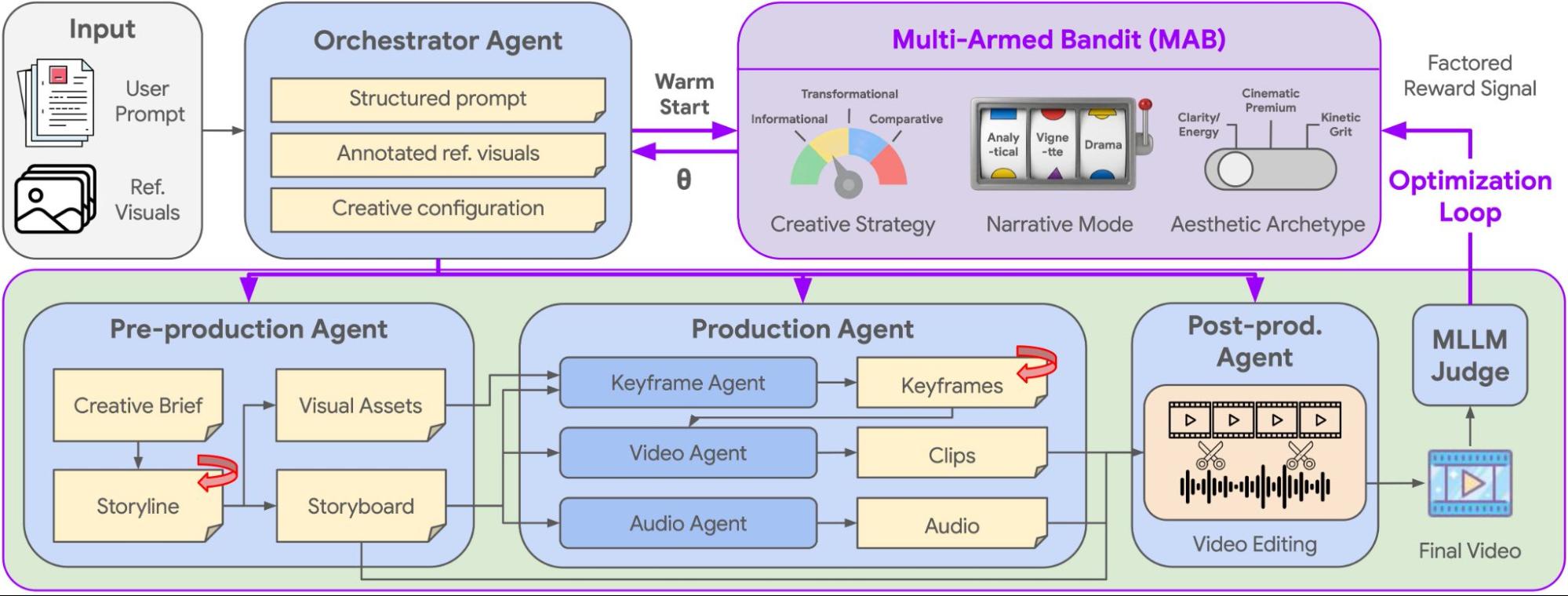
| Co-Director | What creative direction should guide all the shots? | An orchestrator explores narrative strategy, structure and aesthetic; specialized agents build the cut, and a multimodal judge feeds an assessment back. |
| CANVAS | What must remain visually the same when a scene returns? | A storyboard tracks characters, locations and objects with persistent visual anchors. |
| A²RD | How can the film grow segment by segment without losing its history? | Video memory supports a retrieve–synthesize–refine–update cycle and switches between progression and re-anchoring. |
| VQQA | How can a wrong detail be detected and improved? | Visual questions produce language feedback; revised prompts generate new candidates, and a global selector compares them with the original request. |
This division matters because “consistency” is not one score. A character may keep the same face while a prop changes, the geography of a room drifts, or the narrative repeats itself. Each system focuses on a different failure point. The Google article presents them as a research suite; it does not establish that the four papers have been released as one installable end-to-end package.
Planning, memory and a feedback loop
In Co-Director, the orchestrator chooses among high-level creative configurations. A pre-production agent turns the brief into a storyline and storyboard; production agents create keyframes, moving clips and audio. A multimodal judge then evaluates the assembled result and guides another search round. The underlying generation in Google’s description uses Gemini and Veo. The agent framework coordinates those models; it is not a new foundation video model on its own.
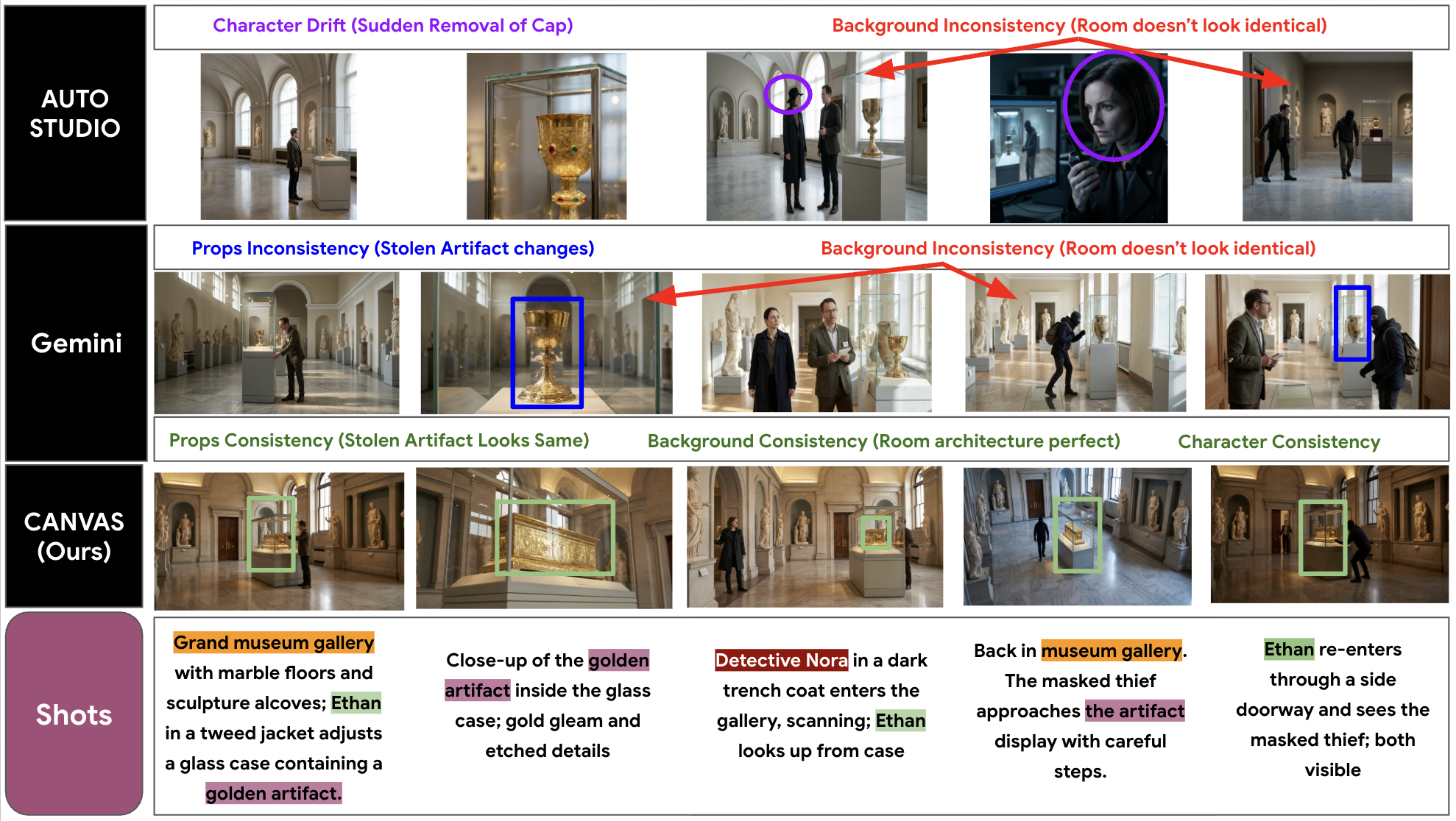
CANVAS concentrates on the storyboard before motion is generated. Its visual memory records what a character, room or object should look like when it reappears, including after several intervening scenes. In the museum-heist comparison used as this article’s cover, the researchers show where their method preserves returning elements that comparison methods lose. It is a selected example, not a blind test of every prompt.
A²RD extends this idea through time. Rather than requesting the whole film in one pass, it makes segments and updates a multimodal memory. It can extrapolate to progress the action, or interpolate to reconnect a segment with established people and places. The paper describes further frame- and video-level refinement to stop an error in one segment from contaminating the rest. That also implies additional generation and evaluation work; the source does not give a simple consumer price per finished minute.
What the ten-minute film demonstrates
Google embeds an official A²RD film described as a continuous ten-minute long-form demonstration. It is useful to inspect returning characters, costumes and locations at widely separated timestamps, rather than judging just the opening seconds. Playback below loads YouTube only after a click.
The A²RD paper reports up to 30% better consistency and 20% better narrative coherence against its tested baselines across one- to ten-minute settings. “Up to” identifies a best reported comparison, not a guaranteed gain. Its LVBench-C benchmark tests long gaps before characters or environments return. The paper’s human evaluations support its findings, but independent reproduction and behavior on a creator’s own footage remain open questions.
Other results measure different things. CANVAS reports improvements of 21.6% in background continuity, 9.6% in character consistency and 7.6% in prop consistency over its best baseline on its storyboard evaluations. VQQA reports absolute gains of 11.57% on T2V-CompBench and 8.43% on VBench2 over unrefined generation. These figures cannot be placed on a single leaderboard: the tasks, baselines and units differ. Google also reports a peak 81.4 quality score for Co-Director on its 400-scenario GenAD-Bench; that is a score in a fictional-product advertising test, not a percentage of films that viewers found coherent.
What VQQA repairs, and what remains for a person
VQQA asks targeted questions about a generated clip, such as whether an object has the requested shape and material or whether a performer changes instruments across a cut. A vision-language model turns the critique into prompt revisions, and the video generator tries again. Its global selector compares candidates against the original request so a local repair does not quietly change the overall goal. It re-generates from prompts; it does not paint over the existing pixels.
A filmmaker would still need to judge pacing, intent, sound, rights and whether the result is worth keeping. Google’s article says the team is exploring more human-in-the-loop work. It mentions inherited SynthID watermarking in the Gemini and Veo-based workflow, but watermarking alone says nothing about narrative quality or whether a particular output is suitable for publication. The practical takeaway is a map of research directions: plan globally, remember visual state, generate in segments and inspect the result. The current evidence is promising for those studied tasks, with no announced route here for ordinary creators to run the complete pipeline themselves.
Sources checked on September 25, 2026. The news event is Google’s September 24 research synthesis; the four underlying preprints were published earlier.
Sources
- Automating coherent long-form video generation ↗Google Research
- Co-Director: Agentic Generative Video Storytelling ↗arXiv
- CANVAS: Continuity-Aware Narratives via Visual Agentic Storyboarding ↗arXiv
- A²RD: Agentic Autoregressive Diffusion for Long Video Consistency ↗arXiv
- VQQA: An Agentic Approach for Video Evaluation and Quality Improvement ↗arXiv
- Official A²RD ten-minute film ↗Google Research / YouTube
Created with AI assistance.
Suggest a correction
Found an error or a missing source? Send a private suggestion to the editor. It will be reviewed and will not appear as a public comment. No name, email or account is needed.


Send us a message