Cloudflare Clef: open decision models that speak Jev's API
Cloudflare released Clef and Clef-Flash, open Jev-compatible decision models that accept images. What Cloudflare claims and what to check.

In this article
The race to copy, and beat, TypeSafe’s Jev has reached a major infrastructure company. On October 1 Cloudflare announced Clef and Clef-Flash, two decision models that it trained itself, hosts on Workers AI and has published on Hugging Face under Apache-2.0. Cloudflare says Clef currently leads the Jev Decision Index. This article covers what was released, how it is built, and what the numbers do and do not show. All figures below are Cloudflare’s own; we did not run the models.
What was released
- Clef: 27 billion parameters, post-trained from Qwen3.8-27B. Cloudflare calls it the “precision model.”
- Clef-Flash: 9 billion parameters, post-trained from Qwen3.5-9B, aimed at latency-critical decisions.
A decision model, as we have described in our coverage of Jev and Laya-MLX, takes a state and a set of typed questions and returns a probability for each allowed answer instead of generating text. Clef’s model card says the API is “fully compatible with Jev and SystemOne,” so an application written for Jev can send the same request. Cloudflare highlights two differences from Jev: Clef has a vision encoder, so it can classify images and video as well as text and JSON, and it has a 64k context window, against what Cloudflare gives as Jev’s 32k.
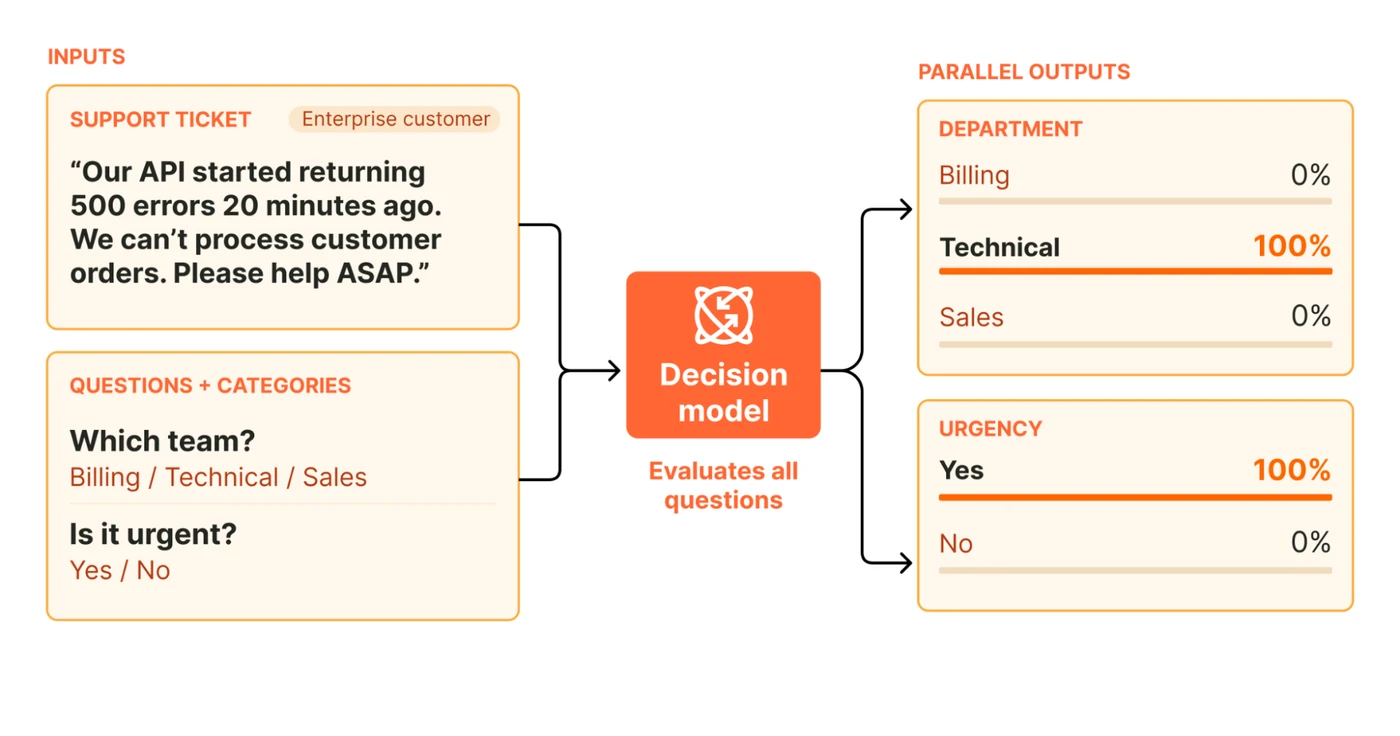
Cloudflare’s own example comes from its Threat Intelligence team: given a domain and its rendered page, Clef returns category probabilities such as fashion, e-commerce or phishing. Cloudflare says that workflow took Clef 2.2 seconds, against 4.7 seconds with gpt-oss-120b, which also returned fewer classifications.
How it is built
Cloudflare freezes the Qwen backbone and trains a routing head together with rank-256 LoRA adapters. At inference the backbone runs a prefill-only pass, then a small “joint schema head” scores every allowed option of every question in parallel, letting the questions attend to each other and back to the input. There is no token-by-token decoding. Training uses label-smoothed cross-entropy with a Brier loss for calibration, on Cloudflare’s own synthetic data, followed by a reinforcement-learning stage Cloudflare calls Reinforcement Learning for Calibrated Decisions (RLCD). That is the same name TypeSafe gave the training method behind Jev; Cloudflare does not say whether the methods are related. The work started from an earlier Cloudflare experiment that adapted DiffusionGemma into a decision model.
The numbers, read carefully
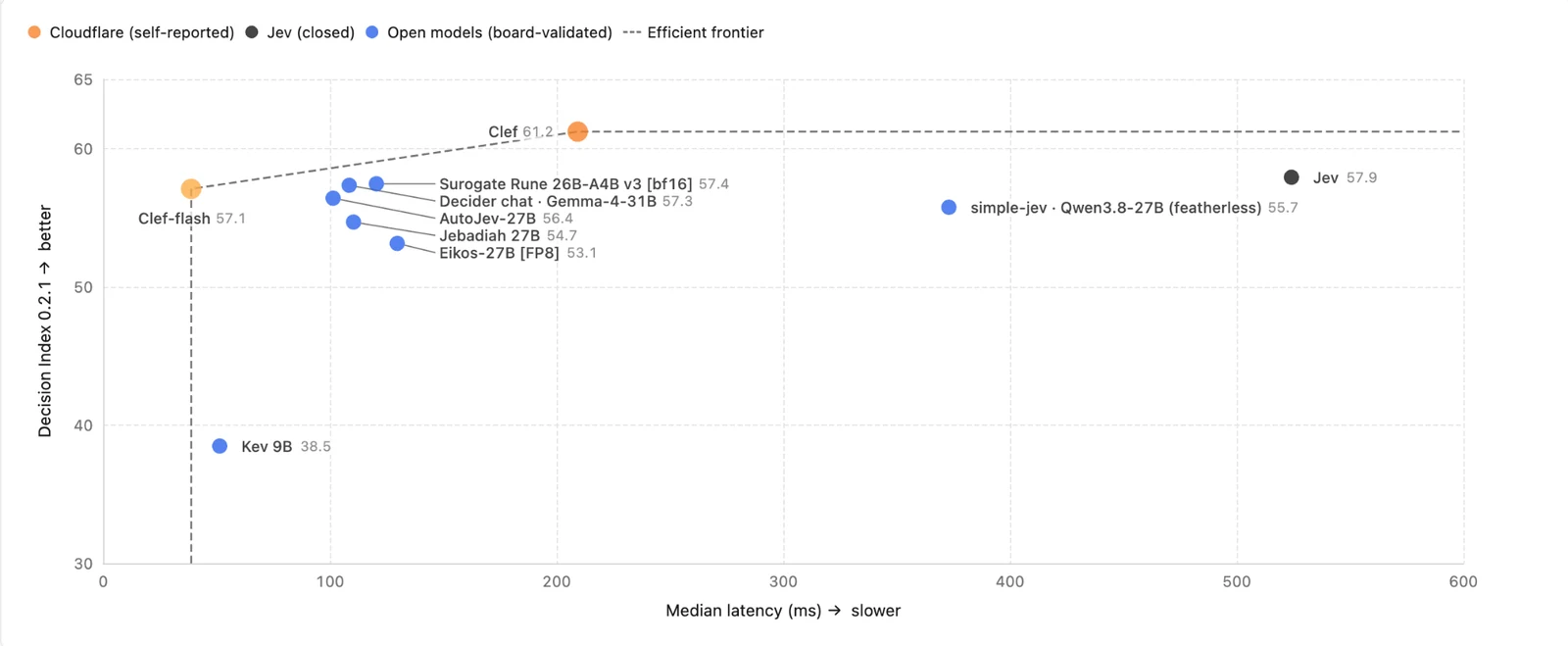
The headline claim is that Clef leads the Jev Decision Index. Cloudflare’s own chart is the place to read it: Clef scores 61.2 and Clef-Flash 57.1, against 57.9 for Jev. The legend marks Clef’s two points as “Cloudflare (self-reported),” while the open models on the board are “board-validated.” Until the board validates Clef’s scores, the lead is Cloudflare’s own measurement.
The benchmark table in the post is also more mixed than the headline:
| Benchmark | Clef | Clef-Flash | Jev |
|---|---|---|---|
| BFCL (case exact) | 98.47 | 98.76 | 95.75 |
| BANKING77 (macro-F1) | 94.20 | 90.93 | 79.74 |
| CLINC150+OOS (macro-F1) | 97.43 | 66.77 | 89.27 |
| When2Call (accuracy) | 72.37 | 65.58 | 80.97 |
| BRIGHT (nDCG@10) | 45.91 | 39.26 | 47.52 |
| PhishNChips (accuracy) | 79.60 | 75.05 | 62.55 |
Clef leads on most rows, but Jev wins When2Call and BRIGHT, and in the full table a DiffusionGemma-based Jev variant scores highest on PhishNChips (85.35). Clef-Flash drops sharply on CLINC150+OOS. On TypeSafe’s own four workflow suites, Cloudflare reports Clef ahead of Jev on three; Jev leads on agent-trace observability (71.6 against 68.5).
On speed, Cloudflare reports median latency across 43 evaluations of 38.8 ms for Clef-Flash, 209 ms for Clef and 524 ms for Jev, with p95 at 122, 239 and 536 ms. The post attributes part of that to running on Cloudflare’s GPUs at the edge, and does not detail how Jev was called for the comparison, so these are not like-for-like hardware numbers.
Fine-tuning and data
Cloudflare is also launching a reinforcement-learning fine-tuning service. It starts hands-on, with Cloudflare’s forward-deployed engineering team, and is meant to become a self-serve platform: capture traffic with AI Gateway, generate rollouts on Workers AI, score them in Containers, update weights with a new Trainer component and redeploy the result on Workers AI.
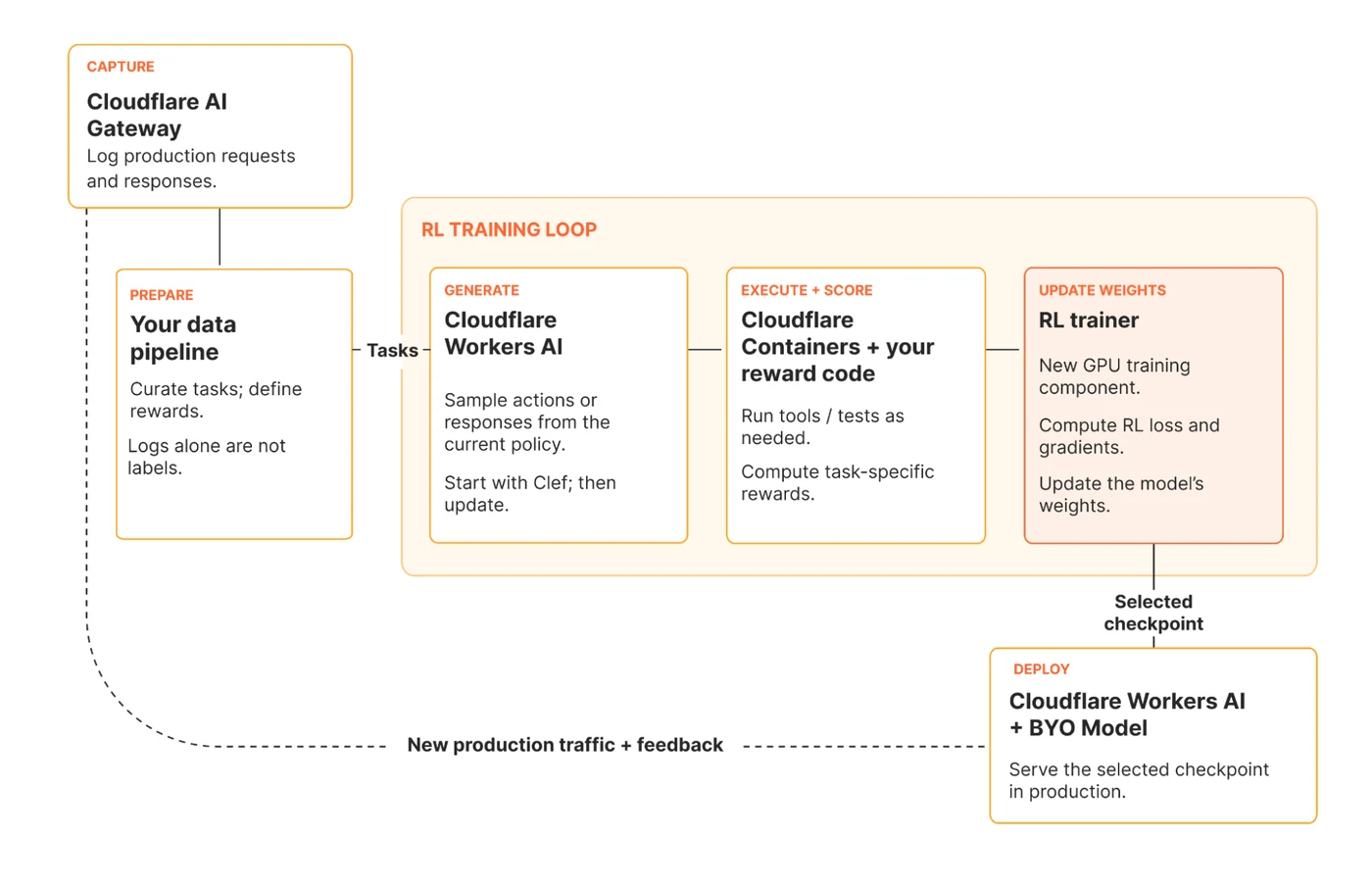
On data, Cloudflare states that it does not read, store or train on Clef requests or responses, unless a customer opts into fine-tuning.
Our take
- The Jev API is becoming a standard. Cloudflare did not invent a new interface; it copied Jev’s. That makes decision models more interchangeable, which is good for users and harder on TypeSafe.
- Images are the real differentiator. Most models in this class read only text. Classifying screenshots, rendered pages or video frames opens uses like the phishing example, and those are worth testing first.
- Wait for validation before calling a winner. The lead rests on self-reported scores, and Jev still wins several tasks. Run both on your own questions before switching.
- The same day, others shipped too. Perplexity published pplx-decider-v1-27b on Hugging Face, also on Qwen3.8-27B under Apache-2.0, with its own comparison against Jev. We will bring this week’s releases together in a separate piece.
Editorial review: October 2, 2026 (AI). Prepared from Cloudflare’s announcement and the Clef and Clef-Flash model cards, read in full the same night. All benchmark and latency figures are Cloudflare’s and were not independently verified; we did not run the models. Images are Cloudflare’s, reproduced with credit and a link to the source.
Sources
Created with AI assistance.
Suggest a correction
Found an error or a missing source? Send a private suggestion to the editor. It will be reviewed and will not appear as a public comment. No name, email or account is needed.


Send us a message