Jev and Laya-MLX: when an AI workflow needs a decision, not a paragraph
A practical look at typed decision models, TypeSafe's Jev, local Laya inference on Apple Silicon and the limits behind the speed claims.

In this article
An agent does not always need to write an answer. Sometimes the next step is simply to choose a queue, assign a severity or decide whether the available evidence is sufficient. Typed decision models make that narrower problem worth examining: what changes when the model’s output is a choice or probability rather than a generated paragraph?
TypeSafe introduced Jev on September 15. Laya and the independent Laya-MLX runtime offer a separate, open-weight route into this area. This is an analysis of that approach and its recent implementations, rather than a claim that all three launched today.
Three names, different roles
| Project | What it provides | Why the distinction matters |
|---|---|---|
| Jev | TypeSafe’s System One model and typed decision API | Its vendor benchmarks describe specific workflows |
| Laya | An open-weight decision engine with English and multilingual checkpoints | Model choice and input length remain constraints |
| Laya-MLX | An independent MLX implementation of Laya for Apple Silicon | A local runtime, not a TypeSafe product or an official Convai release |
The upstream Laya project supports choices, rubric scores and yes/no-style probabilities. Its published checkpoints have short context budgets: 512 tokens for the English model and 1,024 for the multilingual and typed-decisions variants. Instructions and options consume that budget too. Sending an entire long support conversation is therefore a different problem from classifying its latest message.
What Jev’s charts actually show
TypeSafe’s announcement reports large speed and cost gains in four workflows constructed by its team. The original comparison is below. It is useful evidence about those tasks, not a universal ranking of model intelligence.
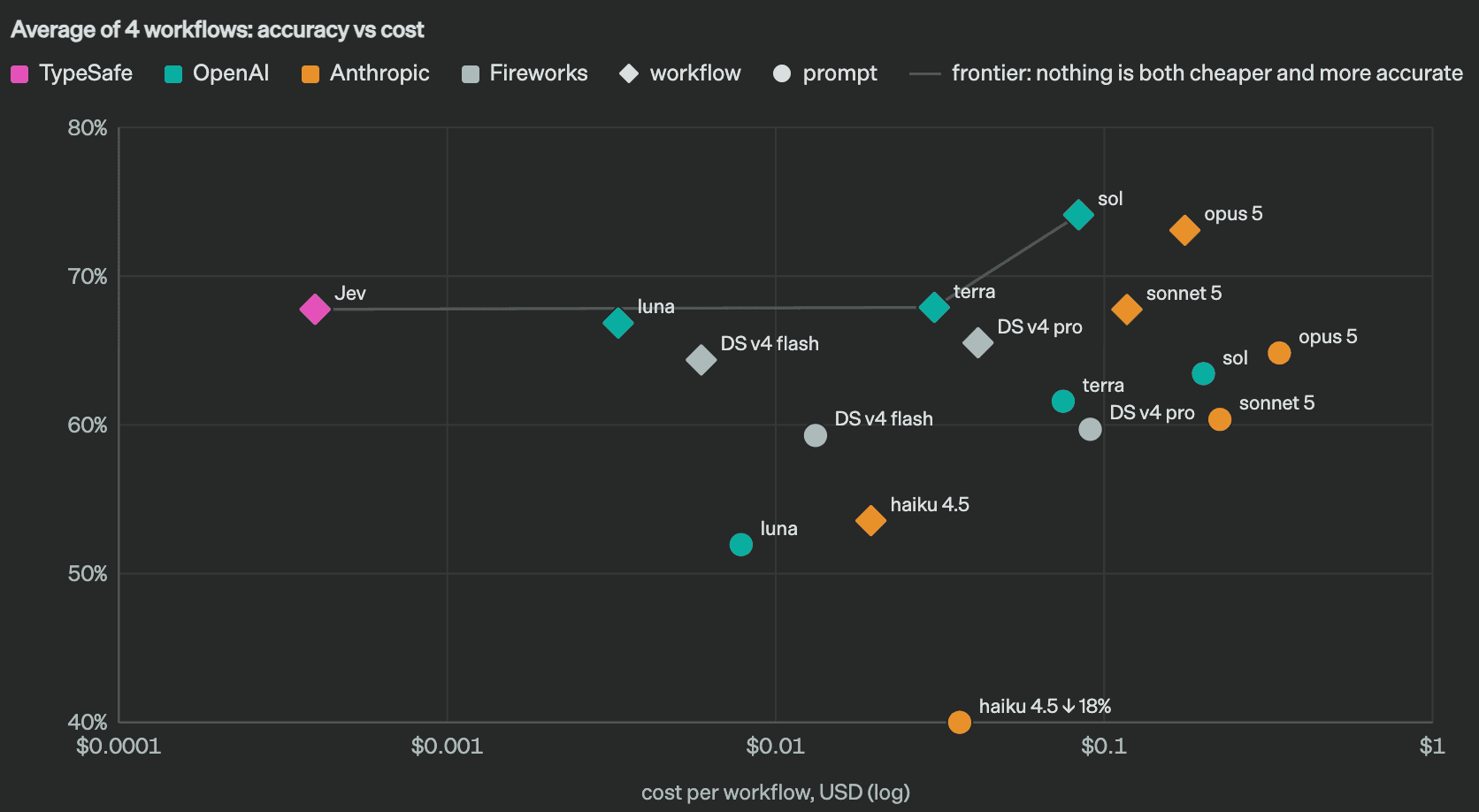
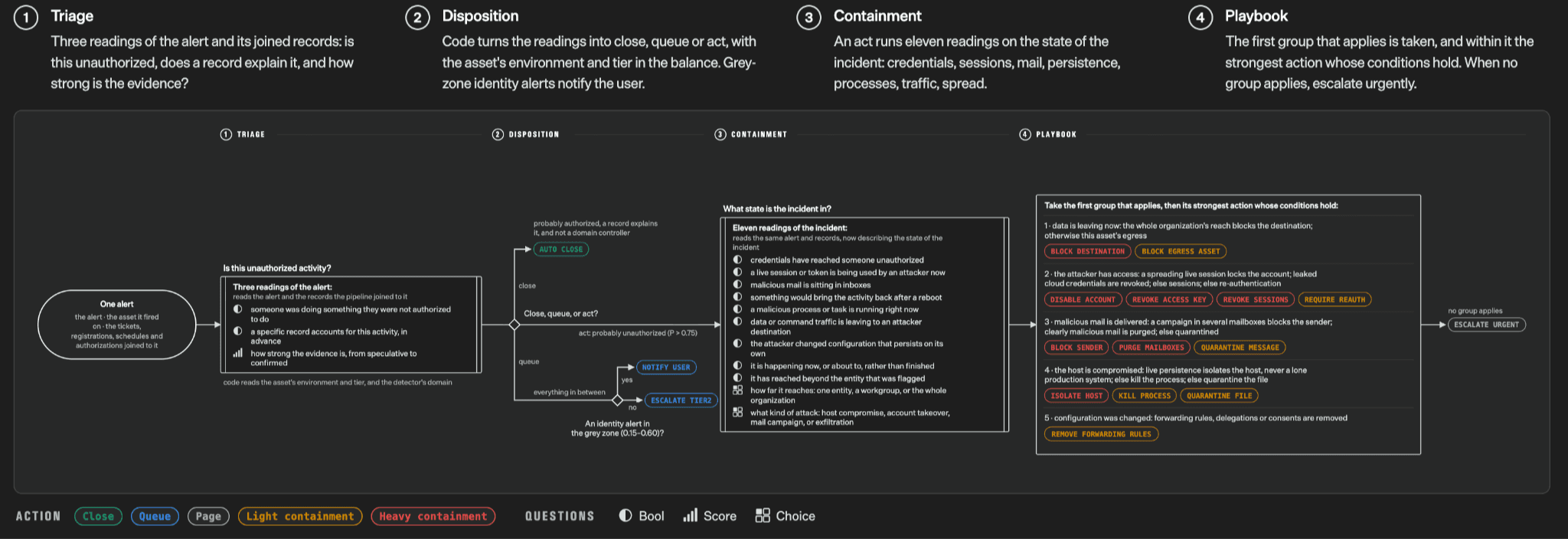
Our interpretation: the application still needs to decide what each answer permits. A correctly typed label can be the wrong label. Turning a probability into permission to refund money, disable an account or publish a story requires a separate policy and an appropriate review step.
Laya-MLX brings the experiment onto a Mac
The Laya-MLX repository targets Apple Silicon, Python 3.11+ and macOS 14+. Checkpoints download first; subsequent inference can run locally. Its Snake clip below is an original recording, with a visible safety layer that can correct unsafe model proposals.
The separate benchmark report lists median short-question latency of 13.42 ms for the English checkpoint and 7.39 ms for the multilingual checkpoint. Measurements use FP16 on an M3 Max with 40 GPU cores and 128 GiB memory. They include preparation and result formatting, but exclude loading the model. These figures cannot be directly compared with a hosted API’s network-inclusive response time.
Independent research points toward selective escalation
A September 22 JEV-as-a-Judge preprint studies Jev as an evaluator. It reports promising results on ordinary preference and factuality tasks, with larger weaknesses on derivations and adversarially polished wrong answers. Its confidence-based cascade accepts some decisions and escalates uncertain ones to a stronger comparator. That is a research result under specified conditions, not a guarantee that confidence always identifies errors.
The experiment we would run first
Start with a reversible task: route short TR/EN reader messages into editorial, subscription and technical queues. Keep a human-labelled test set, including ambiguous requests, mixed-language messages and unrelated text.
Measure the whole workflow: wrong confident decisions, how often it asks for review, latency at realistic input lengths and the cost of correcting mistakes. Compare it with a simple rules baseline as well as a general language model. A fast model that misroutes a difficult minority of messages may save less time than its headline latency suggests.
We have not independently benchmarked these systems. The promising use case is a small, measurable decision embedded in a larger workflow; the next step is to establish where that decision is dependable.
Sources
- Introducing System One Models and Jev — 15 September 2026 ↗TypeSafe
- Laya: upstream decision engine and model documentation ↗Convai Innovations / upstream contributors
- Laya-MLX: independent Apple Silicon runtime ↗mizorewww
- Laya-MLX benchmark method and timing samples ↗Laya-MLX project
- JEV-as-a-Judge: Accept When Confident, Escalate When Unsure — 22 September 2026 ↗Yubo Li and co-authors / arXiv
Created with AI assistance.
Suggest a correction
Found an error or a missing source? Send a private suggestion to the editor. It will be reviewed and will not appear as a public comment. No name, email or account is needed.


Send us a message