EPFL and Apple study: a minimal coding agent matches elaborate ML harnesses
EPFL and Apple researchers report one plain coding-agent session matched four elaborate ML harnesses, though it cost about six times more than one of them.
In this article
Do you need an elaborate harness around a strong coding model? A new paper says that, for machine learning engineering tasks, mostly not. Researchers from EPFL, with Apple affiliations, report that one minimal coding-agent session matched or beat four open-source harnesses built for the job, given the same model, hardware and time. The paper is listed on Apple’s machine learning research site, but its three authors are listed with EPFL and Apple, and one did the work while interning at Apple, so it is not an Apple product announcement. We read the full paper; we did not rerun the experiments.
What did the researchers test?
They compared a minimal single-session agent, which they call Malena, with harnesses that wrap an agent in search trees, subagents and memory machinery. Malena is one coding-agent session built on the OpenCode framework that runs for the whole time budget, with three small tools: one to register a submission, one to report hardware and remaining time, and one to run background jobs. The four open-source harnesses it was compared with are MLEvolve, AiScientist, Arbor and ScienceFlow.
- Models: GLM 5.2, Kimi K3, DeepSeek V4 Flash and Gemma 4 31B, all open-weight, served locally with vLLM.
- Tasks: 30 tasks from MLE-bench (Kaggle-style ML problems) and 40 from NatureBench, a scientific-research benchmark.
- Setup: one A100 80GB GPU per agent, a 24-hour budget, and 17 harness-and-model pairs on MLE-bench, with 95% confidence intervals from bootstrapping.
What did they find?
- The environment is the big lever. Letting the model read, write and run code in a shell, instead of answering in a chat window, was the largest effect measured, and even the smaller Gemma 4 gained.
- Search strategy barely mattered. Four tree-search styles (chain, greedy, UCB1, best-of-N) showed no statistically significant differences. The largest gap, 2.71 percentile points between UCB1 and best-of-N, had an interval of about −1.4 to +6.6.
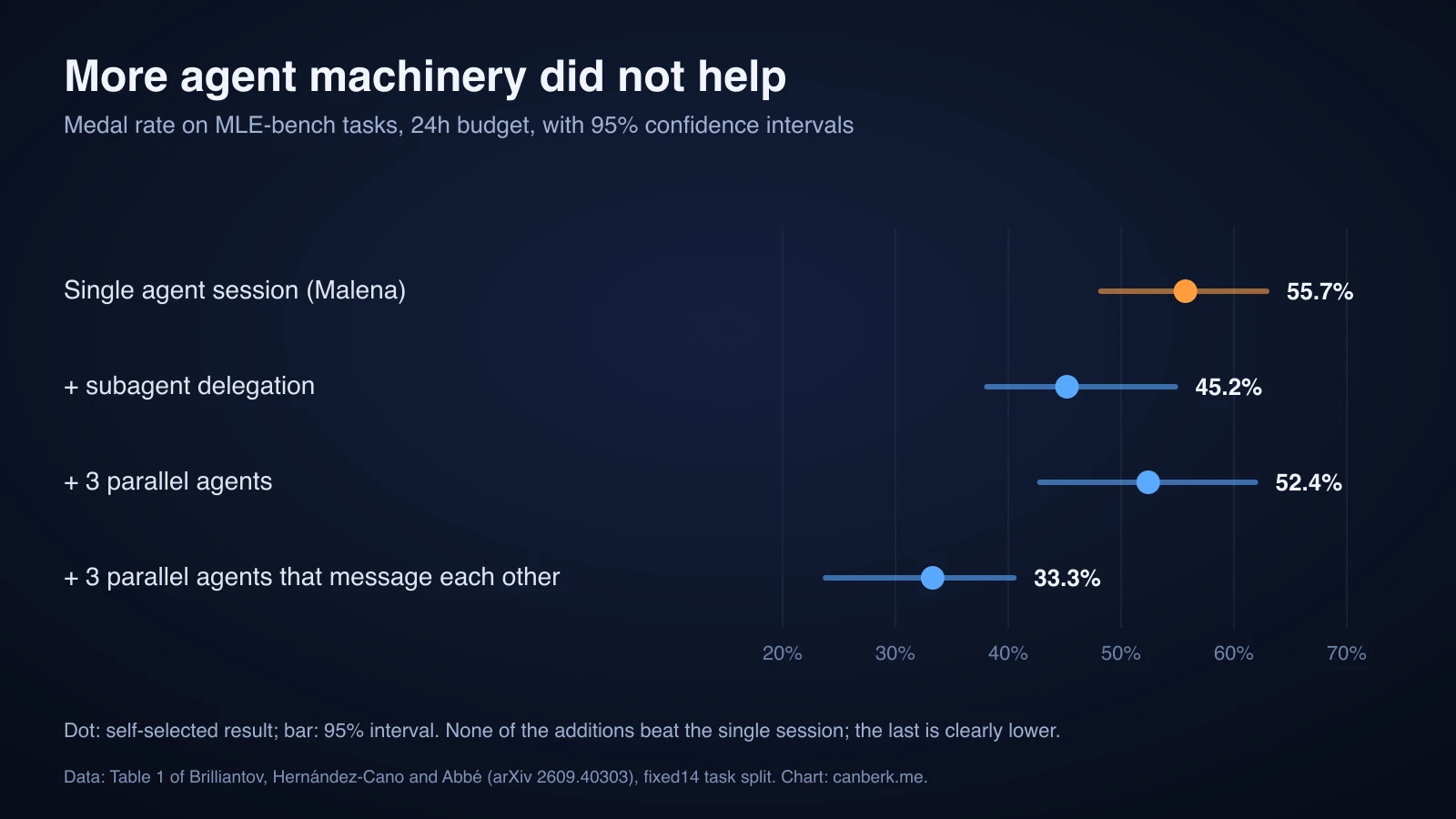
- More agents did not help. On a 14-task split, medal rate was 55.7% for the single session, 45.2% with subagent delegation, 52.4% with three parallel agents and 33.3% with parallel agents that message each other (self-selected results; intervals overlap for the first three).
- It held up against full harnesses. The authors say the single session matched or beat every harness on every pair tested. On NatureBench with GLM 5.2 the share of tasks beating the published best result was 21.7% for the plain agent, 17.5% for AiScientist and 10.8% for MLEvolve; with Kimi K3 it was 26.7%, 27.1% and 11.7%. The exception was the small Gemma 4 model, where MLEvolve led on average, though the intervals overlapped.
Was it cheaper?
No. The authors’ modeled inference cost with GLM 5.2 was $12.12 for the single session against $1.95 for AiScientist, about 6.2 times more, because one ever-growing session resends its context and the cost is driven almost entirely by cache-read tokens. They note that 24 hours of A100 time costs between $24 and $85 depending on the provider.
Why do the authors think it works?
They analyzed the agents’ traces and conclude that a capable coding agent carries out on its own the search that harnesses hard-code: it builds one general pipeline, then spends the run improving it with code patches, reusing checkpoints and code, and shifts late in the run toward ensembling and tricks such as pseudo-labeling. They also report it kept trying comparatively rare techniques. This is the authors’ interpretation of traces, not a controlled test of mechanism.
What are the limits?
The authors list four: MLE-bench has known preparation issues and is built from public Kaggle competitions, so contamination is plausible (they fixed tasks and checked it, and added NatureBench); some confidence intervals are wide enough to rule out strong claims about size, so the “no worse than” claims are better supported than “better than”; most interventions operate within a single worker, so sophisticated multi-agent coordination is left open; and tuning effort may differ, because the winner is the authors’ own system, which they tried to offset by fixing bugs and configurations in the external harnesses.
What to keep in mind
These are our observations:
- It is about ML engineering with open-weight models. The results say nothing about Claude, GPT or Gemini, or about everyday software work, and “harness” here means the outer orchestration program, not the agent’s tools.
- “Minimal” is still a harness. Malena runs inside an agent framework with a shell, a filesystem and three tools. The finding is that the extra layers added little, not that scaffolding is unnecessary, in line with the direction of minimal harnesses such as Pi.
- Cost matters. If you adopt a single long session, watch the context-resend bill.
Editorial review: October 5, 2026 (AI). Prepared from the full text of the paper (arXiv 2609.40303, submitted September 30, 2026; read in full, including methods, results, limitations and appendix A.4 model list) and Apple’s research page (read the same day; it gives the date only as October 2026). We did not rerun any experiment. All figures are the authors’; the chart is ours, built from the paper’s Table 1. “What to keep in mind” is ours.
Sources
Created with AI assistance.
Suggest a correction
Found an error or a missing source? Send a private suggestion to the editor. It will be reviewed and will not appear as a public comment. No name, email or account is needed.


Send us a message