Claude Duet: Anthropic's proactive agent and what it asks first
Anthropic opened a waitlist for Claude Duet, an agent that briefs you each morning and works while you are away. What it does, asks first, and who gets in.

In this article
Anthropic has put a different kind of Claude in front of US subscribers. Claude Duet does not wait for you to open a chat. It comes to you with a morning brief, takes tasks by message and keeps working when you step away. We read Anthropic’s announcement and the product page. This article covers what Duet does, what it checks with you first, who can try it and what is not yet known.
What is Claude Duet?
A proactive agent app, opened today as a research preview. Anthropic describes it as an app “where Claude works as a proactive agent” that “comes to you with what needs your attention, completes tasks you ask of it, keeps working even when you step away, and checks with you before it acts on your behalf.” It is aimed at professionals and small business owners, and it is a standalone iOS and Android app that also runs on claude.ai. Anthropic says it designed Duet around Claude Opus 5.5.
It uses your Claude account, including memory, skills and connected apps, and you reach it by text or voice in one ongoing thread. Anthropic says the Claude app waits for you to open a chat, while Duet comes to you.
What can it do?
Anthropic lists these uses across its two pages:
- Morning brief and monitoring. A short brief each morning on the most important items across connected apps, then messages only when something needs you, for example flagged email and calendar items and drafted replies.
- Business tasks. Finding unpaid invoices in tools like QuickBooks or Stripe and drafting reminders, preparing payroll in Gusto for review, preparing agreements for Docusign, drafting follow-ups from HubSpot data and setting up a Shopify store.
- Larger work. Scheduling meetings, building dashboards, creating financial or sales forecasts, prototyping and building web apps.
- Purchases. It can buy things for a business through Link, Stripe’s digital wallet, which pays with a virtual card, or check out through Shop Pay. Anthropic says Duet confirms the item and Link asks you to approve the spend.
It works in a cloud virtual machine with its own browser, so it does not need your laptop or phone on. It uses the connectors and plugins in the Claude Marketplace, which Anthropic puts at more than 6,000.
What does it ask before acting?
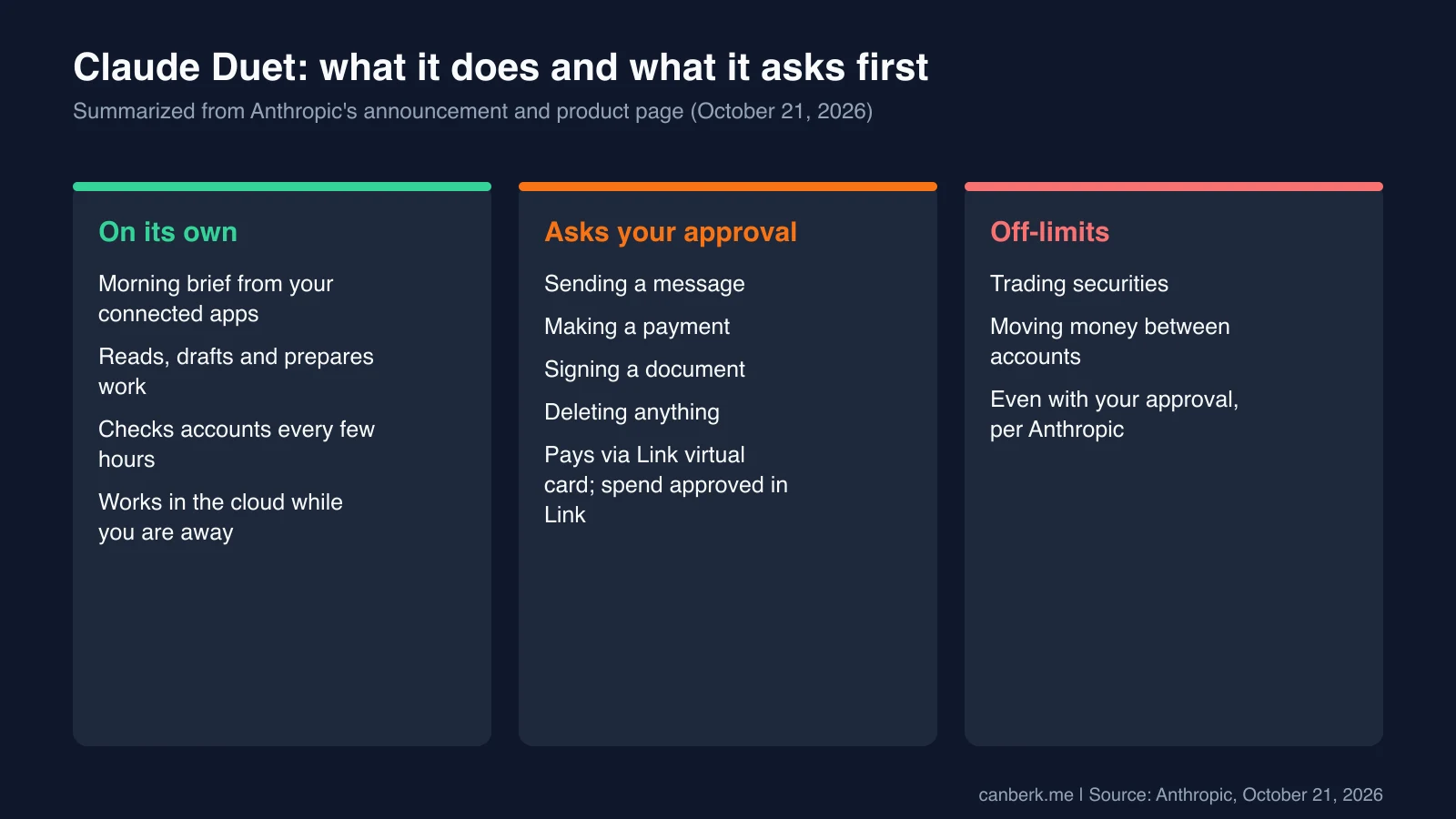
Sending, paying, signing and deleting. Anthropic says Duet “reads, drafts, and prepares work on its own,” but before it sends a message, makes a payment, signs a document or deletes anything, it shows you what it is about to do and waits for approval. It lists two things as off-limits even with approval: trading securities and moving money between accounts. You can disconnect any app it has access to.
What safety measures does Anthropic describe?
Several, and they are Anthropic’s own account. The announcement says:
- Duet follows Anthropic’s framework for trustworthy agents and handles credentials the way Claude Managed Agents does, so it never directly sees your passwords or sign-in tokens.
- Actions are approved by the auto mode classifier that Anthropic uses for Claude and Claude Code.
- Its defenses against hidden instructions and prompt injection come from Anthropic’s browser-use research.
- A new dedicated classifier and safety system prompt check each message and are designed to reject sharing the strictest tier of information, including credit card numbers and government identification. Other sensitive information, such as health or personal finances, goes through only when you have explicitly told Duet to send it.
- Red teams and an external firm penetration tested Duet, and it is covered by Anthropic’s public bug bounty program. Anthropic says it will share more about its safety design “in the coming days”.
Who can use it, and at what cost?
US Pro and Max subscribers, through a waitlist. Team and Enterprise plans are not included yet. There is no separate price in the research preview: Duet shares your plan’s usage limits with the rest of Claude and uses them differently from a normal conversation. Anthropic says its background checks count toward the limits, and larger tasks such as a financial model or a deck take more model turns and background work. It checks accounts every few hours instead of continuously for that reason.
What are the limits?
Anthropic lists them itself. Duet may misread a thread, miscalibrate what is urgent and miss something that arrives between its checks. Its core is built around work, so personal errands such as booking tickets are weaker, and it cannot yet show you its browser. For now it lives in its own app, separate from the main Claude app. Some announced features are marked as coming soon: a richer visual editor for Shopify storefronts and signing in to sites with logins saved in 1Password.
What is still unknown?
- Availability outside the US and whether Team and Enterprise plans follow. Anthropic gives no dates.
- Pricing after the research preview.
- How well the classifiers and approval steps hold up. Anthropic’s description is not an independent test, and its fuller safety write-up has not been published yet.
- How often it decides to contact you and how that is tuned. Anthropic says it is still testing this judgment.
- How the app and the main Claude app will relate. Anthropic says early users will shape this.
What to keep in mind
These are our observations:
- The approval list is the product. An agent that reads your email and can pay and send for you is defined by what it must ask about. Anthropic’s list is clear, but we did not test whether every route to those actions goes through it.
- Two layers of approval are described. The announcement says actions are approved by an auto mode classifier, and elsewhere says Duet waits for your approval. It does not spell out how the two divide the work, which is worth watching in the safety write-up.
- Checking every few hours is a design choice, not a flaw. It affects what “proactive” means: it can flag a problem after a delay, and Anthropic itself says it can miss something between checks.
- The product page’s examples are illustrations. The business scenarios on it are staged, so treat them as demonstrations of intent, not results.
- It extends a pattern we have followed. See Opus 5.5, the Claude Marketplace and our timeline of OpenAI agent incidents for how agents that take actions have gone wrong elsewhere.
Editorial review: October 21, 2026 (AI). Prepared from Anthropic’s announcement “Introducing Claude Duet” (dated October 21, 2026) and the Claude Duet product page, both read as page text through a command-line fetch. We did not join the waitlist, use the app, or test any of the described safety measures, and we did not contact Anthropic. The pages may change after our reading.
Sources
Created with AI assistance.
Suggest a correction
Found an error or a missing source? Send a private suggestion to the editor. It will be reviewed and will not appear as a public comment. No name, email or account is needed.


Send us a message