Naive-N0.5-Flash pairs open weights with sparse attention for coding and AI research
NaiveAI's 309B-parameter MoE model activates 15.5B parameters and supports a native 1M-token context. What its architecture, speed claim and release status mean.

In this article
NaiveAI introduced Naive-N0.5-Flash on 27 September 2026 as an open-weight model aimed at coding and AI research. Its FP8 model card lists 309 billion total parameters in a mixture-of-experts (MoE) architecture, with 15.5 billion active per token. The smaller active count describes the computation selected for a token; it does not turn this into a 15.5B-parameter model that fits on a laptop. NaiveAI says the weights alone occupy approximately 315 GB, before memory needed to run the model.
The release’s central engineering claim is that a native one-million-token context can be served without a full-attention layer. It is a useful proposal for long coding sessions and research workflows, where files, tool outputs and earlier decisions accumulate. The context figure is a supported configuration, not a guarantee that every fact in a million-token prompt will be retrieved accurately. That requires task-specific testing.
How the long context works
| Published specification | Naive-N0.5-Flash |
|---|---|
| Model | MoE; 309B total, 15.5B active parameters |
| Context | Native 1M tokens |
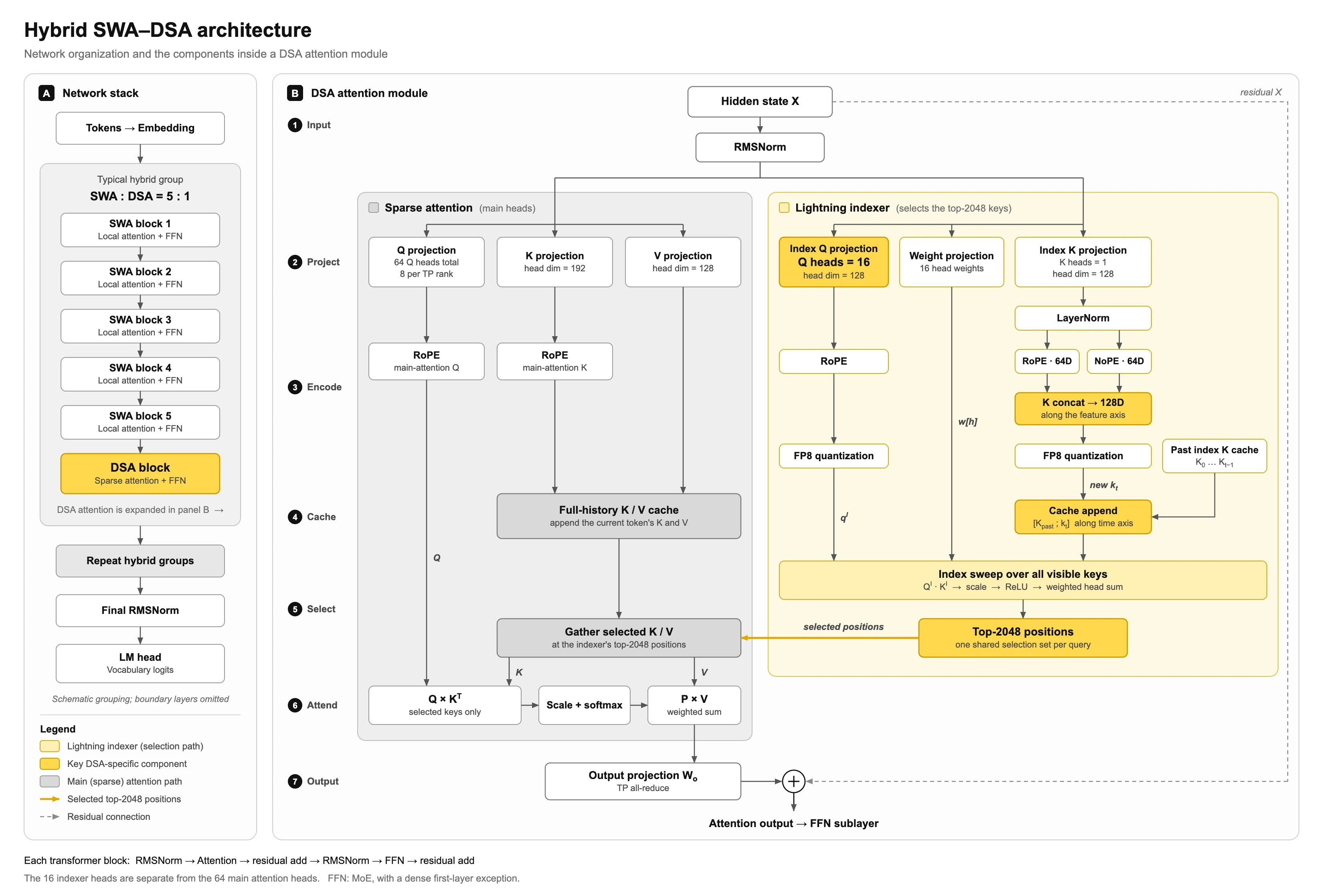
| Attention stack | 48 layers: 39 sliding-window (SWA), 9 DeepSeek Sparse Attention (DSA) |
| Local and sparse selection | 128-token SWA window; top 2,048 tokens for DSA backbone attention |
| DSA grouping | Four KV groups (GQA4); 16 indexer query heads |
| FP8 deployment | Approximately 315 GB of weights; additional GPU memory required |
Most layers inspect a short local window. At nine layers, a lightweight indexer scores the history and selects tokens for the main attention calculation. This reduces work in the backbone, but the indexer still scans the history and the full key-value cache remains. “No full attention” therefore does not mean memory use stops growing with context. The model card says the model builds on Xiaomi’s open MiMo-V2.5 base and was adapted through 3.25 trillion tokens of staged training: 50 billion for indexer warmup, 3 trillion for sparse-attention training and 200 billion for learning-rate decay.
Coding and research claims need their test setup
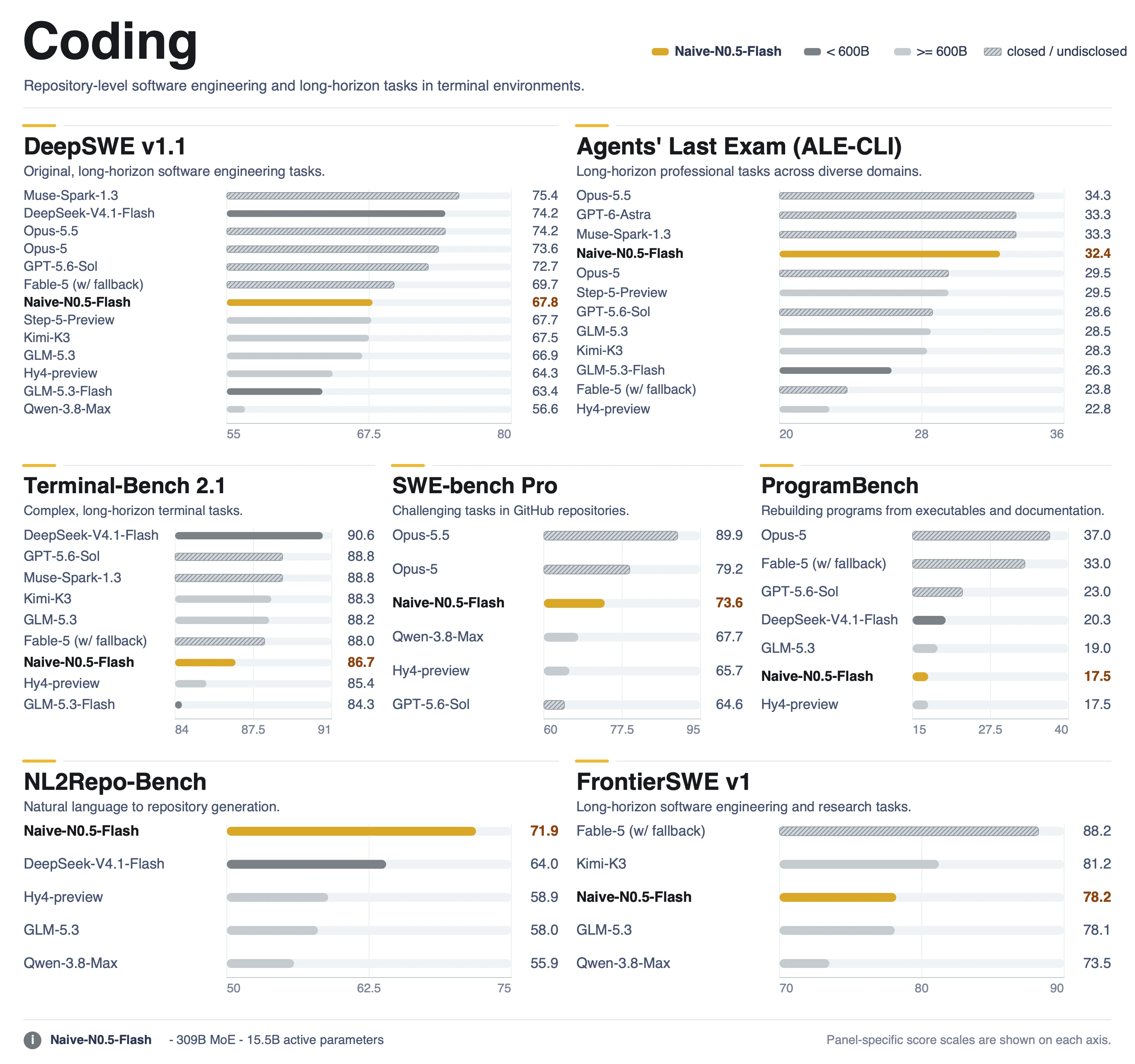
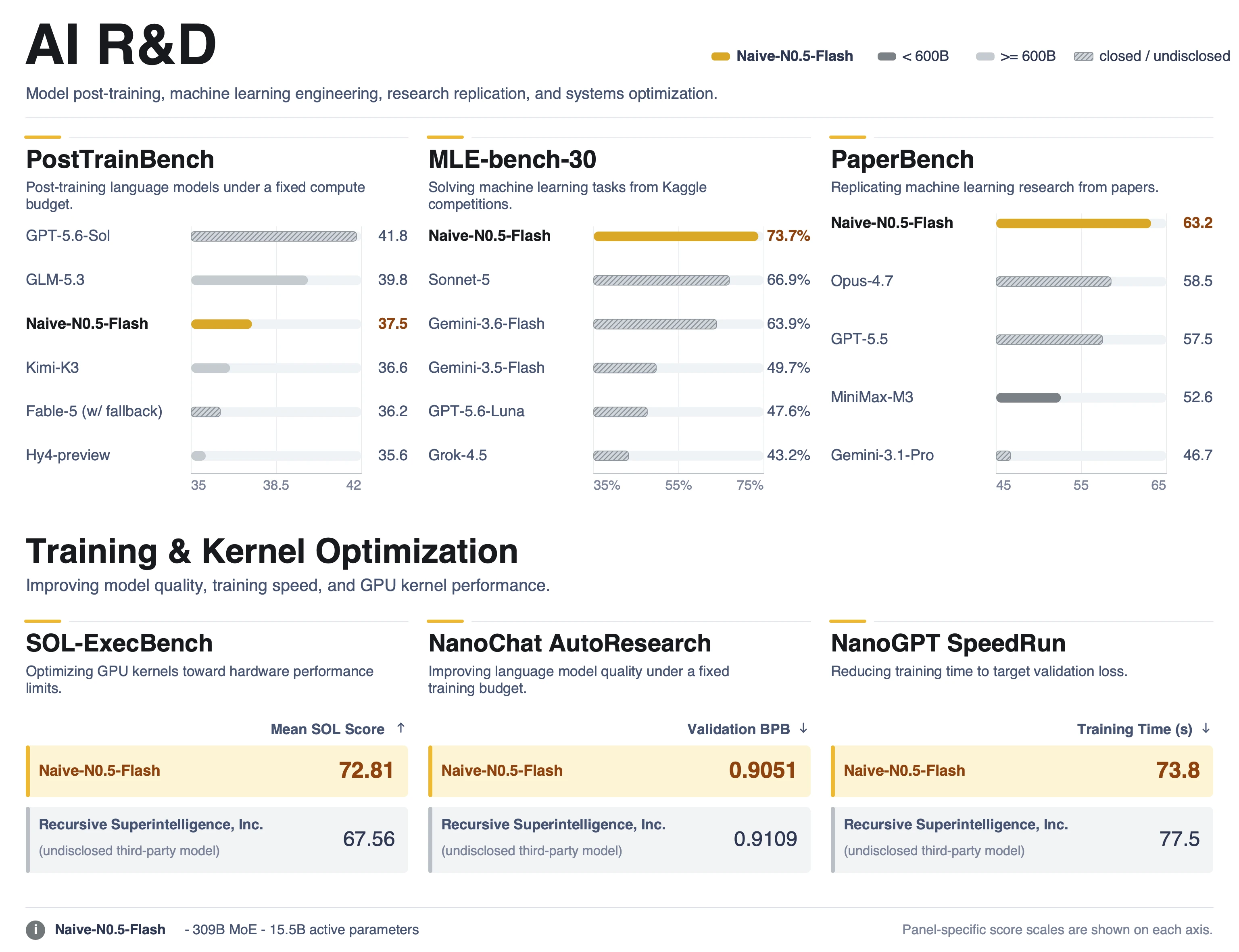
NaiveAI publishes charts for software engineering, agent tasks and AI research, including MLE-bench-30, PaperBench and its AutoResearch work. The evaluation notes say its own model usually ran through Claude Code 2.1.207 with file and Bash tools, while several rival scores came from other companies’ posts or public leaderboards. Those are heterogeneous systems and protocols. The charts indicate where NaiveAI sees strength, but should not be read as a controlled, same-harness ranking or as proof of performance in a reader’s repository.
The company describes AI models writing code, running experiments and analyzing results while people set goals, constraints and acceptance criteria. Its AutoWM example reports a 77.43 WorldArena-1 Track 1 score after 400 cumulative research hours and 15 major experimental rounds, compared with a 73.64 previously published high score. It is an account of a human-directed research process, with a company-reported comparison. It does not establish autonomous recursive self-improvement or show that a model can independently create better successors.
What the speed number measures
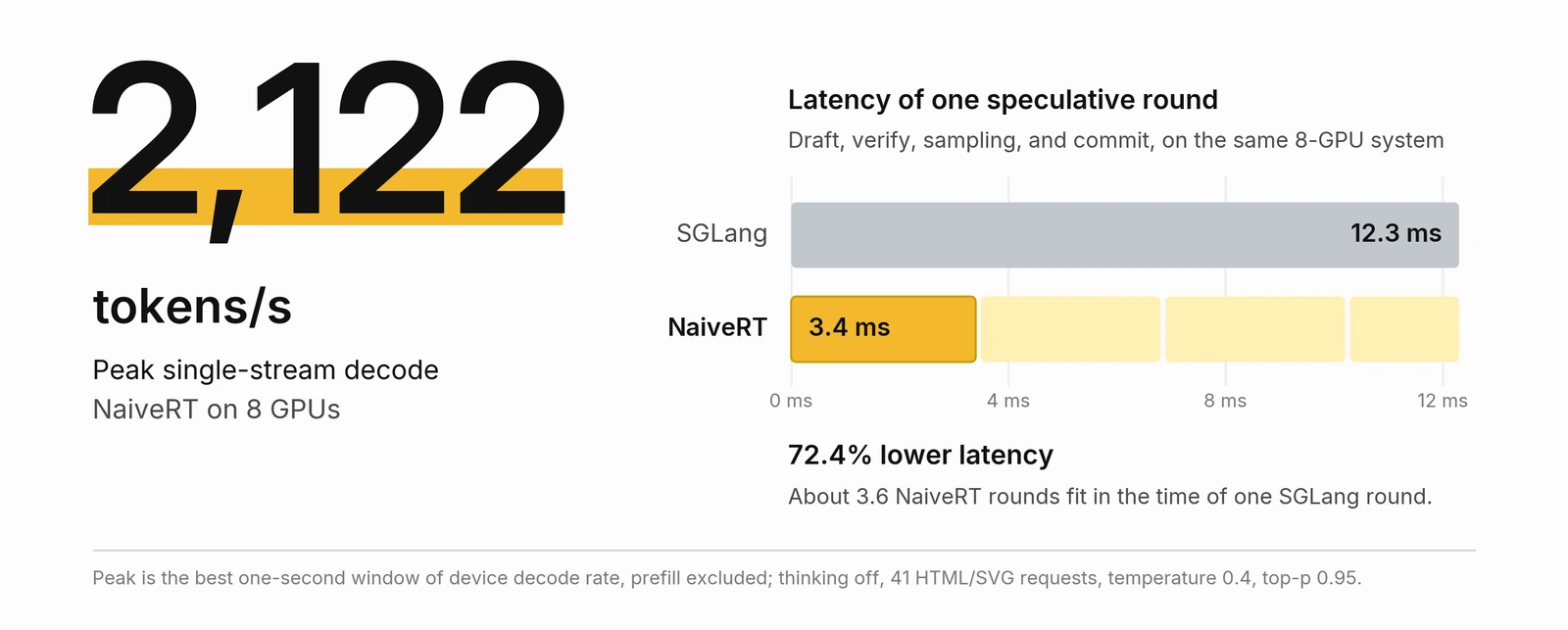
NaiveAI’s NaiveRT runtime uses fused GPU kernels, dependent launches and speculative decoding. Its headline 2,122 tokens per second is the peak single-stream decode rate in the best one-second window across 41 HTML/SVG generation prompts, with thinking off, temperature 0.4 and top-p 0.95, on eight GPUs. The measurement excludes prefill, the work of ingesting the prompt. It is neither sustained end-to-end throughput nor a generic per-user API speed. The company also reports a 3.4 ms speculative round against 12.3 ms for SGLang on the same system; these are its measurements for that configuration.
Access and what to verify
The FP8 weights are listed under the MIT license, and the model card provides a Transformers example requiring FP8-capable NVIDIA GPUs. NaiveAI says an API will be provided, advertising $0.10 per million input tokens, $0.40 per million output tokens and $0.01 per million cache-read tokens. A live API and its effective limits were not verified for this draft. The research page calls NaiveRT open source but also says the runtime code, fused kernels and benchmark scripts described there will be available by October 12. That future date matters when assessing whether the speed result can be reproduced today.
For a developer, the practical test is a representative long repository or research task: measure answer quality, prompt ingestion, sustained generation speed and total hardware cost together. The published architecture makes the model interesting; the deployment and evaluation claims still need that workload-level check.
Sources reviewed for this draft on 27 September 2026. Specifications and performance figures are attributed to NaiveAI; no independent model, API or runtime test was conducted.
Sources
- Naive-N0.5-Flash: Building Frontier AI with AI ↗NaiveAI
- Naive-N0.5-Flash-FP8 model card ↗Hugging Face / NaiveAI
Created with AI assistance.
Suggest a correction
Found an error or a missing source? Send a private suggestion to the editor. It will be reviewed and will not appear as a public comment. No name, email or account is needed.


Send us a message