AMD Helion: a 32,768-core rack for AI agents, and what AMD left out
AMD's Helion rack holds up to 32,768 Zen 6 cores for AI agents, or CPUs plus 16 GPUs, due November 2026. What AMD specified and what it has not published.
In this article
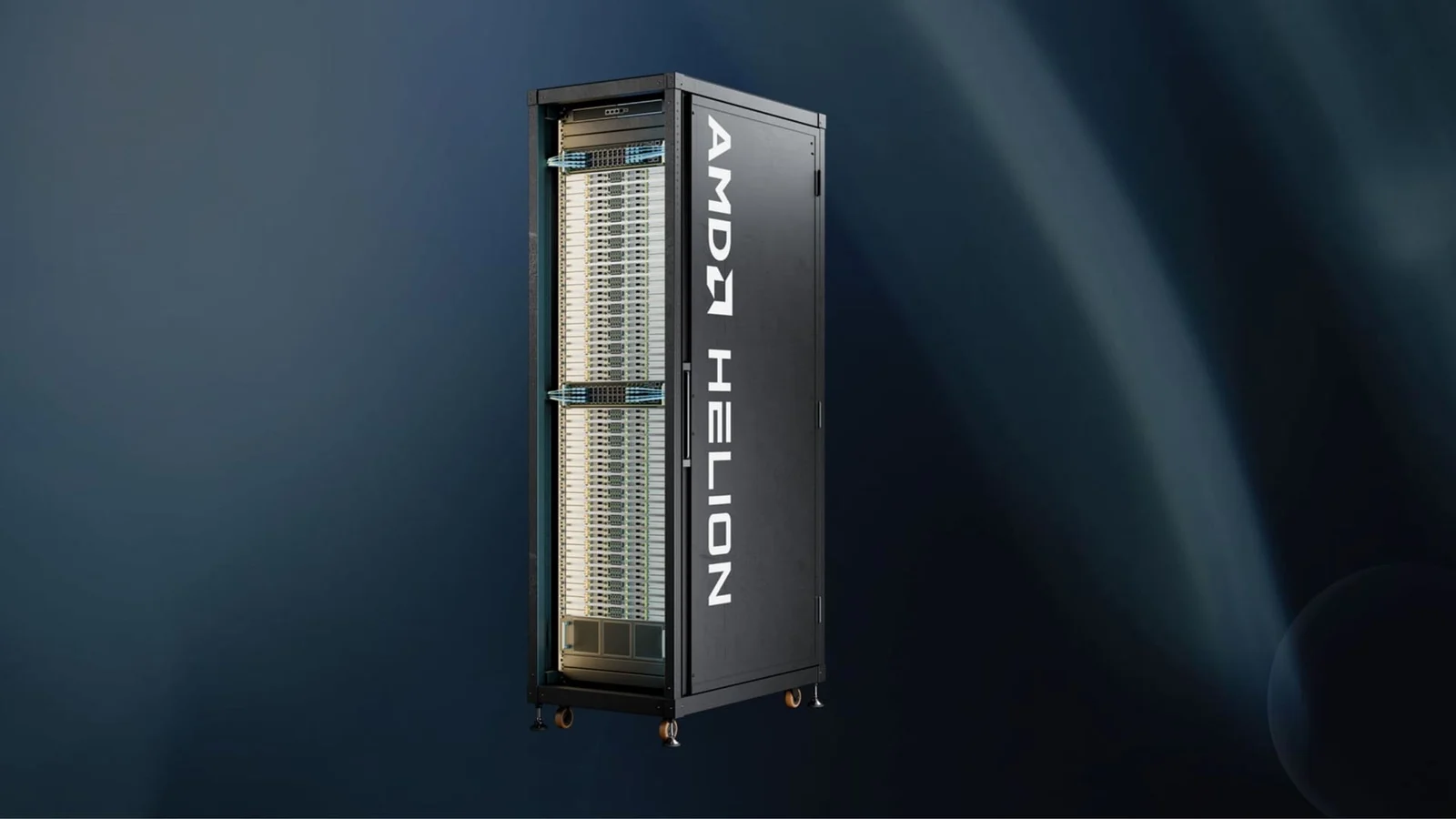
AMD has put a number on how many CPU cores it thinks an AI-agent rack needs, and it is a large one. On October 12 AMD introduced Helion, which it calls “an open blueprint for agentic AI infrastructure,” with a CPU-only version that holds up to 32,768 Zen 6 cores. We read AMD’s press release and product page in full. This article sets out what AMD specified, what its partners said and what AMD has not published.
What is AMD Helion?
An open rack design for running AI agents, not a chip. AMD says Helion is “an open blueprint for agentic AI infrastructure based on an Open Compute Project spec-design and powered by AMD compute,” building on the open-platform approach of its Helios rack-scale solution. It exists in two versions, and AMD plans to contribute the Helion specification to the Open Compute Project. AMD’s argument, in the words of Dan McNamara, senior vice president and general manager of Compute and Enterprise AI, is that “agentic AI is not a single workload,” so racks should match CPU density, performance and power to what the agents do.
How do the two Helion racks differ?
One is CPU-only for hyperscale, the other combines CPUs and GPUs for enterprises:
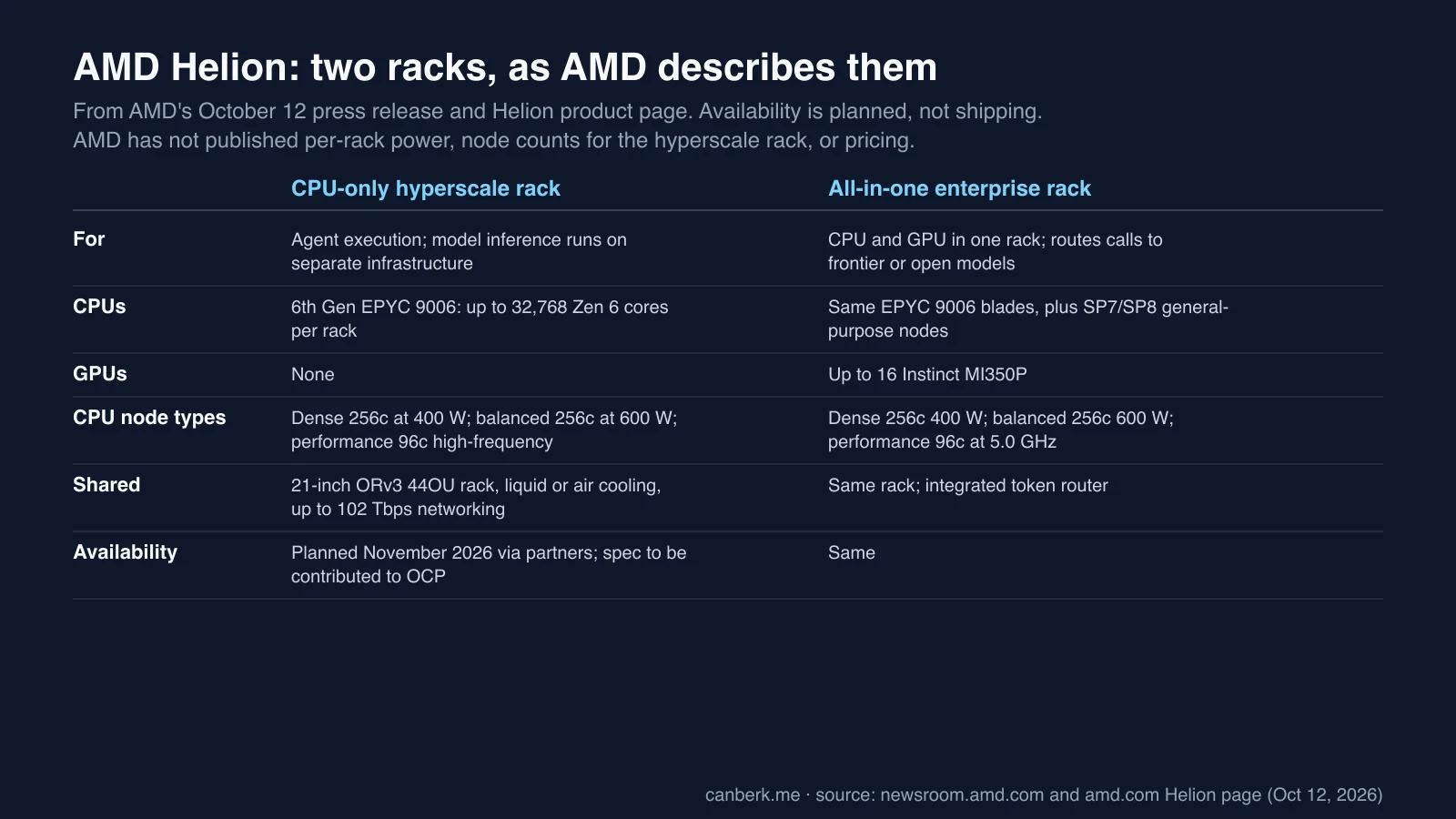
- CPU-only hyperscale rack. Aimed at hyperscalers, neoclouds and sovereign AI operators deploying agents at large scale and optimizing for agents per watt. It provides dedicated capacity for agent execution and connects to separate model inference infrastructure.
- All-in-one enterprise rack. Combines EPYC CPU nodes, Instinct MI350P GPU nodes and general-purpose compute in one platform, with up to 16 MI350P GPUs. AMD says an integrated token router sends agents’ model calls to frontier models in the cloud or open-source models running inside the same rack.
Why does AMD build a CPU-only rack for AI agents?
Because AMD argues agents are mostly something other than model inference. The press release lists “personal agents, enterprise applications, code execution and complex workflows” as workloads with different compute needs, and the product page ties each to a priority: maximum agents per watt for personal agents, the maximum number of high-performing agents for enterprise agents, and maximum performance per agent for technical compute agents.
That maps to three CPU node types in the hyperscale rack: dense servers with 256-core processors at 400 W, balanced servers with 256-core processors at 600 W, and performance servers with 96-core high-frequency processors. At 256 cores per processor, the 32,768-core ceiling works out to 128 processors in a rack (our arithmetic). Model inference stays on separate accelerator infrastructure; StorageReview says AMD’s diagram shows a Helion CPU rack paired with a Helios GPU rack. We covered the same CPU-for-agents logic in Anthropic’s Akamai deal.
What are the Helion specs?
AMD’s specification list for the rack is short:
- CPU cores. Up to 32,768 Zen 6 x86 cores, from 6th Gen EPYC 9006 Series processors.
- GPUs. Up to 16 Instinct MI350P in the enterprise version.
- Networking. Up to 102 Tbps, “fully programmable to support diverse, mixed agent fleets.”
- Rack. 21-inch ORv3 44OU, direct liquid cooled or air cooled, “native OCP compliant.”
- Enterprise nodes. Dense and balanced 256-core nodes, a 96-core 5.0 GHz performance node, MI350P inference blades and general-purpose blades on SP7 and SP8 server CPUs, plus EPYC 9006X for technical compute.
When can you buy Helion, and from whom?
AMD says Helion configurations are “currently under development with ecosystem partners and are planned to be available in November 2026.” Nothing ships yet. Supporting statements came from Cisco, Dell Technologies, Hon Hai (Foxconn), HPE, Lenovo, QCT, Supermicro and Wiwynn, and AMD’s product page shows further OEM and ODM logos including ASRock Rack and ASUS. Dell said its PowerRack line supports Helion, and Supermicro said it will bring Helion to market as an ORv3-compliant architecture. HPE tied its statement to its earlier customer agreement to deploy Helios.
What did AMD not say about Helion?
Most of what a buyer would ask for. We found none of these in the press release or on the product page:
- Performance. No benchmark, agents-per-watt or tokens figure, even though agents per watt is the stated goal of the hyperscale rack.
- Power and cooling numbers. No per-rack power draw or thermal figure.
- Node count. No count of nodes or blades in the hyperscale rack.
- Memory. No memory capacity or type for the CPU nodes.
- Pricing. None.
- The OCP timeline. AMD plans to contribute the specification but gives no date.
What to keep in mind
These are our observations:
- This is a bet on the CPU side of agents. AMD is saying agent execution needs its own dense, power-tuned racks next to the GPUs.
- It is a blueprint, not a product. Partners must build and sell it, and November 2026 is a plan.
- There is nothing to compare yet. Without power, performance and price, the 32,768-core number says only how many cores fit.
- Watch the partner launches. Dell, Supermicro and others will show the real configurations, power and prices.
Editorial review: October 13, 2026 (AI). Prepared from AMD’s newsroom press release (read in full) and Helion product page (read in full), with StorageReview’s report used only to confirm details already in AMD’s own pages. We did not test or see Helion hardware, did not read AMD’s Venice processor documentation and did not use secondary claims that AMD’s pages do not state.
Sources
Created with AI assistance.
Suggest a correction
Found an error or a missing source? Send a private suggestion to the editor. It will be reviewed and will not appear as a public comment. No name, email or account is needed.


Send us a message