Jev Code Reviewer puts priorities beside GitHub diffs
Jev assigns review priority while OpenAI writes change explanations. The local GitHub extension is a useful triage idea with real coverage, privacy and trust limits.
In this article
When an agent opens a pull request with dozens of files, another wall of review prose can make the hard part worse: deciding where a person should look first. Jev Code Reviewer takes a narrower approach. Its local command-line tool analyzes a pull request, then a Chrome extension places priority badges and change summaries inside GitHub’s existing file view. The project appeared on Hacker News on September 25; that discussion date does not establish when development or the first release began.
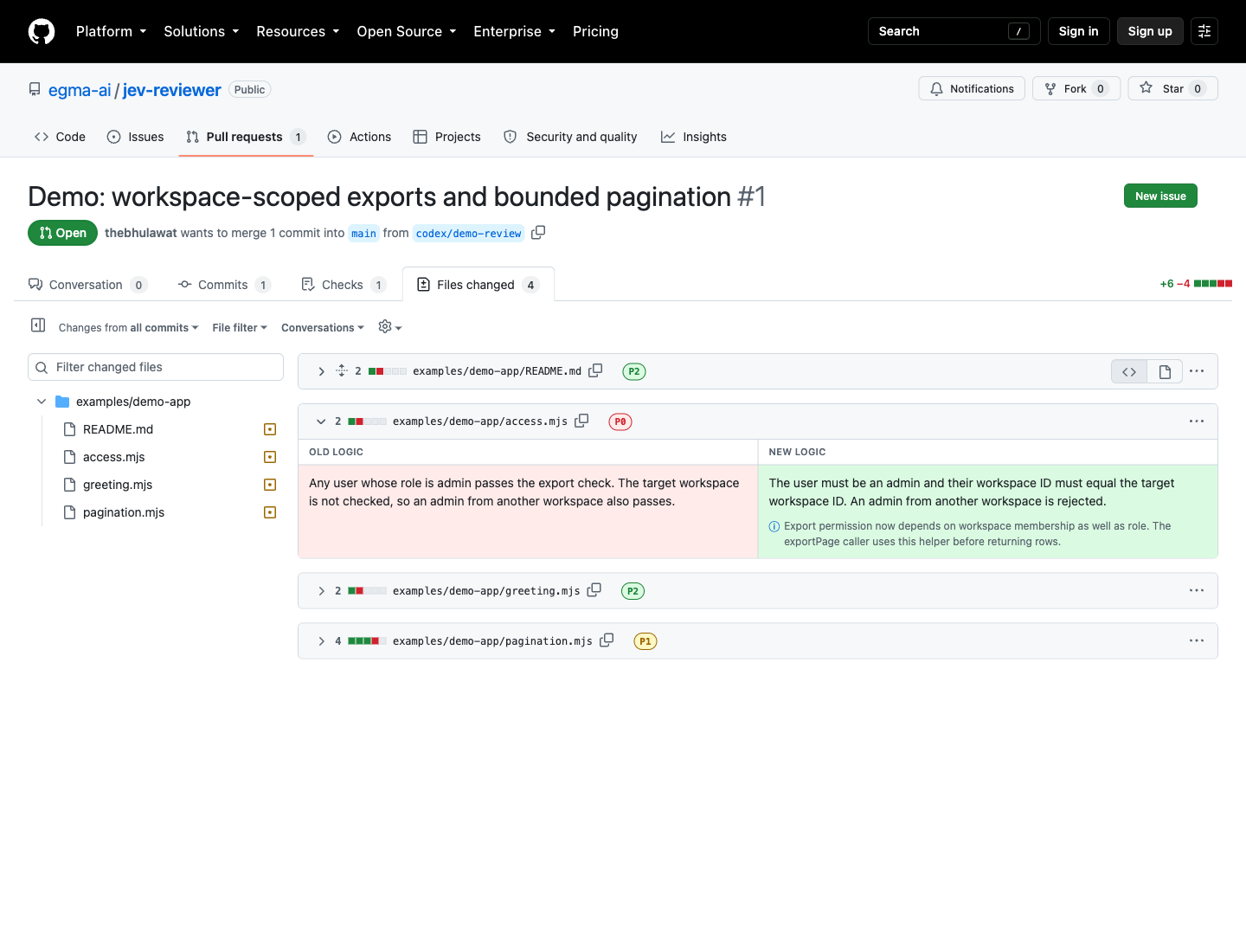
The design splits two jobs between providers. TypeSafe’s Jev returns a structured priority signal. The project’s policy maps that signal to P0 (human review required), P1 (recommended) or P2 (mechanical or well-supported). OpenAI writes the natural-language fields: old logic, new logic, what changed and why it may deserve attention. That division matters. Jev is not being asked to write the review paragraph, and the prose model does not set the priority. Both outputs can still be wrong, and a readable explanation can make a bad classification feel more convincing than it is. The architecture document describes both provider roles and the mapping policy.
What happens in a review
| Step | What the project does | Practical limit |
|---|---|---|
| Analyze | A local CLI uses the current checkout and GitHub CLI to inspect a PR; Jev classifies change units and OpenAI drafts explanations. | The default covers the first 12 diff hunks in path order; --max-units can raise the ceiling to 100. Remaining changes stay as GitHub code. |
| Display | A locally served report is paired with an unpacked Chrome extension, which replaces diff tables with old/new logic cards and priority badges. | It supports GitHub’s classic Files changed page, not the newer /changes view. P1 and P2 begin collapsed; only P0 is open by default. |
| Verify | The reviewer can toggle the original code back into view; stale or unavailable reports leave GitHub’s native diff in place. | The cards are an aid to reading, not a correctness check or a merge decision. |
That last boundary is essential. A lower-priority change may still contain a security flaw, while a P0 label only means “look here”; it does not prove a defect. Priority meanings are configurable, so teams need to decide what each category means and check whether the ordering matches their own risks. Keeping the source diff one toggle away is a useful safeguard, but it does not remove the work of reading it.
Local interface, provider-bound analysis
“Local” describes the CLI, report cache, server and browser connection. Live analysis is not offline: the README says changed code and nearby context are sent to TypeSafe and OpenAI. The architecture document also describes optional Graphify context. Teams should review both providers’ data terms before sending private source. Credentials are stored outside the repository with owner-only file permissions, but the project says they are not encrypted at rest.
The included recording shows the review interface on a small demonstration pull request. It uses real Jev priority classifications, but the explanation copy was prepared for the demo: the configured OpenAI project returned credit_balance_exhausted during that recording. The repository documents this distinction in its demo provenance note. It is therefore a walkthrough of the interface, not evidence that the displayed explanation text came from a live OpenAI call.
A useful question for a pilot
The idea is most compelling where review attention is genuinely scarce, such as a large generated change with mixed risk. A pilot should compare the priority ordering with an experienced human’s review, measure high-severity issues missed in P1/P2, and inspect how often the summaries omit a relevant behavior. It should also include mechanical changes, subtle authorization changes and deliberately misleading comments. Those cases test whether triage helps people find important behavior rather than merely making the diff look shorter.
A fair comparison also needs a baseline: the team’s current review, a simple path or rule filter, and a model that writes comments without prioritizing. Record the confusion matrix and time spent in follow-up, then compare results by change type. Otherwise a system can look successful by surfacing easy formatting changes while missing the less frequent logic flaw. Build that scorecard from a representative, permissioned sample before expanding its use.
The repository provides a no-provider replay through npm run demo, while reviewing a real pull request requires a local clone, GitHub CLI access, TypeSafe and OpenAI keys, and a manually loaded Chrome extension. We did not run either path for this article, so this is a source-based evaluation rather than a hands-on test. The first check before adoption is straightforward: confirm which files and context leave the machine, then compare the priorities against a human-reviewed sample before allowing the badges to influence a real review.
Sources
- Jev Code Reviewer README and quick start ↗Jev-Reviewer contributors
- Jev Reviewer architecture and data boundaries ↗Jev-Reviewer contributors
- Bundled demo provenance ↗Jev-Reviewer contributors
- Jev Based Code Review — Hacker News discussion, 25 September 2026 ↗Hacker News
- Repository MIT License ↗Jev-Reviewer contributors
Created with AI assistance.
Suggest a correction
Found an error or a missing source? Send a private suggestion to the editor. It will be reviewed and will not appear as a public comment. No name, email or account is needed.


Send us a message